The clash between President Trump and Big Oil over “too much money” from the Iran oil shock is not just a political spat; it exposes how wartime windfalls, opaque fuel pricing, and consumer anger intersect in one of the most misunderstood markets in the economy.
At a Glance
- President Trump publicly accused ExxonMobil, Chevron, Shell and BP of “gouging” Americans by keeping gasoline prices high even as crude prices fell from their Iran-war peak.
- He ordered the Department of Justice to probe fuel pricing, signaling that the allegation is not mere rhetoric but a formal policy stance.
- Independent reporting shows the Iran conflict delivered a massive profit windfall to major oil firms via higher crude and product prices, even as inventories were drained and global supplies disrupted.
- Market and regulatory research make clear that a lag between falling crude prices and pump prices is common and not, on its own, proof of collusion or unlawful price gouging.
- The evidence strongly supports that Big Oil earned unusually high profits during the Iran crisis; it is less conclusive on whether those profits crossed the line from aggressive capitalism into illegal gouging.
Trump’s Charge: Oil Companies Profiting While Drivers Pay the Price
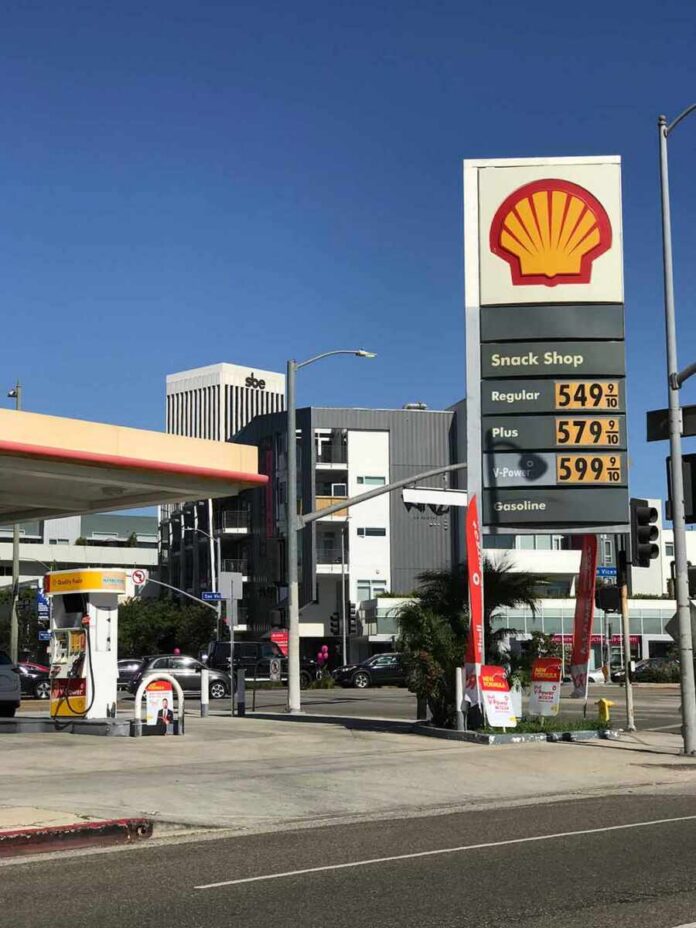
President Trump’s core allegation is straightforward: after the initial Iran war shock pushed oil to extreme levels, crude prices began to retreat, but gasoline prices at the pump did not fall in line. In his social media posts and televised remarks, he accused “the big Oil Companies” of refusing to “drop their price at the pump commensurate with the sharply lower prices they are paying for Oil,” concluding that “customers are being ‘gouged’.” That language is not careful regulatory jargon; it is the vernacular of consumer outrage, directed squarely at some of the world’s most powerful corporations.
Trump did more than vent. He named names—ExxonMobil, Chevron, Shell, BP—charging that these companies were keeping pump prices elevated and warning of “big trouble” if they were found to be manipulating prices. In late June, he announced that he had instructed the Department of Justice to “immediately start looking into this,” triggering what multiple outlets described as a formal inquiry into gasoline pricing behavior by leading energy firms. For a president who had spent years embracing “drill, baby, drill” and touting U.S. “energy dominance,” the turn against his own industry donors was striking.
The accusation resonates politically because it connects two highly visible facts: American drivers were paying noticeably more at the pump than they had before the Iran war, and the oil majors were reporting eye-popping profits. Trump’s message is that the second is coming at the expense of the first—and that, in his words, they are “making too much money” off a crisis he himself launched.
The Iran Oil Shock: How a War Became a Windfall
To understand the “too much money” claim, you have to start with the scale of the disruption. The war with Iran and the closure or choking of the Strait of Hormuz removed a vast volume of oil and refined product from global markets—by some estimates, on the order of hundreds of millions of barrels within months. Politico, the Wall Street Journal, and others describe global petroleum inventories falling by roughly 5.8 million barrels per day since the war began, with worldwide stocks down about 500 million barrels. That is not a routine fluctuation; it is one of the largest supply shocks in modern oil-market history.
The price response matched the shock. U.S. crude prices averaged around $95 a barrel from March through June, up from roughly $66 before the war. As the Financial Times and other business outlets reported, that jump translated into extraordinary earnings: ExxonMobil, Chevron, ConocoPhillips and Occidental were projected to rake in about $31 billion in second-quarter profits, compared with about $12 billion a year earlier. For Exxon, expected net income of $15 billion in the quarter was more than three times the previous period; Chevron’s near-$10 billion was similarly outsized.
These numbers explain why analysts talk about a “windfall.” U.S. oil majors capitalized on the shortfall by exporting record volumes of crude and refined products as prices surged above $100 a barrel after the war’s launch. One estimate cited by Politico suggested the Iran shock was costing American households roughly $1,000 each in higher fuel, food, and other expenses. Put bluntly: the crisis pushed costs onto consumers while dramatically boosting industry earnings.
Initially, Trump himself sounded almost pleased about the spike, noting that as the world’s largest oil producer, “when oil prices rise, we generate substantial revenue,” a comment critics interpreted as prioritizing producer profits over consumer pain. As the domestic political consequences of high gasoline prices sharpened—particularly heading into midterm elections—his tone shifted. The same war-driven price environment that had been a symbol of U.S. leverage over Iran became the backdrop for accusations that American companies were cashing in excessively.
When Crude Falls But the Pump Doesn’t: How Pricing Really Works
Trump’s specific charge hinges on a timing mismatch: crude prices falling “like a rock” after peaks tied to Iran headlines, while gasoline prices stayed stubbornly high. That pattern is visually compelling and intuitively frustrating. It is also, as decades of economic and regulatory research show, not unusual.
Several strands of work—by the Federal Trade Commission (FTC), central banks, and academic economists—have examined how changes in crude prices pass through to retail fuel. The basic concept, “oil price pass-through,” measures how much and how quickly a change in the price of crude shows up in the price on the forecourt. These studies reliably find that pass-through is incomplete and asymmetric: retail prices tend to rise quickly when crude climbs, but fall more slowly when crude declines. In other words, drivers experience exactly the lag that fuels suspicions of gouging.
The FTC’s post-Katrina investigations into gasoline pricing are instructive. After Hurricane Katrina, crude and wholesale prices spiked, and consumers accused companies of manipulation. The Commission examined refining margins—the difference between the price at which refiners sell finished products and their acquisition cost for crude—and concluded that while margins for refiners rose in the month after the hurricane, margins for wholesalers and retailers actually fell. Critically, the FTC found “no conclusive evidence of collusion” in its multiple major inquiries into gasoline price spikes. High prices and rising margins, in other words, did not automatically equate to unlawful gouging.
More recent work by the Bureau of Labor Statistics on U.S. retail fuel margins reinforces this. It shows a large negative contemporaneous response of fuel margins to changes in crude prices, meaning margins tend to shrink when crude rises and expand when crude falls—but with complex dynamics that vary by region and over time. Taxes, transport costs, refinery bottlenecks, regional supply constraints, and inventory replacement costs all affect how quickly and fully crude moves through to the pump.
None of this exonerates the companies in the Iran episode; what it does is set a high evidentiary bar. To prove that firms were “making too much money” because they deliberately held pump prices high as crude fell, investigators would need detailed data on refining and retail margins, inventory strategies, hedging, and regional logistics—not just the observable lag in prices.
Big Oil’s Counter-Narrative: It’s the War, Not Us
Industry leaders do not dispute that profits soared. Their argument is about causation and control. Executives from ExxonMobil, Chevron, and others warned the administration early in the crisis that disruptions through the Strait of Hormuz would keep markets tight and inventories falling, leading to sustained high fuel prices. They framed the situation as an exogenous shock: a war-driven supply crunch that any market participant would have to live with, not a pricing strategy they engineered.
Reporting from the Wall Street Journal and Politico describes these executives cautioning that fuel prices were “likely to rise” if inventory depletion continued, and that the conflict was “the worst” they had seen in terms of market disruption. Analysts echoed the concern, noting that with tens of millions of barrels stranded or delayed, transport bottlenecks and refinery utilization issues would keep pressure on prices even if benchmark crude eased off initial highs.
Trump himself has, in other contexts, leaned on this supply-risk framing. He has urged producers to increase output, ordered releases from the Strategic Petroleum Reserve—172 million barrels in coordination with international allies—to cool prices, and warned publicly that a prolonged disruption could put hundreds of millions of barrels at risk. Those actions implicitly acknowledge that high prices were fundamentally a function of constrained supply, not solely corporate greed.
What the counter-narrative does not provide, however, is detailed proof that downstream margins remained within historical norms as crude retreated. The industry argument points to geopolitics and logistics, not to refinery-by-refinery data showing that companies were merely passing through costs. That leaves open the possibility that real shocks and opportunistic pricing coexisted—that firms benefited handsomely from the crisis even while accurately describing its causes.
“Too Much Money” Versus Illegal Gouging: What the Evidence Shows
So where does the evidence leave Trump’s claim? On one dimension, it is strongly supported: the Iran war delivered a huge, crisis-driven profit windfall to major oil companies, and ordinary Americans bore substantial costs. FactSet estimates of second-quarter earnings, the documented jump in crude to around $95–$100 per barrel, record U.S. exports, and household cost estimates around $1,000 all point in the same direction. These firms made far more money during the crisis than before it.
On another dimension, the case is murkier. The materials at hand do not include company-level financial statements broken out by refining and retail segments, nor DOJ or FTC memoranda detailing the rationale for their probe or any findings. There is no public evidence here of explicit collusion, coordinated withholding of supply, or internal communications instructing managers to keep pump prices high regardless of crude moves. That is precisely the sort of evidence regulators have looked for in past investigations and often failed to find.
From a policy standpoint, “too much money” is not a legal standard; it is a moral and political judgment about the distribution of gains from a crisis. Oil markets are structured such that large integrated firms inevitably earn more when prices spike, particularly if they have production and export capacity positioned away from the disrupted zone. When the spike is the consequence of a war initiated by the United States, the optics grow even harder to defend: American companies profit from a conflict that raises costs for American households and destabilizes a region.
Trump’s accusation taps into that discomfort. It reflects an intuition many voters share: that companies should not be allowed to transform a national-security crisis into a bonanza for shareholders while essential costs for families stay elevated. The economic literature, however, cautions that price stickiness and asymmetric pass-through are endemic features of fuel markets, not smoking guns. They create fertile ground for suspicion, but not, in isolation, a prosecutable case.
Why This Fight Will Keep Returning
The confrontation between President Trump and Big Oil over Iran-war profits fits a long-standing pattern. Whenever a geopolitical shock hits oil supply and retail prices spike, politicians accuse the industry of gouging, and the industry replies that it is merely responding to market forces. The Iran episode stands out because the war itself was a U.S. decision, the profit windfall was unusually large, and the president eventually turned his fire on companies that had been central to his energy agenda.
For consumers, the distinction between “market-driven windfall” and “exploitative profit” is largely academic; what matters is that they pay more for the same gallon of gasoline. For policymakers, though, the distinction is crucial. If investigations repeatedly find no collusion and no clear manipulation—even as profits soar—it suggests that the problem lies in the structure of the market and the tax and regulatory regime, not simply in corporate bad actors.
That points toward different remedies: excess-profit taxes during wartime, tighter rules on export behavior during domestic supply crises, more transparent reporting of refining and retail margins, and clearer, enforceable definitions of “gouging” that move beyond rhetoric to measurable thresholds. None of those are politically easy, especially when energy security and domestic production are high priorities.
The Iran war has thus forced an uncomfortable reckoning. The same strategy that gave the United States leverage over a hostile regime also handed extraordinary profits to its oil companies and angered its own citizens at the pump. Trump’s declaration that they are “making too much money” captures the unease; the data on profits and prices show the charge has substance. Whether it adds up to illegal gouging is, as past investigations suggest, far harder to prove—and that gap between outrage and evidence is likely to haunt the politics of gasoline prices long after this particular conflict fades.
Part 8: EXPOSING TRUMP’S DARK MONEY SWAMP. 💰💰🆘
Meet #KelcyWarren, the pipeline billionaire who poured millions into Donald Trump’s return to power while his industry pushed for deregulation and expanded fossil-fuel development.
Warren is the co-founder and executive chairman… pic.twitter.com/QCOx2wwS0n
— Ethical American (@AmericanEthical) August 1, 2026
Sources:
insiderpaper.com, politico.com, reuters.com, wsj.com, fortune.com, youtube.com, english.elpais.com, energynow.com, bloomberg.com, nytimes.com, cnbc.com, econpapers.repec.org, forbes.com, papers.ssrn.com, ftc.gov, imf.org, dallasfed.org, sciencedirect.com, bls.gov, ideas.repec.org