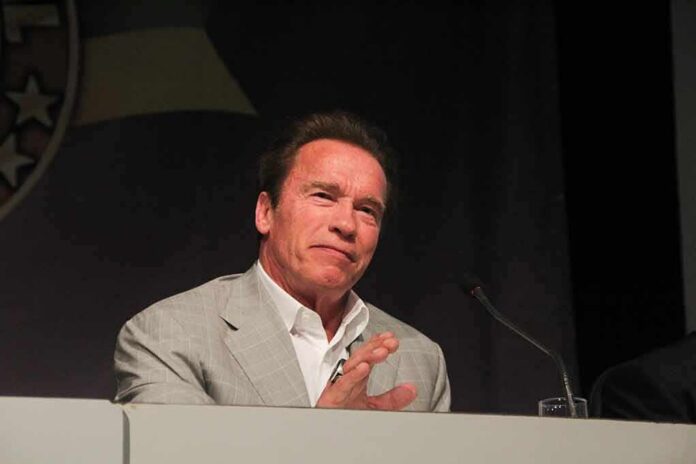
In modern city politics, the rooms that matter are often private: introductions, not endorsements; questions, not speeches. Arnold Schwarzenegger’s recent off-the-record session with Los Angeles mayoral candidate Nithya Raman fits that pattern precisely — a curated encounter with Hollywood, business, and nonprofit power brokers designed to test, brief, and, if she performs, accelerate her access.
At a Glance
- Schwarzenegger hosted Raman for an off-the-record, open-question meeting at his Los Angeles office.
- The attendee mix reportedly spanned Hollywood, finance, and civic groups; the format was conversation, not a formal endorsement.
- Discussion touched policing, unions, and the city’s “mansion tax,” with Raman rejecting the “anti-police” label.
- Multiple outlets converged on the core details within hours, signaling a coordinated, high-profile introduction.
What Happened: A Deliberate Access Play, Not a Rally
Reports from entertainment and political outlets describe Schwarzenegger convening a private, off-the-record meeting at his Los Angeles office to introduce Raman to an audience drawn from Hollywood representation, investment, and civic institutions. Attendees were told they could ask anything — a vetting posture more akin to a boardroom diligence session than a stump event. The conversation reportedly ranged across quintessentially municipal topics: policing posture, labor relations, and the real-estate transfer levy often dubbed the “mansion tax.” Raman is reported to have rejected the idea she is anti-police and emphasized administrative efficiency and service delivery, consistent with how serious candidates address skeptics in a mixed room.
The meeting lasted more than an hour — enough time for probing and for a candidate to demonstrate command. Coverage by TMZ was followed by convergent write-ups from national and local aggregators and talk radio sites, all reiterating core facts: Schwarzenegger hosted, doors were opened to a cross-sector set of influencers, and no endorsement was issued. That harmony across outlets matters; it anchors the event in a consistent description even as precise guest lists and a transcript remain private by design.
Why This Format Matters in Los Angeles Politics
Los Angeles municipal campaigns operate under tight caps on direct contributions, which pushes meaningful leverage into independent committees and, more informally, into networks of introductions. When donation ceilings limit the marginal value of one more maxed-out check, who brings a candidate into which room — and with what framing — becomes a strategic currency. Elite salons, donor briefings, and issue roundtables are therefore less about a singular “blessing” than about coalition formation and narrative testing: can the candidate handle pointed questions, reassure the wary, and absorb feedback from constituencies that fund, produce, and message at civic scale.
For a figure with Schwarzenegger’s hybrid résumé — entertainment icon, ex–California governor, and convening node across philanthropy and business — the value is not a yard sign but a gate key. Introducing a candidate to leaders at talent agencies, investment shops, and civic nonprofits aligns with that role; these are the people who seed surrogates, underwrite independent efforts, and surface policy pilots. In contemporary L.A., the legitimacy a candidate earns in such rooms often arrives months before any formal endorsement appears on a website.
Topics in the Room: Policing, Labor, and the Transfer Tax
Reports align on the policy areas that drew questions: policing posture, the city’s voter-approved real-estate transfer tax on high-value property sales, and labor relations with powerful public-sector unions. Each is a proxy for broader managerial philosophy. On policing, the binary label — “anti-police” or not — is a test of governance temperament as much as ideology; the capacity to balance reform with public safety is the municipal job description. On the “mansion tax,” business and entertainment figures are assessing whether a mayoral hopeful understands capital flows, unintended consequences, and revenue reliability. Labor questions in Los Angeles, meanwhile, are inseparable from service delivery and budget math; union relations can define a mayor’s first-year agenda and crisis bandwidth.
Accounts say Raman argued for efficiency and rejected being cast as anti-police, a stance calibrated to keep cross-pressured donors and civic leaders at the table. In an off-the-record format, that posture functions as a starting point for future, more technical follow-ups — the spreadsheets come later, often through policy aides and surrogates after the candidate proves steady under live fire in the introduction round.
How We Know: Convergent Reporting and Specific Institutional Touchpoints
While the session itself was private, the public reporting coalesced quickly around shared specifics: the venue (Schwarzenegger’s Los Angeles office), the format (off-the-record Q&A running over an hour), the non-endorsement posture, and the mix of attendees, including named entities like United Talent Agency–linked figures, Main Street Advisors, After-School All-Stars, the L.A. Cleantech Incubator, and the USC Schwarzenegger Institute. Those institutional touchpoints are neither exotic nor implausible for a Schwarzenegger-hosted civic salon; they are precisely the networks he has worked through for years.
Multiple outlets — from TMZ to the New York Post and radio syndication — carried the same core description within hours, a signal that the event occurred as framed and that its purpose was to make Raman legible to a set of cross-cutting power centers without locking anyone into a banner headline endorsement. The reporting makes clear this was conversation, not coronation.
Arnold Schwarzenegger hosts private meeting with Nithya Raman and LA bigwigs https://t.co/HuunQdS9uD pic.twitter.com/lbDQOs7BWa
— New York Post Metro (@nypmetro) September 26, 2026
The Strategic Takeaway: Access Is the Asset
The civic significance of this gathering is not whether Schwarzenegger and Raman agree on every municipal lever; it is that a candidate with an avowedly progressive profile sat for unscripted questions from rooms that historically test for fiscal prudence, service reliability, and public safety seriousness. In a city where independent expenditures can dwarf direct campaign budgets, the value of such meetings is multiplicative: introductions yield follow-on coffees; coffees yield surrogate validators; validators dampen the attack lines that otherwise calcify. If the meeting went as reported, Raman left with more than a friendly photo — she gained a pathway to the people who fund and narrate Los Angeles politics at scale.
Sources:
nypost.com, yahoo.com, tmz.com, www-origin.tmz.com