Presidential travel in midterm season is less about flipping opponents than igniting allies; President Trump’s Grand Island, Nebraska rally exemplified that calculus by coupling a high-energy base event with a tangible policy move aimed at core constituencies.
At a Glance
- President Trump headlined a midterm-branded rally in Grand Island to boost Nebraska Republicans Pete Ricketts and Jim Pillen.
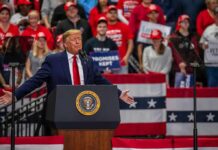
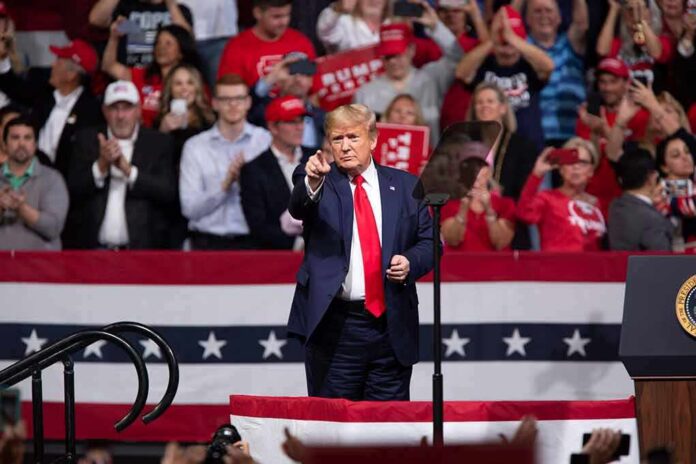
- The event took place at Fonner Park’s Pinnacle Bank Expo Center and drew a substantial in-person crowd with visible on-site mobilization.
- Trump signed an executive order easing limits on tax-free red-dyed diesel at the rally, linking policy to local farm and freight economics.
- The stop fits a broader midterm strategy: reinforce strongholds, galvanize turnout, and fuse policy messaging with campaign aims.
A midterm stop designed for turnout and message discipline
The Grand Island event was explicitly billed as a midterm rally with President Trump as the headline speaker, framed to lift Nebraska Republicans on the ballot. Party listings and national programming described the stop as a campaign rally with GOP candidates, removing any ambiguity about purpose: energize the base, fortify allies, and convert presidential attention into measurable turnout effects in a friendly district. Contemporaneous reporting tied Trump’s appearance directly to support for Governor Jim Pillen and Senator Pete Ricketts, with the president himself promising an electoral boost from the stage—precisely the kind of signal campaigns want amplified in the final month.
Local coverage fixed the rally in concrete space and time: the Pinnacle Bank Expo Center at Fonner Park in Grand Island, on a Monday in early October. On-the-ground reports described lines curling around the venue and an audience in the low thousands—an indicator not just of interest but of the campaign’s capacity to stage and staff a full-scale event in a regional hub that serves Central Nebraska’s farm and small-business economy.
Why Grand Island, and why now
Presidents facing midterm headwinds historically spend scarce travel time in geographies where returns are predictable: energize aligned voters, appear with down-ballot allies, and weld policy announcements to local priorities. The Nebraska stop matches that pattern. Analysts and political reporters have long described these tours as “base mobilization” plays—an exercise in turnout arithmetic rather than persuasion—especially as Election Day nears and the marginal benefit of rallying loyalists exceeds the cost of trying to convert the opposition. Grand Island is both symbol and staging ground: agricultural producers, trucking routes, and a media market that carries statewide with minimal risk of dilution.
In that context, the decision to pair the rally with a policy action was strategic. When a president arrives with not just rhetoric but an executive pen, the message’s half-life increases; supporters leave with a tangible deliverable that connects national leadership to local pocketbooks, while campaigns gain a fresh hook for ads, mail, and surrogate events in the final push.
The policy lever on stage: red-dyed diesel
Trump signed an executive order at the Grand Island rally to ease limits on the tax-free use of red-dyed diesel—fuel widely used in off-road agricultural equipment and certain commercial settings. That move speaks directly to operating costs for farmers and haulers, sectors that feel diesel spikes immediately in harvest and transport seasons. The Associated Press and regional outlets documented the signing at the event and relayed the administration’s economic rationale: lower input costs for producers with spillover effects across supply chains.
Red-dyed diesel, by design, is taxed differently from on-road fuel; it carries dye and chemical markers to distinguish exempt uses, with penalties for improper on-road consumption. Relaxing limits in a targeted window can buffer producers during high-demand periods. For a rally set in the heart of a commodity economy, the optics and the substance aligned—the kind of policy-campaign fusion that turns a stump speech into a statewide talking point for allied candidates. As always, an executive action’s full contours reside in the text and subsequent implementation, but its announcement in Grand Island functioned as intended: an immediate, locally legible policy message.
🇺🇸🇺🇸 Donald Trump Draws Thousands to Nebraska Rally as Midterm Campaign Intensifies
President Donald Trump brought his midterm campaign push to Grand Island, Nebraska, on October 5, drawing thousands of supporters to the Pinnacle Bank Expo Center as Republicans prepare for the…
— Bikram Zenthoryx (@bikramzenthoryx) October 6, 2026
Venue, logistics, and what crowd energy signals
The rally’s location—the Pinnacle Bank Expo Center at Fonner Park—is purpose-built for large assemblies, trade shows, and livestock events; it offers ample floor space, controlled ingress and egress, and the parking footprint required to manage high-volume turnout. Local outlets reported lines forming well in advance and estimated attendance in the 1,500–2,000 range inside, consistent with a full but manageable indoor setup, with additional activity outside as supporters and protesters gathered. For campaigns, those operational details matter: predictable security corridors, quick credentialing for local surrogates, and audio-visual infrastructure that supports live-streams and regional broadcast pickups. Taken together, they convert one night’s crowd into weeks of reusable footage and testimonials.
How it fits the larger midterm map
Midterm cycles reward message discipline. National parties increasingly treat presidential rallies as force multipliers for down-ballot figures, especially governors and senators who can localize national themes—energy costs, agricultural policy, border and crime narratives—into state-specific language. Reporting placed Trump alongside Ricketts and Pillen in that template: highlight Nebraska’s agricultural backbone, cast the election as a choice, and promise concrete benefits tied to Republican governance. The local news frame was similar: an event organized to boost allied campaigns and galvanize early-vote and Election Day turnout in a reliably conservative region that nonetheless sets tone and momentum for the state.
What to watch after the rally
For readers tracking consequence rather than spectacle, two threads matter. First, does the executive order on red-dyed diesel deliver measurable cost relief at the producer level in the stated timeframe? Agricultural groups, co-ops, and trucking associations are the early barometers of effect; if the policy hits its mark, it will echo in elevator margins and harvest logistics before showing up in consumer prices. The administration’s public case is straightforward—ease tax-related constraints to cut costs—and it is now testable in the real economy.
Second, do Nebraska Republicans convert the rally’s energy into votes? Rallies do not replace field operations; they amplify them. The most effective campaigns leave such events with replenished volunteer ranks, fresh donor lists, and a week’s worth of local media content. By that standard, a well-attended, tightly produced event in Grand Island—with the president on stage, allied candidates featured, and a headline policy in hand—gives the GOP what it came for: attention, enthusiasm, and a clean narrative heading into the final stretch.
Sources:
ajc.com, wbaltv.com, nebraska.tv, wowt.com, events.gop.com, thegatewaypundit.com