When protest policing collides with immigration politics, facts harden into competing narratives: police leaders point to officer injuries and escalating violence; critics focus on force, civil liberties, and who police choose to protect. Los Angeles just relived this clash in miniature through a single campaign video and a police chief’s pointed rebuttal.
At a Glance
- LAPD Chief Jim McDonnell defends his department’s response to anti-ICE unrest, citing 52 injured officers and unprecedented assaults.
- Mayoral candidate Nithya Raman condemns tear gas use and frames LAPD as shielding federal immigration operations over residents’ rights.
- Both accounts can be partly true: volatile crowds and officer injuries can coexist with problematic crowd-control tactics.
- The real stakes are governance: who sets protest rules in a federal–local overlap, and how leaders calibrate force, rights, and political legitimacy.
What This Dispute Is Really About
Strip away the viral clip and the rhetorical shrapnel and you reach a stubborn policy problem: local police are regularly drafted—by law, practice, or political pressure—into the periphery of federal immigration actions. When public anger crests, city departments become the face of order even if they neither designed nor control the federal mission. That is the tinderbox. Police executives measure success by restored order and officer safety; civil-rights advocates and many residents measure it by whether speech and assembly endured without indiscriminate force. In Los Angeles, both yardsticks carry history and consequence.
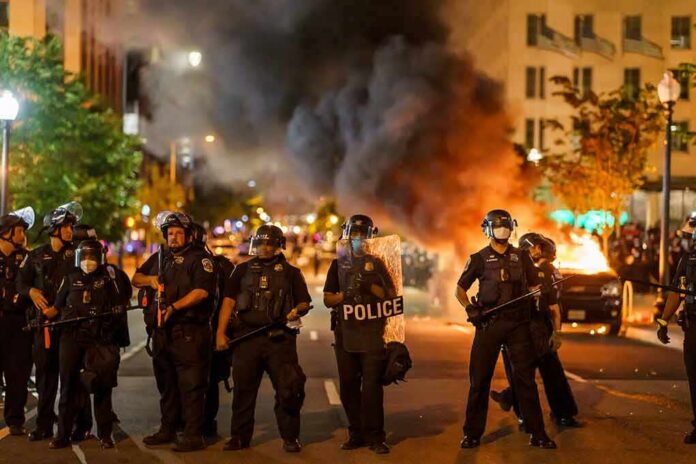
Chief Jim McDonnell’s case rests on concrete claims of officer harm. He has said 52 LAPD officers were injured during the anti-ICE unrest and described assaults unlike anything in his tenure—commercial-grade fireworks fired at officers, with some left with hearing impairment. That is not routine protest scuffling; fireworks of that class are concussive and directional, and they change the threat calculus for any incident commander.
How Crowd Control Decisions Get Made When Protests Turn Volatile
Modern protest policing operates on a continuum: presence, targeted arrests for discrete crimes, dispersal orders, and, at the outer edge, less-lethal munitions and chemical irritants. Properly used, those tools are meant to separate violent actors from peaceful crowds and break cascading risk. Improperly used—or used without discriminating between violent and nonviolent participants—they erode public trust and produce the very disorder they are supposed to quell. McDonnell argues LAPD handled the unrest “remarkably well” under unprecedented assaults, invoking injuries and the use of fireworks and Molotovs as justification for tactics chosen in the moment. That framing centers operational necessity: when force becomes necessary, it is because lesser measures failed or would have yielded worse harm.
Raman’s counterargument targets the same moment from the other side of the visor. She says LAPD under McDonnell and Mayor Karen Bass employed tear gas against protesters and violated Angelenos’ First Amendment rights—and that this marks a regression from 2020 crowd-control practice that should end. Her throughline is not about denying violence occurred; it is about priorities and proportionality: a city police force, she contends, should be “actually protecting people instead of protecting ICE on our streets,” and leadership culture must change to make that real.
Both Truths Can Stand: Violence Against Police and Flawed Tactics Are Not Mutually Exclusive
For readers trying to reconcile the accounts: you don’t have to choose a cartoon. If 52 officers required medical treatment, that is consequential and evidentiary of serious criminal conduct within the crowds; that fact supports the chief’s posture on threat environment and the need for firm tactics. Yet history in Los Angeles also shows that, in heated protest cycles, crowd-control mistakes and excessive force have occurred—independent reviews and human rights reporting have documented misuse of less-lethal munitions and broad, indiscriminate applications that harmed peaceful demonstrators in prior episodes, including around immigration enforcement. Those findings do not erase officer injuries; they clarify that tactical severity and tactical error can sit side by side.
Understanding chemical agents is instructive. Tear gas disperses crowds by making the air painful to inhale and eyes hard to open; it is indiscriminate by design. Commanders who authorize it usually judge that targeted arrests are impracticable and that escalation toward lethal harm is plausible absent rapid dispersal. The ethical hinge is discrimination and necessity—did conditions truly foreclose more precise tools, and did deployment minimize harm to nonviolent participants? McDonnell’s defenders answer yes; Raman rejects that premise and argues policy should foreclose tear gas in such contexts regardless. That is a policy argument about acceptable risk, not a factual refutation.
The Federal–Local Tension That Keeps Producing This Fight
Immigration enforcement sharpens every edge. ICE plans and executes federal operations; local police manage the public space around the flashpoint and the city’s risk more broadly. The presence of federal agents in city streets makes LAPD a lightning rod for decisions it does not fully own, yet its choices on posture—skirmish lines, kettling, crowd designation, and threshold for chemical agents—are fully local. Critics like Raman fold those choices into a broader indictment of aligning city policing with federal immigration priorities; police leaders answer that the duty to protect the public, bystanders, and their own officers does not vanish because the catalyst is federal. Both positions are coherent; they reflect different values about which harms matter most in the moment and which legitimacy claims bind a city department.
This asymmetry also shapes the evidentiary record. Police can rapidly quantify officer injuries and compile incident logs; civil-rights claims typically mature later, after medical evaluations, video analysis, and litigation. Early public debates therefore lean on agency counts and commander narratives, while deeper scrutiny of tactics lands months later. The Los Angeles conversation is following that familiar arc; in the meantime, candidates fight on cable-ready terrain—quotes, clips, and who “stands with” whom.
🚨 WHY PROTECT THEM: LAPD chief blasts Nithya Raman for attacking police as cops faced ‘lethal’ force at anti-ICE riots
“I was out there,” McDonnell told the California Post in a pointed reference to Raman's happy hour drinks session as the city burned.https://t.co/onJhPixEMO
— Cyber Hunter (@Gene_SD) October 9, 2026
What Competent Leadership Would Clarify Now
Three commitments separate durable policy from campaign posture. First, transparent accounting: publish a full, incident-level after-action report that links each major tactical decision—tear gas, less-lethal rounds, dispersal orders—to specific threat conditions and documented alternatives considered. McDonnell has offered the injury ledger and a defense of necessity; a public matrix of decision points would either validate or refine that judgment in the open.
Second, rulemaking that fits the modern protest landscape: bright-line standards for chemical agents, tighter doctrine for discriminating violent actors from peaceful crowds, and supervisory sign-offs that are auditable against contemporaneous video and radio traffic. Human Rights Watch’s findings in analogous Los Angeles events underscore why these refinements matter: indiscriminate tools can exact severe physical costs on nonviolent people, legal observers, and journalists.
Third, federal–local clarity: memorialize when and how LAPD will assist, co-locate with, or abstain from federal immigration actions in public-facing policy. Residents should not have to infer from a skirmish line whether their city is protecting a federal operation or protecting their right to assemble. Raman is pressing this line of clarity; the chief and mayor owe the city an equally clear articulation of operational boundaries and escalation thresholds.
Bottom Line
The cleanest reading of the current record is straightforward. Violent actors at anti-ICE protests inflicted significant harm on LAPD personnel; the department confronted threats that justify a serious, coordinated response. Simultaneously, Los Angeles’ recent history warns that powerful crowd-control tools have too often swept up peaceful people; any defense of necessity carries obligations of transparency and restraint backed by evidence, not assertion. Voters should discount the theatrics and judge leaders on whether they can hold both truths at once—protecting officers and the public from violence while protecting constitutional rights with discipline and clarity when the street turns hot.
Sources:
nbclosangeles.com, abc7.com, kabc.com, ground.news