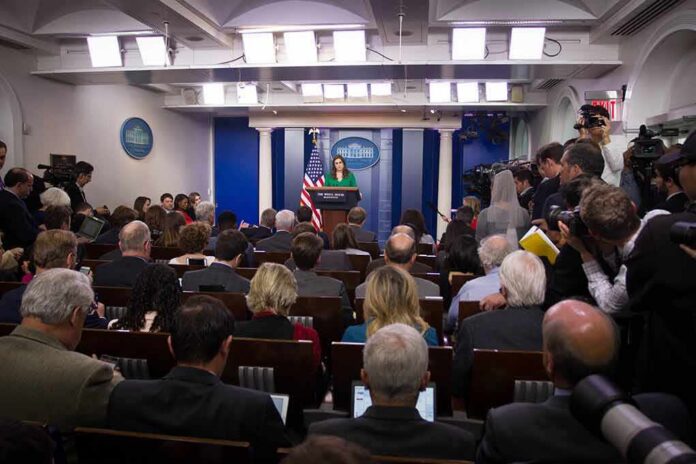
Presidents have tried to punish unfriendly newsrooms by locking them out of the White House for as long as there has been a White House press corps, and the courts have answered with almost tedious consistency: once the government opens a room to reporters, it cannot slam the door on some of them because it dislikes what they write. That settled doctrine, not the latest Truth Social post, is the real story behind President Trump’s announced ban on CNN, MS NOW, and Politico — and the fact that some of his own network’s most prominent voices are the ones saying so out loud makes this less a partisan skirmish than a rare moment of cross-ideological agreement on where the constitutional line sits.
Key Points
- Trump announced an “effective immediately” ban on CNN, MS NOW, and Politico from White House access, citing what he called “FAKE NEWS” coverage and warning “other fake news outlets to follow.”
- He tied the action partly to an unverified allegation that Politico received an “illegal and ridiculous $8 million subscription” from the government under President Biden.
- Fox News’s own Jonathan Turley and Jacqui Heinrich publicly broke with the White House, calling the ban unconstitutional and counterproductive.
- A D.C. federal court already ruled in the Associated Press’s 2025 access fight that the White House cannot exclude reporters from open press spaces based on viewpoint.
- The ban’s practical enforcement was reported as unclear, with CNN staff still present at the White House after the announcement.
What Was Announced, and the Stated Rationale
Trump posted on Truth Social that he was banning CNN, MS NOW, and Politico from the White House, describing their coverage as “constant ‘reporting’ FAKE NEWS!” and promising that “other fake news outlets to follow.” Speaking later from the Oval Office, he sharpened the rationale in a way that matters enormously to the legal analysis: asked to define “fake news,” he said it meant “purposely negative stories” rather than stories that are factually wrong. That is not a technical slip. A ban premised on tone or hostility toward the administration, rather than on demonstrable inaccuracy, is a viewpoint-based restriction by definition — the exact category of government action the First Amendment treats with the deepest suspicion once a forum has been opened to the press generally.
Trump also folded in an unrelated accusation, claiming Politico had received an “illegal and ridiculous $8 million subscription” directly from the federal government during the Biden administration, which he called corruption. No procurement records, contract documents, or audit findings accompanied the claim in any of the contemporaneous reporting, leaving it an assertion rather than a demonstrated fact. Whether or not such an arrangement existed and whatever its propriety, it is a separate legal and factual question from whether a sitting president may exclude a newsroom from covering him — conflating the two does not strengthen either claim, it just makes the overall justification harder to evaluate on its own terms.
The Legal Terrain the White House Has Already Lost Once
This is not a novel fight; it is nearly a rerun. In February 2025 the administration barred Associated Press journalists from the Oval Office, Air Force One, and similar events after the wire service declined to adopt the administration’s preferred name for the Gulf of Mexico. AP sued, and U.S. District Judge Trevor McFadden — a Trump appointee — ruled squarely for the news organization, writing that “if the Government opens its doors to some journalists… it cannot then shut those doors to other journalists because of their viewpoints.” The D.C. Circuit later split the difference procedurally, but the underlying doctrine both sides invoked, tracing back to Sherrill v. Knight (1977), has never been seriously disputed by any panel that has heard these cases: the Oval Office, briefing room, and similar press spaces function as nonpublic fora, and viewpoint discrimination within them is presumptively unconstitutional. A new ban built on the same rationale — dislike of coverage rather than a specific, adjudicated falsehood — inherits the identical legal vulnerability.
The Notable Defection: Fox’s Own Talent Says No
What distinguishes this episode from the AP fight is who is objecting. George Washington University law professor and longtime Fox contributor Jonathan Turley, a figure generally sympathetic to this administration, called the move “an assault on long-honored principles of a free press” and a “terrible precedent and practice” that would “undermine the country’s long-standing position as a voice for the free press.” He argued explicitly that the remedy for disliked coverage is confrontation, not exclusion: “Challenge liberal reporters. Argue and defeat them. Don’t ban them.” Jacqui Heinrich, Fox’s senior White House correspondent and president of the White House Correspondents’ Association, said plainly that the ban “goes against the US Constitution.” When a network’s own credentialed correspondent and its most-cited legal commentator both reject a White House press policy on constitutional grounds, that is not partisan noise — it is a signal that the legal footing is genuinely thin, independent of who occupies the Oval Office.
Fox News is a lot of things, but they’re a press at the end of the day.
If Trump is allowed to ban press from the White House, that’s a clear violation of the 1st amendment and sets a precedent that freedom of press is now on the chopping block.
Just because you don’t agree…
— The Asphalt Poet (@CuratorOfRot) September 19, 2026
Implementation Gaps and What Comes Next
Reporting in the hours after the announcement noted that CNN staff remained present at the White House despite the “effective immediately” framing, and no policy memo, credentialing directive, or appeals process was made public. That ambiguity matters practically — a restriction announced on social media but not operationalized through the normal channels (Secret Service credentialing, Press Office directives) is legally and functionally different from a formal policy, and it leaves the door open to inconsistent enforcement or a quiet retreat. Given the AP precedent, any formal implementation would almost certainly draw immediate litigation, and given McFadden’s prior ruling, the outlets would enter that fight with a favorable roadmap already written by a judge appointed by the very president imposing the ban. The durable lesson, reinforced now from inside Trump’s own media ecosystem, is that press-access punishment tends to generate exactly the outcome it was meant to avoid: sustained coverage of the fight itself, a court record unfavorable to the White House, and a reminder that “fake news” as a legal standard has never once survived contact with a judge.
Sources:
cnbc.com, time.com, cnn.com, yahoo.com, vinnews.com, mediaite.com, livenowfox.com, foxnews.com