
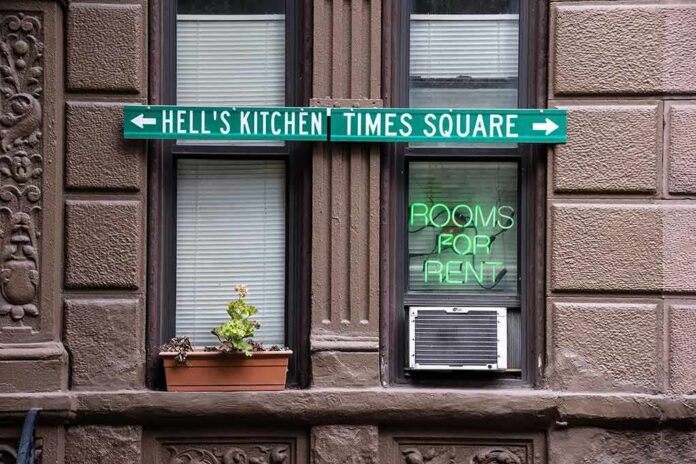
New York’s rent freeze was designed to protect roughly a million households from immediate rent hikes; it was never going to tame headline Manhattan rents in the open market, where demand, supply, and scarcity set the price. Confusing those two markets — the regulated submarket and the unregulated median — guarantees political disappointment and bad analysis.
At a Glance
- Manhattan’s median rent set a record in June 2026, even as the city froze increases on stabilized one- and two-year leases.
- A rent freeze targets the regulated submarket; the median rent cited in headlines reflects the broader, largely market-rate inventory.
- Economists have long been skeptical that rent control improves overall affordability; supply expansion remains the durable lever.
- Lawsuits from landlords challenge the freeze’s process and costs, underscoring a policy fight that will play out in court and in construction pipelines.
What happened: record market rents alongside a freeze on regulated leases
Start with the facts that shape the political theater. The city’s Rent Guidelines Board voted to freeze rents on one- and two-year leases for about one million rent-stabilized apartments, delivering a marquee promise of Mayor Zohran Mamdani and locking in zero allowable increases on renewals within that regulated system. The decision, adopted 7–1, binds a large but defined swath of the rental stock; it does not set prices in the open market or on new leases for unregulated units.
Simultaneously, the Manhattan rental market continued its march upward. The median Manhattan rent reached $5,295 in June 2026 — a new high, up 3% from May and 8% year over year. Studios averaged $4,014 and one-bedrooms averaged $5,408, both records in the dataset, signaling intense demand and tight vacancy at the entry points into the market-rate ladder. These are market outcomes in a high-amenity, supply-constrained borough, only partially connected to what a rent board decrees for stabilized renewals.
How the rent freeze actually works — and what it doesn’t do
New York’s rent freeze is a rule for renewals within the rent-stabilized system — a legal regime that governs lease terms for eligible units, not an across-the-board price cap on all apartments. The Rent Guidelines Board sets allowable percentage changes for new one- and two-year leases and renewals signed within a defined window; this cycle’s decision set those changes at zero. For tenants already in stabilized housing, that decision can be financially decisive. For a new arrival trying to rent a market-rate one-bedroom in Murray Hill, it is irrelevant.
This distinction is not a technicality; it’s the policy’s design boundary. A freeze protects incumbents in the regulated submarket from nominal rent growth for a period; it cannot, by itself, expand supply, lower asking rents in the unregulated segment, or alter the median rent that blends stabilized, luxury, and everything in between. When commentators score the freeze against the Manhattan median, they are grading a thermostat by the weather outside.
The economic base case: why rent control rarely moves citywide medians
Decades of housing economics land in roughly the same place: rent control can transfer value to covered tenants, especially long-time residents, but it tends to reduce investment, distort mobility, and shrink effective supply over time — none of which lowers the citywide median rent. A widely cited 2012 survey of top economists found only a small minority believed rent control improved the overall availability and quality of affordable housing; the broader literature warns about maintenance shortfalls and supply responses that push pressure onto the uncontrolled stock.
That doesn’t make a freeze meaningless. For a fixed-income renter in a stabilized unit, a zero percent renewal is protection against nominal increases during a cost-of-living crunch. But the citywide affordability crisis is a geometry problem: too many households chasing too few homes, especially near transit and jobs. Freezing a subset of prices does not alter that math; adding units does.
Supply, scarcity, and the Manhattan median
The Manhattan rent series tells a familiar story about scarcity. When job centers deepen, amenities proliferate, and in-migration resumes, demand re-aggregates in high-opportunity neighborhoods. If zoning, entitlement risk, and financing slow new production — or renovations that refresh aging stock — asking rents climb at the margin. That’s precisely what the June report captures: the tightest points on the ladder, studios and one-bedrooms, hit fresh records, implying constrained turnover and a bruising competition for small units among new entrants.
A rent freeze in the stabilized sector can even exacerbate that turnover dynamic by reducing mobility: households who might otherwise trade up or down choose to stay put. In a tight market, reduced churn amplifies scarcity for anyone searching — especially those outside the regulated system. Meanwhile, if owners of stabilized properties face rising operating costs but frozen rents, some will defer maintenance or capital upgrades; others will try to reposition units on vacancy when lawful. None of that adds apartments where they are needed most.
The policy bundle beyond the freeze: promises versus pipeline
City Hall has framed the freeze as one plank in a broader housing plan that includes production and preservation goals on the order of hundreds of thousands of units; the administration has cited a combined target of building and preserving 400,000 “affordable and rent-stabilized” homes over several years, alongside zoning reforms intended to streamline approvals and unlock capacity. Ambition on that scale lives or dies in the pipeline: site control, environmental review, financing stacks, and predictable rules. If those pieces proceed, the city will add units. If they stall, the median won’t budge.
“Preservation” is politically popular and often faster than breaking ground, but it seldom increases net supply. Affordability at scale requires net new units — accessory dwelling units, infill on underutilized parcels, upzoning near frequent transit, office-to-residential conversions when feasible, and public-private deals that pencil without years of litigation. That is the lever that moves the market-wide median over time, and it is the test every mayor eventually faces.
The legal and political counterpressure
The rent freeze has also triggered legal pushback. Landlord groups have sued to invalidate the decision, arguing that the mayor improperly influenced the Rent Guidelines Board and that the vote ignored evidence of rising operating costs. Lawsuits like these do not change median rents; they do affect the policy’s durability and can reshape subsequent board behavior if courts find procedural faults or require new cost-accounting in future determinations.
However those suits resolve, they underscore the central trade-off: shielding stabilized tenants from near-term increases shifts pressure — financial, political, or both — somewhere else. If operating budgets are squeezed, owners respond through cost-cutting, capital plans, or exits. If the market segment outside the freeze absorbs more demand, asking rents there rise faster. None of this is moral approval of any side; it is simply how constrained systems re-equilibrate.
Why the headline mismatch fuels confusion — and what to watch instead
Critics have seized on the timing — record-high Manhattan rents alongside a citywide rent freeze — as prima facie evidence of policy failure. The temptation is obvious, but the inference is sloppy. The freeze never claimed to set the borough median; it promised to cap increases in a regulated subset. The correct scoreboard for that promise is whether stabilized tenants face zero renewal hikes during the policy window and whether building quality holds under that constraint. The correct scoreboard for the affordability crisis, by contrast, is production: how many net new homes get permitted, financed, and delivered, and where.
Accordingly, the meaningful metrics to track over the next several years are simple and unforgiving. First, annual net additions to the housing stock, disaggregated by income band and location. Second, time-to-permit and time-to-completion for multifamily projects, which capture the friction in the system. Third, stabilized building conditions — violations, capital needs, and turnover — to test whether a freeze degrades quality. And fourth, vacancy rates by bedroom type, which reveal where scarcity bites hardest and predict rent trajectories.
The durable lesson: protect incumbents if you choose, but build to bend the curve
There is a coherent case for a rent freeze as a targeted relief measure in an inflationary period: it insures a large group of tenants against immediate shocks. But there is no serious case that a freeze will, by itself, lower market rents in Manhattan or deliver broad affordability. To change the median, cities must change the denominator — the number of homes people can actually rent where they want to live.
New York can run both plays at once: stabilize costs for regulated households while clearing the path to build, convert, and add relentlessly. If the production pipeline fills and moves, the median will eventually reflect it. If it doesn’t, no sequence of freezes will make the open market any less brutal — because the problem is not the thermostat. It is the weather system of demand, scarcity, and time.
You’re criticizing Mamdani based on a misleading article. The $6,655 figure is for Manhattan’s market rental market, while the freeze applies to rent-stabilized leases and doesn’t take effect until Oct. 1. How exactly did a policy not yet in effect cause today’s record rents?
— Drew (@realtalk360blog) August 12, 2026
Sources:
nyc.gov, nytimes.com, marketplace.org, cityandstateny.com, wsj.com