
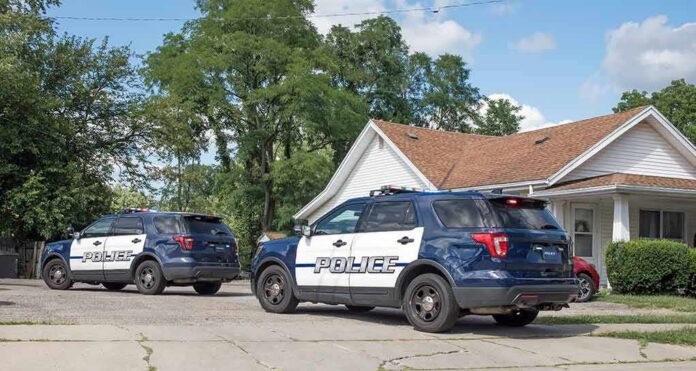
When authorities publicly classify a household’s four deaths as three homicides and one suicide, they are not speaking loosely; they are translating a pattern of injuries, scene findings, and coroner determinations into the plainest possible conclusion about what happened inside that home.
At a Glance
- Tippecanoe County’s coroner identified four family members and preliminarily ruled three homicides and one suicide.
- Autopsy findings reported multiple gunshot wounds for the three victims and a self-inflicted gunshot wound for the suspected perpetrator.
- A 911 call, placed before police discovered the bodies, reported that the father had a gun.
- Indiana State Police assumed the lead investigative role due to the father’s employment at the county sheriff’s office.
What investigators established and why it carries weight
Officials identified the deceased as Thomas and Julie Tkach and their daughters, Katharyn and Lauren, all from the same West Lafayette residence. The Tippecanoe County Coroner’s preliminary determinations are unambiguous: Thomas died by suicide; the others were homicide victims. Reported autopsy findings align with that classification—multiple gunshot wounds for Julie and the daughters, and a self-inflicted gunshot wound to Thomas’s head—an injury pattern that, taken with the scene, fits the familicide-suicide framework used by medical examiners and detectives in comparable cases. In parallel, dispatch records and reporting cite a 911 call around 8:30 p.m. describing that Thomas had a gun, a contemporaneous data point that preceded the grim discovery and further narrows the investigative lens.
A point of process also matters here. Because Thomas worked for the Tippecanoe County Sheriff’s Office, Indiana State Police assumed the investigation, reducing an obvious conflict risk and bringing an outside agency’s homicide protocols to bear. That handoff—to a separate investigative body—is standard where agency ties could create a credibility problem, and outlets reported that ISP’s Lafayette Post detectives were leading the active case.
How the classification emerges from forensic practice
Coroners and medical examiners do not assign “homicide” or “suicide” in the colloquial sense; they classify manner of death based on injuries and context. In firearm events with multiple victims, three elements frequently converge: wound characteristics and trajectories, weapon recovery and its condition, and scene reconstruction that places victims and shooter in time and space. Preliminary autopsies identify cause and manner—here, gunshot wounds producing three homicides and one suicide. Investigators then integrate ballistics, residue tests, and spatial evidence to attribute agency. While those technical reports are not always made public during an active inquiry, the early coroner call is a strong, formal signal about the role each person is believed to have played, grounded in medical-legal standards rather than speculation.
The dispatch chronology also helps anchor the narrative. A family member’s 911 report that the father had a gun, logged before officers entered the scene, is probative because it timestamps an immediate threat inside the household. Combined with the later discovery of all four bodies and the autopsy split between homicides and a self-inflicted fatal injury, the through-line for a murder-suicide becomes coherent and supported by intersecting evidence streams rather than a single witness assertion.
Why outside lead investigators strengthen legitimacy
Transferring the case to Indiana State Police was not a mere courtesy; it is an established best practice whenever the deceased or a potential subject is connected to a local agency. Independent teams bring fresh supervisory oversight, separate evidence handling, and fewer perceived pressures that could color judgment. Though frameworks vary by state, the principle—use a primary investigative body that is organizationally distinct from the involved agency—has been widely adopted in sensitive violent incidents, precisely to reinforce public trust in difficult determinations.
In practical terms, ISP’s role centralizes interviews, lab submissions, and scene documentation under a single command structure that is not the decedent’s employer. That distance helps both internally—investigators can work without local loyalties complicating decisions—and externally, where the community expects independence when conclusions are severe and final.
Where this case fits in the broader pattern of familicide-suicide
Although every household tragedy has its own particulars, the aggregate research on homicide-suicide events helps explain why officials quickly recognized the configuration they did. Across multiple jurisdictions and time frames, men account for the overwhelming majority of homicide-suicide perpetrators, and firearms are the predominant method. The National Institute of Justice’s review of 408 homicide-suicide cases found 91% of perpetrators were men and 88% used guns—figures that map onto the scenario Indiana investigators confronted: a father, a firearm, multiple family victims, and a completed suicide.
Comparative research in Canada and England-Wales draws similar lines. Analyses of familicide and filicide-suicide consistently show that fathers are disproportionately represented and that a substantial fraction end in the offender’s suicide, often immediately after the killings. The point is not to reduce a household to a statistic; it is to understand why a coroner’s homicide-suicide designation, made early but anchored in injury patterns, is widely consistent with what decades of cross-national data have documented.
What remains for investigators to finalize
Even when manner-of-death findings are clear, professional homicide work continues until the evidence meets closed-case standards. That typically includes firearm provenance and ballistics comparison, DNA and latent print analysis, gunshot residue results for both the suspected shooter and victims, and a timeline stitched from 911 call logs, phone extractions, and neighborhood canvasses. Detectives also review mental health history, recent stressors, and any writings or digital traces that speak to intent. None of that changes the core picture already established by the coroner and scene—a murder-suicide inside a single household—but it does complete the record for prosecutors, the coroner’s files, and surviving family.
One should expect officials to release only what they can while laboratory work and report writing proceed. In high-profile family homicides—particularly those touching a university community and a law-enforcement agency—the cadence of disclosure is cautious by design. The essential facts in West Lafayette are, however, already solid: a father dead by suicide; a mother and two daughters dead by multiple gunshot wounds; and an investigation led by an external state agency, consistent with best practices and with the evidence-driven framework that classifies the event as a murder-suicide.
Sources:
foxnews.com, sacbee.com, fox5ny.com, wlky.com, newsnationnow.com, wrtv.com, wishtv.com, purdueexponent.org