
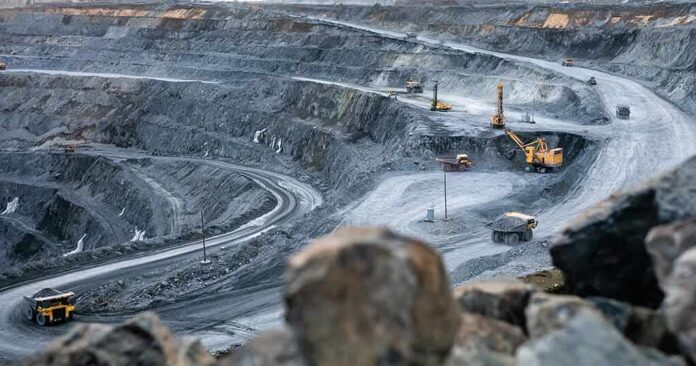
President Trump’s mining pitch is not just a slogan about industrial revival; it is an attempt to recast domestic extraction as a national-security instrument, with permits, financing, trade policy, and foreign partnerships all pulled into the same frame. The significance lies in the mechanism: the administration is trying to turn mineral supply from a market problem into a state-backed strategic project.
Key Points
- The roundtable placed **critical minerals** at the center of Trump’s industrial agenda, linking mining directly to defense, advanced technology, and supply-chain security.
- The administration’s approach is expansive: accelerate permits, mobilize federal financing, use tariffs, and coordinate with allies rather than rely on the market alone.
- The evidentiary record strongly supports the existence and policy framing of the meeting; there is no specific counter-record that disproves the event or its basic agenda.
- The real debate is not whether Trump is championing miners, but whether this model produces durable domestic capacity or simply privileges large incumbent firms with federal leverage.
What the Roundtable Was Really About
The reported State Department roundtable brought Trump together with top mining executives at the very moment his administration was pressing a broad critical-minerals campaign. Reuters reported that he was expected to attend a State Department-hosted meeting with mining leaders, and the White House later said he held a “historic roundtable” in which more than $2 billion in critical mining and mining-related projects was announced. The policy frame was explicit: secure domestic and allied supplies of minerals needed for energy, defense, and advanced technologies, and do it in a way that reduces dependence on hostile foreign countries.
That matters because critical minerals are not a rhetorical category; they are the material base of modern industrial power. Copper, rare earths, graphite, nickel, and related inputs sit inside power grids, jet engines, precision weapons, batteries, semiconductors, and the manufacturing systems that support them. When a president makes mining a central national-security theme, he is not merely flattering an industry. He is signaling that the state will use its own tools — permitting, procurement, diplomacy, and finance — to shape the market rather than wait for private capital to solve a strategic shortage on its own.
The Policy Architecture Behind the Message
The deeper story is the architecture that has been built around Trump’s mineral agenda since early 2025. A White House executive order declared a national emergency to expand domestic mining, reduce permitting delays, and cut dependence on China for critical minerals; it also began the process of using Defense Production Act authorities to fund mineral processing tied to national security. Another executive order later directed agencies to accelerate permitting, leasing, and financing, and to reallocate federal support toward private-sector mineral production. In other words, the roundtable is the public-facing summit of a much larger governing strategy, not an isolated event.
That strategy has several moving parts. First, it tries to compress the time between discovery and production by speeding federal review and land access. Second, it uses state power to de-risk projects through loans, equity stakes, grants, and other federal supports. Third, it folds trade policy into industrial policy, including tariffs and negotiated supply arrangements with allies. Policy analysts have described this as a decisive shift away from a narrow tax-credit model toward a more interventionist regime built on administrative acceleration, public capital, and strategic coordination. The historical comparison is straightforward: this is closer to wartime industrial policy than to a conventional laissez-faire resource market.
Why the Administration Calls It “Championing” Miners
Trump’s defenders can point to tangible outputs, not just rhetoric. The White House says the administration has signed or approved 160 minerals deals totaling almost $40 billion since January 2025, and that the roundtable itself featured more than $2 billion in new mining and mining-related projects plus more than $180 million for mining schools. Those figures, if sustained in practice, support the claim that this White House is doing more than issuing slogans. It is trying to create a pipeline from federal policy to mine development, processing capacity, and workforce formation.
The workforce element is easy to miss but crucial. Mining is a capital-intensive business, yet it is also a human-capital business; without geologists, metallurgists, engineers, and skilled operators, federal money does not become output. The administration’s focus on mining schools reflects a sober recognition that the U.S. has spent decades underproducing the talent needed for a serious minerals buildout. That is why “supporting miners” in this framework means subsidizing education, not just celebrating the industry at a podium.
Where the Hard Questions Live
The counterargument is not that Trump is indifferent to mining; it is that state-backed mineral policy can become selective, opaque, and heavily tilted toward large firms with the best access. The evidence package does not contain a direct refutation of the roundtable itself or its critical-minerals framing, and the strongest counter-material is contextual rather than contradictory. Still, the broader policy record shows why critics remain uneasy: expanded federal land access, aggressive permitting shortcuts, and public financing can reduce bottlenecks, but they can also concentrate power in the hands of incumbents and blur the line between strategic support and regulatory favoritism.
That tension is baked into the model. If the state wants mines faster, it must do at least one of three things: relax constraints, assume more risk, or override ordinary timelines. Every one of those choices creates political and practical tradeoffs. Faster permitting can unlock production, but it can also compress review. Public lending can crowd in private capital, but it can also expose taxpayers to losses. Tariffs can protect domestic capacity, but they can also raise costs downstream. The administration’s mineral doctrine is internally coherent; the open question is whether coherence is the same thing as durability.
NOW: President Trump opens the mining industry roundtable with praise for Secretary of State Marco Rubio for hosting it at the State Department:
"I want to thank our great Secretary of State, Marco Rubio, for hosting, this beautiful building.”
pic.twitter.com/nkZucFuZKU— Susan S.Wiles (@Realsusan_sWile) August 7, 2026
The Real Test: Capacity, Not Ceremony
The most revealing fact in the research package is that the issue has already moved beyond a single meeting. White House and policy sources describe a continuing campaign: executive orders, mineral project fast-tracking, strategic stockpiles, alliance building, and direct federal stakes in companies tied to the minerals supply chain. That means the roundtable should be read as a milestone in a broader institutional project. If new mines open, processing expands, and critical inputs become more secure, the policy will have accomplished something historically difficult. If not, the administration will have proved only that it could stage an impressive industrial theater.
For now, the evidence supports a clear and limited judgment: Trump is treating American mining as a strategic priority and using presidential power to push that priority through the federal system. The phrase “greater champion” is, in that sense, an accurate description of intent and posture. Whether it becomes an accurate description of outcomes will depend on permits converted into production, financing converted into facilities, and political symbolism converted into actual tons of critical minerals.
Sources:
youtube.com, reuters.com, investing.com, cryptobriefing.com, roic.ai, facebook.com, aol.com, x.com, trumpwhitehouse.archives.gov