
When a medically equipped business jet vanishes between two well-instrumented airspaces, the most reliable story in the first 24 hours is the search itself: who launched it, where they are looking, and what the last controlled exchanges with air traffic control revealed.
At a Glance
- A Canadian-registered Gulfstream G100 air ambulance departed Bermuda for Boston with six aboard and later lost contact.
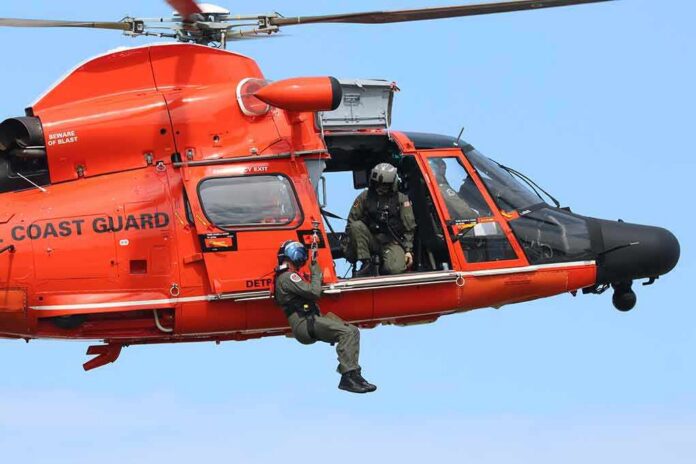
- The FAA issued a Search and Rescue Alert; the U.S. Coast Guard mounted air-and-sea operations south of Cape Cod, focusing off Nantucket.
- Reports tie the aircraft to Latitude Air Ambulance (tail number C-GRJP) on a medical evacuation mission.
- Air traffic control audio excerpts suggest degraded communications before contact was lost.
What is established: aircraft, mission, and last known route
The missing aircraft was widely identified as a Canadian-registered Gulfstream G100 operated by Latitude Air Ambulance, carrying six people: two pilots, two medical crew, and two passengers consistent with a medevac mission profile. Multiple outlets tied the tail number C-GRJP to the operator’s Hamilton, Ontario base, matching the flight’s role and crew complement reported by the company and officials in Canada and Bermuda. The flight departed LF Wade International Airport in Bermuda around 12:41 a.m. local time for Boston Logan International Airport. En route, the aircraft lost contact with air traffic control; the FAA subsequently issued a Search and Rescue Alert, the standard trigger that mobilizes interagency search resources when radar/radio contact is lost with an aircraft believed to be in distress.
The Coast Guard concentrated its search off Nantucket—south of Cape Cod—where the last reliable track and controller handoffs placed the jet’s general area before it disappeared from communications and tracking summaries. That geography is consistent across federal statements and independent reporting, which is why surface and overwater aviation assets were deployed in grid patterns there rather than farther offshore or closer to Boston.
The search-and-rescue machinery: how the response actually works
Once the FAA issues an alert notice, coordination shifts quickly to the Coast Guard for maritime sectors; they combine air searches (fixed-wing for wide-area sweeps, helicopters for focused low-altitude work) with fast surface craft to investigate sightings and retrieve debris or survivors. Standardized search patterns—parallel track, creeping line, and expanding square—are selected based on last known position, drift models, and sensor capability, then refined as new data arrives from radar replays, pilot reports, and any Emergency Locator Transmitter (ELT) activation that might be detected on 406 MHz via satellite or aerial receivers. When media flight-track plots narrow to a tight loiter from Coast Guard aircraft over one spot, that usually signals either a potential debris field, an ELT hit to home in on, or an object of interest meriting repeated overflights to cue surface assets.
In parallel, aviation agencies begin preserving the technical trail: radar playback, controller audio and transcripts, and any communications from other aircraft relaying on the missing jet’s behalf. If wreckage is found within U.S. jurisdiction, the National Transportation Safety Board (NTSB) will lead the safety investigation, with accredited representatives from Canada (state of registry) and potentially Bermuda (state of departure) participating under ICAO Annex 13 norms. In international waters, investigative lead follows location and practical capability but still adheres to Annex 13 roles to protect evidence, document sequence, and, crucially, prevent recurrence.
What controllers heard: the role of final transmissions
In early public reporting, the Boston Globe highlighted an exchange on air traffic control recordings—“You’re coming in blind?”—that points to degraded radio or avionics prior to the loss of contact. Such phrasing suggests the aircraft was transmitting without receiving, or vice versa, a failure mode consistent with electrical or antenna path issues. In busy terminal environments, controllers will often enlist nearby aircraft to relay clearances and queries in a “poor comms” scenario; the practice is routine and documented in controller handbooks, and it can sustain safe separation if the aircraft’s other systems remain nominal. When it cannot, ATC shifts to procedural separation and, if contact ceases and track quality degrades, initiates the alert escalation the FAA used here.
Several outlets also relayed commercial flight-tracking summaries indicating a rapid descent from cruise altitude into the low twenties or teens before the track vanished. Those summaries are useful for triangulating where to search but are not substitutes for certified radar returns or flight data; investigators will reconcile these feeds against primary and secondary radar, multilateration, and any recovered recorders to determine the precise trajectory.
Why timelines wobble in the first hours—and how the formal record catches up
Discrepancies in reported loss-of-contact times—1:00 a.m., 1:20 a.m., 1:30 a.m., even closer to 2:00 a.m.—reflect the staggered nature of early data: airport departure stamps, sector handoff logs, pilot reports, and consumer-facing trackers rarely agree to the minute until agencies reconcile them. That reconciliation becomes the spine of the preliminary report that Annex 13 expects within 30 days; industry groups have pushed for timelier output because a structured preliminary, even with caveats, anchors public understanding and reduces speculation about what data exists and what it shows. A recent analysis underscored why speed matters: almost half of 268 accidents from 2018 through 2023 reached the public without a final report, extending uncertainty about causal chains and corrective actions.
For a cross-border medevac, the paper trail is richer—and more fragmented—than a typical business flight. Dispatch records, patient-transfer authorization, crew manifests, and maintenance releases will sit with the operator; departure stamps and security footage with Bermuda authorities; ATC and radar with U.S. facilities; and nationality and consular liaison with Canada. Coordinating those streams into a coherent chronology is routine work for investigators but slow by design, because accuracy and evidentiary integrity outrank speed in safety cases.
The aircraft and mission profile: what a Gulfstream G100 brings to medevac
The G100—originally the Astra SPX before Gulfstream branding—is a midsize twinjet with a typical high-teens to low-twenties thousand-foot cruise altitude on medium legs, more than sufficient to bridge Bermuda to Boston with medical equipment and staff aboard. Medevac operators fit these cabins with stretcher systems, oxygen, monitors, and often power inverters to run ICU-grade devices; crews are trained to balance patient stability with aviation constraints. That training includes contingency handling for electrical or pressurization issues that could compromise both patient care and avionics. Latitude Air Ambulance’s statement that the flight was evacuating a patient is consistent with this configuration and the reported four-crew composition—two pilots, flight nurse, and flight paramedic.
In such missions, abnormal communications can cascade into workload spikes: flying the airplane, troubleshooting systems, coordinating with ATC through relays, and maintaining patient care. Controllers, for their part, will prioritize clear, simple vectors and altitudes; nearby aircraft become ad hoc partners in maintaining situational awareness. If the aircraft then leaves radar or no longer responds, the search trigger is immediate, as it was here.
🚨🇺🇸 Debris from a missing medical jet has been found off Nantucket: 6 people were aboard the Bermuda to Boston flight
The Canadian-registered Gulfstream dropped off FAA radar shortly before its scheduled 1:25 a.m. landing at Logan, and the Coast Guard has confirmed the wreckage… pic.twitter.com/MmfGGHYoYu
— Mario Nawfal (@MarioNawfal) October 4, 2026
What to watch for next: the durable signals in a maturing record
Three artifacts will convert this from a search narrative into an accident chronology. First, the FAA’s Search and Rescue Alert and associated controller logs will lock the timeline and last acknowledged clearances. Second, Coast Guard situation reports will define the search grid evolution, any debris or ELT hits, and environmental factors that influenced drift and visibility. Third, if located, the flight data and cockpit voice recorders—or their functional equivalents for this airframe—will resolve the aircraft’s configuration, system status, and crew problem-solving in the final minutes. Alongside operator dispatch and maintenance records and the patient-transfer manifest, these documents allow investigators to say not only what happened, but why.
Sources:
aljazeera.com, abc7.com, cbc.ca, bostonglobe.com, bostonherald.com, edition.cnn.com, kcci.com, boston25news.com, boston.com