
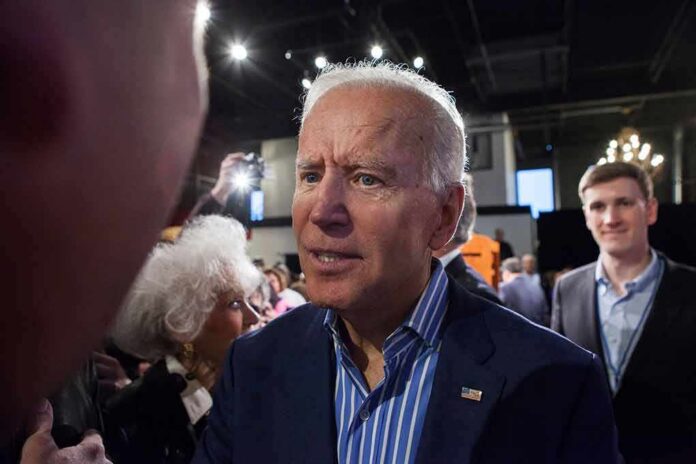
Presidential memoirs used to generate buzz through a sit-down with a network anchor or a glossy magazine excerpt; the fact that former President Biden built buzz for his new memoir, “Promise Me, America,” through a TikTok creator instead says more about where political communication is headed than anything in the book itself.
Key Points
- Former President Biden shared a clip of himself with Spanish-language TikTok influencer Carlos Eduardo Espina after hosting a group of liberal content creators at his Wilmington, Delaware home to discuss his memoir.
- Espina is a repeat Democratic surrogate who previously appeared alongside Biden at the White House in June 2024 for an immigration policy rollout.
- The episode fits a years-long pattern of campaigns and officials routing outreach through individual creators rather than traditional press, especially to reach Spanish-speaking and younger audiences.
- No uniform federal law requires disclosure of paid or coordinated political influencer content, leaving audiences largely on their own to judge what they’re watching.
What the clip actually shows
The reporting is specific and unremarkable in its particulars: over a weekend in November, Biden invited a cluster of online political creators, including Harry Sisson, to his Wilmington home to talk through “Promise Me, America.” Among them was Carlos Eduardo Espina, a creator known for Spanish-language political content aimed at Latino audiences. One of the resulting clips captured Biden turning to someone off-camera and saying, “Take care of this guy,” followed by, “I need him! Badly!” The remark reads as an off-the-cuff compliment from a former president who understands, better than most politicians his age, that a TikTok creator’s reach can now rival a cable news hit.
That Biden personally shared the clip afterward matters more than the clip’s content. Sharing is an act of amplification and endorsement; it signals that the relationship with Espina is not incidental but something the former president’s team considers worth promoting. Separate reporting on the same gathering corroborates the basic sequence — the memoir discussion, the guest list, Espina’s presence — without surfacing any competing account of what occurred. On the facts of the event itself, the record is not in dispute.
Why Espina specifically
Espina is not a random creator who happened to be in the room. He built a large following posting Spanish-language explainers on immigration policy and voting information, and the Biden operation identified him as valuable well before this memoir tour. In June 2024, while Biden was still in office, Espina joined him at the White House for the announcement of executive actions letting some undocumented spouses and children of U.S. citizens apply for permanent residency without leaving the country. That earlier appearance established Espina as a recurring conduit between the administration and Spanish-speaking audiences — a role the Wilmington gathering simply continued into Biden’s post-presidency.
This is not a new playbook for Democratic outreach to Latino voters. Jennifer Lopez and Alex Rodriguez delivered direct-to-camera Spanish-language endorsements for the Biden campaign in 2020, explicitly urging Latino viewers to vote. What has changed is the scale and granularity: instead of a handful of celebrity endorsements, campaigns now cultivate dozens of mid-tier creators, each with a tightly defined audience, and treat them as a distribution network in their own right.
The mechanics of political influencer outreach
Academic researchers have a name for what Espina and creators like him do: political relational influencers, defined as creators who use parasocial trust with followers to legitimize and amplify political messages, particularly on platforms like Instagram and TikTok. The appeal to campaigns is straightforward. A creator’s audience already extends them a kind of trust that a campaign ad or a news segment cannot easily replicate, and that trust transfers, at least partially, to whatever message the creator carries. Biden’s own campaign recognized this dynamic back in 2024, launching its first TikTok video during the Super Bowl despite the White House’s prior security concerns about the platform’s Chinese ownership — a decision that prioritized reach over caution.
The strategy is bipartisan and durable rather than a Democratic quirk. Researchers studying the 2020 and 2024 cycles have found that exposure to online political influencers now rivals exposure to candidate-sponsored advertising and, in some cases, established news sources. That shift explains why a former president promoting a memoir reaches for a TikTok creator instead of a morning show segment: the audience he wants is already there, scrolling, and already primed to trust the messenger.
The disclosure gap nobody is closing
The one genuine vulnerability in this model isn’t whether the Biden-Espina meeting happened — it did — but how little the law requires anyone to disclose about arrangements like it. The Federal Trade Commission’s endorsement guides say a connection between an endorser and the entity benefiting from the endorsement should be disclosed if it would affect how audiences evaluate the message, but enforcement is thin and the standard is aspirational more than binding. More pointedly, there is no generally applicable federal rule requiring political creators to disclose compensation or coordination with campaigns, and only a scattering of states have tried to legislate the gap themselves. A separate mapping of the political influencer industry reached the same conclusion: audiences across the political spectrum rank secretly paid political influencers as a serious concern, yet the regulatory apparatus to address it barely exists.
What this means going forward
None of this makes the Biden-Espina clip sinister. It makes it representative. Political figures, in or out of office, now treat individual creators the way their predecessors treated local newspaper editors or radio hosts — as gatekeepers to a specific, hard-to-reach audience, in this case Spanish-speaking voters who increasingly get their political information from short-form video rather than legacy outlets. The durable story here isn’t one clip or one memoir tour; it’s that the line between “press outreach” and “political messaging through a trusted personal relationship” has effectively dissolved, and the public has almost no formal mechanism to see where one ends and the other begins. Readers who want to evaluate the next viral political clip would do well to ask not whether it happened, but who arranged it and why.
Sources:
thegatewaypundit.com, news-pravda.com, cip.uw.edu, abcnews.com, economictimes.indiatimes.com, ijoc.org, tandfonline.com, academic.oup.com, seattletimes.com