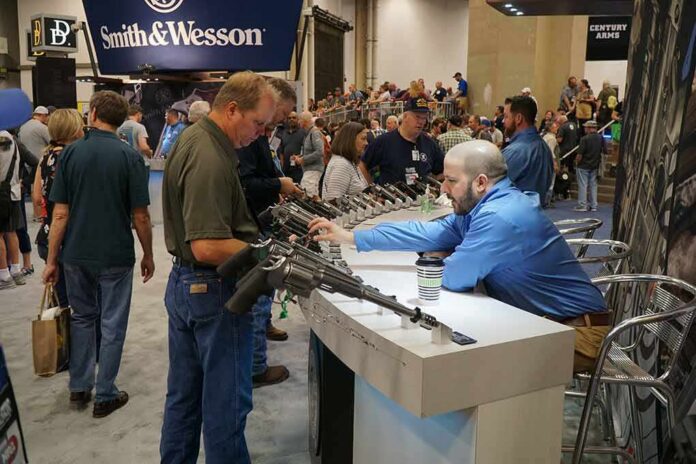
At a crowded Columbia gun show, a routine security detail turned lethal when a patron opened fire on a deputy; the deputy returned fire and killed him, ending the threat in seconds and setting in motion the well-worn machinery that evaluates police use of deadly force in America.
At a Glance
- Authorities say a patron fired on a Lexington County deputy working security at the Jamil Temple during a South Carolina Arms Collectors Association event; the deputy returned fire and killed the shooter.
- The deputy was shot and taken into surgery; officials described his condition as stable, confirming a live-fire exchange rather than a disputed discharge.
- The deceased was identified by the coroner as 34-year-old Telvin Pierre Portee, who died at the scene.
- Investigators reported no ongoing threat after the exchange and referred the case to the South Carolina Law Enforcement Division under standard protocol.
What Happened: A brief, violent exchange inside a public venue
During a South Carolina Arms Collectors Association gun and knife show at Columbia’s Jamil Temple, a Lexington County deputy providing event security was shot by a patron identified as Telvin Pierre Portee, 34, according to the sheriff’s department and the county coroner. The deputy returned fire and fatally wounded Portee; he died on scene. The deputy was transported for surgery and was reported in stable condition afterward, an independent indicator that the incident was a live gunfight rather than an inadvertent or contested discharge. Officials emphasized there was no continuing danger to attendees or the public following the exchange, consistent with a contained event halted by immediate return fire.
The scene—large indoor halls, dense foot traffic, and numerous private vendors—complicates both risk and response. Security at such shows focuses on ingress rules, prohibited handling, and incident containment inside a space with abundant firearms present but typically rendered non-operational for display. When a live round enters that environment, the calculus compresses to seconds. Accounts from Lexington County authorities uniformly state the patron fired first; the deputy’s responsive use of deadly force ended the threat and secured the venue.
How such incidents are evaluated: the Fourth Amendment’s reasonableness test
Officer-involved shootings are judged by a reasonableness standard grounded in the Fourth Amendment. Two Supreme Court decisions frame nearly every analysis. In Tennessee v. Garner, the Court limited deadly force against a fleeing suspect to circumstances where an officer has probable cause to believe the suspect poses a significant threat of death or serious physical injury to the officer or others. Graham v. Connor refined the inquiry: the force must be objectively reasonable in light of the facts and circumstances confronting the officer, judged from the perspective of a reasonable officer on the scene, not with 20/20 hindsight.
Applied here, the dispositive question is straightforward: did the deputy have an objectively reasonable basis to use deadly force at the moment he fired? The sheriff’s department’s account—patron shoots and wounds deputy; deputy returns fire—maps directly onto the core of Garner and Graham. An assailant who has already discharged a weapon at an officer presents an immediate and significant threat; deadly force in response is broadly considered reasonable within constitutional doctrine and police training, even if subsequent forensics refine details such as distance, angles, or round counts.
The facts available now: what is established and what follows procedure
Several points are established by official statements and corroborated local reporting. First, the deputy was struck by a gunshot and required surgery, which strongly anchors the claim that a firefight—not merely a display or negligent handling—occurred. Second, Portee was pronounced dead at the venue and identified by the coroner, a necessary step before public naming. Third, the venue and sponsoring association are specific and consistent across reports: the Jamil Temple in Columbia during a South Carolina Arms Collectors Association event. Fourth, authorities declared no ongoing public threat after the shooting, aligning with a contained, two-party exchange stopped on scene.
What follows procedural norm is equally clear. The Lexington County Sheriff’s Department requested the South Carolina Law Enforcement Division (SLED) to lead the investigation—a common handoff designed to separate an agency’s internal interests from evidence collection and to standardize scene processing, witness canvassing, and forensic workup. That referral does not imply suspicion; it ensures the investigative record—body camera or venue video if available, autopsy and ballistic analysis, weapon function tests, and dispatch logs—can support any eventual prosecutorial review within the state’s use-of-force framework.
Why the setting matters: gun shows, security posture, and risk in compressed time frames
Gun shows operate under venue rules that typically require firearms brought by patrons to be unloaded and often tagged or zip-tied to inhibit function; vendors similarly secure displayed firearms. Security staff—sworn deputies or off-duty officers—police handling, investigate disputes, and act as immediate response in the rare event a weapon is fired. The environment is paradoxical: there are many firearms present, but live ammunition use is prohibited and safety practices are codified by promoters and local law. When a rule-breaking patron brings an operable firearm into that setting and fires it, the protective envelope collapses quickly; the deputy’s first tasks are to stop the shooter, protect bystanders, and prevent a cascade of crossfire in a space with limited cover and narrow aisles.
In practice, a deputy’s defensive engagement at arm’s length or down a short aisle will favor rapid, aimed strings of fire to immediate incapacitation. The doctrine is to neutralize a lethal threat swiftly to prevent additional casualties—a standard reflected in both training syllabi and the case law’s focus on imminent danger rather than perfect tactics reconstructed after the fact.
A suspect who died after shooting at a Lexington County deputy working security at this weekend’s South Carolina Arms Collectors Association gun show has been identified. pic.twitter.com/NPD5DHSdEn
— KNOP News 2 (@KNOPNews2) November 16, 2026
What comes next: investigation, legal review, and public accounting
SLED’s inquiry will assemble a timeline anchored by dispatch records and medical findings, collect venue and nearby surveillance footage if available, and reconcile witness accounts with physical evidence such as casings, projectile recovery, and strike patterns. The coroner’s autopsy will document Portee’s wounds and trajectories; the deputy’s medical file will detail injury mechanics. Together, those elements allow investigators to determine range, positioning, and sequence of shots with professional confidence. Prosecutors then apply the Graham reasonableness test and Garner’s threat standard to the established facts to reach a use-of-force determination.
Why it matters: clarity about force in moments that can’t be slow-walked
Most public spaces depend on a simple social contract: when a lethal threat appears, the first capable responder stops it. Inside a gun show—ironically one of the most rules-bound firearm environments—that responsibility often falls to sworn security. The Lexington County shooting, as described by authorities, is the textbook case the law anticipates: an officer under fire responds with deadly force to end an active lethal threat. The legal standards exist precisely for these compressed decisions, and the investigative machinery exists to make the explanation hold up not just in the moment, but on paper, in court, and for the community that expects both safety and accountability.
Sources:
nypost.com, us.cnn.com, apnews.com, mdjonline.com, coasttv.com, panhandle.newschannelnebraska.com, myrtlebeachonline.com