
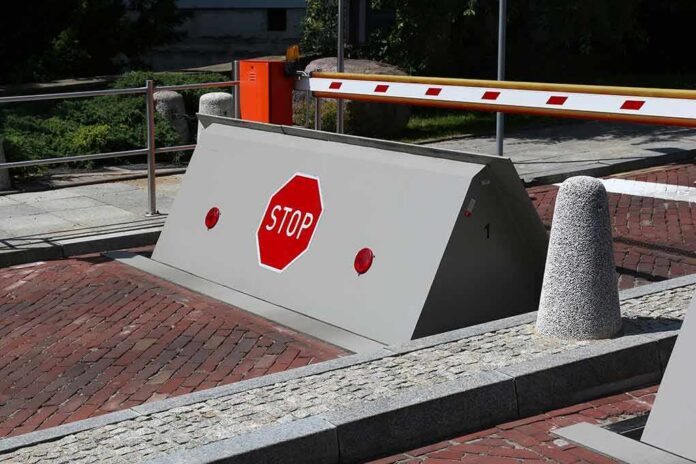
Across UK cities, the spread of portable anti‑ram barriers is the clearest physical sign that vehicle‑ramming has been built into everyday security planning, not as an abstract fear but as a routinely managed threat in crowded public spaces.
Key Points
- Portable anti‑ram barriers are now standard kit for protecting “soft targets” such as beaches, markets, and festivals from vehicle‑as‑a‑weapon attacks.
- The Nottingham Beach installation shows how local authorities blend routine event management with formal hostile vehicle mitigation guidance.
- Modern barriers are engineered systems: impact‑tested, rated, and designed to stop or deflect heavy vehicles at urban speeds.
- National guidance treats temporary barriers as part of an established security discipline, shaping how cities balance openness with protection.
Hostile Vehicle Mitigation Moves From Exceptional to Routine
What once looked like extraordinary counter‑terror infrastructure is increasingly embedded in the visual grammar of British city life. Hostile vehicle mitigation—using engineered obstacles to prevent vehicles being used as weapons against crowds—has shifted from specialist concern to standard guidance in the UK’s protective security regime. Official documents from the National Protective Security Authority now list crash‑rated bollards, vehicle barriers and controlled stand‑off distances as core measures against “vehicle as a weapon” attacks, a formulation that treats vehicle‑ramming as a defined threat category to be planned for in advance rather than responded to after the fact.
The Nottingham Beach event illustrates this normalization clearly. The annual artificial beach in Old Market Square, a family‑oriented summer attraction drawing dense footfall in the city centre, opened behind a line of Husson H‑Stop portable barriers—bright red units placed across main approaches to stop hostile vehicles entering the crowd space. Councillor Neghat Khan, leader of Nottingham City Council, described them publicly as an “additional safety measure” advised by a multi‑agency events safety group that included counter‑terrorism specialists, framing the barriers not as a panic response but as prudent adherence to established risk guidance.
How Modern Anti‑Ram Barriers Work
To understand why these installations are spreading, it helps to look at the engineering philosophy behind them. Modern anti‑ram barriers are not simply heavy objects placed in the road; they are purpose‑designed systems to manage kinetic energy—energy of motion—under controlled failure modes. The Husson H‑Stop units used in Nottingham are rated to halt a truck of around three and a half tonnes at roughly 30 miles per hour, a typical urban impact scenario for a deliberate ramming attempt. They achieve this not by being immovable, but by tilting upward when struck, forcing the vehicle to climb and scrub off speed through friction and disruption of its trajectory rather than allowing a clean, horizontal impact.
This approach reflects a broader technical evolution. Guidance to designers and specifiers distinguishes between permanent, semi‑permanent and temporary barriers, with each expected to meet defined performance standards under test. In the UK, documents used by security professionals emphasise that only barriers which have passed proper impact testing should be deployed in hostile vehicle mitigation schemes. For temporary barriers—exactly the kind seen at events and pop‑up attractions—the recommended standard is not a single crash test but a combination of high‑speed impact and repetitive ramming tests, ensuring that they can withstand multiple strikes and still maintain protective performance.
The physics is straightforward but unforgiving. A vehicle of 1,800 kg travelling at 30 mph carries enough kinetic energy to cause catastrophic harm if allowed to enter a pedestrian space unchecked. Specifications such as ASTM F2656 or similar defence standards in other jurisdictions rate barriers in terms of the vehicle mass and speed they can successfully stop. In practice, this means designers match barrier ratings to credible threat vehicles in a given environment—light vans, heavy SUVs, or small trucks—so that the mitigation is proportionate, neither under‑engineered nor excessively disruptive.
From Ram‑Raid Protection to Crowd Safety
The anti‑ram concept did not originate with crowd protection; it emerged first from efforts to curb ram‑raids—vehicle attacks against shopfronts and ATMs in the context of organised theft and, later, terrorism. British Standards such as PAS 68 (impact test specification for vehicle security barrier systems) and PAS 69 (guidance on barrier selection) were developed in response to escalating threats from violent theft and terrorist use of vehicles to breach perimeters. These standards created a shared language for manufacturers, insurers and security planners: a bollard or barrier is no longer just “strong,” but demonstrably rated under controlled test conditions.
As public‑space vehicle attacks entered the global consciousness—most visibly after high‑profile incidents on bridges, promenades and markets—the same toolset was redeployed to protect pedestrians. Anti‑ram bollards, once associated primarily with stopping trucks from smashing through roller shutters, now line pavements and plaza perimeters. Technical bulletins describe steel cylinders anchored in deep concrete foundations as a way to prevent vehicle passage entirely, and portable units to manage transient risk where permanent construction is impractical. In effect, the technology migrated from the edges of commercial buildings into the centre of civic life.
Temporary Barriers and the Logic of “Soft Target” Protection
The Nottingham installation is a textbook example of protecting what security professionals call a “soft target”—a crowded, open, civilian environment with little natural physical protection. Companies specialising in event security describe portable anti‑ram barriers as movable stopping systems that both prevent unauthorised vehicle access and maintain safe pedestrian flow, explicitly tailored for festivals, stadium perimeters, markets and other temporary venues. They are modular, allowing planners to create chokepoints, secure perimeters, or vehicle‑screening lanes on demand, then remove them when the event ends.
Protective guidance reinforces this operational logic. Documents aimed at UK practitioners advise that hostile vehicle mitigation is not a one‑off installation but a scheme: an integrated design that considers approach speeds, street geometry, emergency access and the behaviour of crowds under stress. The question is rarely “should there be a barrier at all?”; rather, it is “which barrier, to what standard, in what configuration, for which threat profile?” In crowded urban centres, where pedestrian density is high at predictable times, the case for some form of mitigation has become compelling enough that it is now built into routine safety briefings, as Nottingham’s multi‑agency group shows.
The Visual Politics of “Diversity Barriers”
Not all commentary on this shift is technical. Critics have coined the phrase “diversity barriers” to describe the spreading anti‑ram installations, tying their presence to debates about migration, terrorism and social cohesion. From an engineering and policy standpoint, however, the barriers themselves do not encode the cause of the threat; they only express the acknowledgement that vehicle‑ramming is a credible risk worth mitigating in places where crowds gather. Official guidance and local authority statements frame them in strictly functional terms: hostile vehicle mitigation, vehicle‑as‑a‑weapon protection, additional safety measures.
For residents and visitors, the more immediate experience is aesthetic and psychological. Event organisers such as James Mellors, responsible for Nottingham Beach, concede that these units “don’t look very pretty,” but emphasise that in high‑footfall spaces “it’s not always about how things look, it’s about keeping people safe.” That trade‑off—between visual openness and perceived security—is now a familiar part of urban life. Just as CCTV cameras moved from novelty to background infrastructure, anti‑ram barriers are following a similar trajectory: at first conspicuous, then increasingly taken for granted as part of the built environment.
Designing Cities That Are Both Open and Defended
The deeper challenge for planners is not whether to use hostile vehicle mitigation, but how to integrate it without turning public squares into fortified compounds. Contemporary design practice often tries to disguise permanent barriers as street furniture—planters, benches, art installations—while temporary units are chosen for colour and form that signal safety rather than crisis. The Husson H‑Stop barriers in Nottingham, for example, are brightly coloured and arranged to read as event infrastructure as much as security hardware.
As ethnic and cultural diversity in England and Wales has increased over recent decades, research shows that neighbourhood segregation has declined, with more people living alongside neighbours of different backgrounds and cities emerging as “rainbow” towns. That social reality interacts with security planning indirectly: crowded, mixed, lively urban spaces are both a sign of vitality and, by definition, soft targets. It is therefore unsurprising that protection strategies focus on the physical mechanics of attack—vehicle speed, mass, approach routes—rather than on demographic narratives. The barriers do not police who is present; they simply constrain how a vehicle can move through space.
Where This Leaves UK Cities
Looking ahead, the trajectory is clear. As long as vehicle‑ramming remains a recognised method of attack, UK cities will continue to harden the approaches to their busiest public spaces through a mix of permanent bollards and temporary event barriers. Guidance will tighten around tested standards, multi‑agency event safety groups will include counter‑terror specialists as routine participants, and manufacturers will iterate on designs that stop heavier vehicles at higher speeds while minimising visual intrusion.
For citizens, the presence of anti‑ram infrastructure will likely become as unremarkable as the fire exits and emergency lighting that surround them already—visible, occasionally inconvenient, but ultimately accepted as part of the invisible engineering that makes dense urban life possible. The Nottingham Beach barriers are not an outlier; they are a local expression of a broader security mindset in which vehicle‑ramming is treated as a normalised hazard to be engineered against, rather than an aberration to be ignored until it happens again.
Sources:
bandlshutters.co.uk, bbc.co.uk, youtube.com, tymetal.com, bbc.com, protectuk.police.uk, blacksp.com, deltascientific.com