
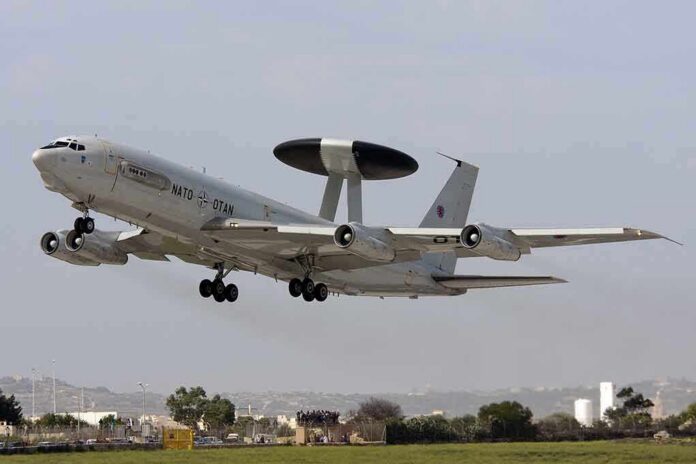
Deterrence in the Baltic has shifted from the visible geometry of fighter patrols to the invisible physics of the electromagnetic spectrum—and nothing telegraphed that shift more clearly than NATO’s recent air package that put the U.S. Air Force’s new EA-37B Compass Call on station just west of Kaliningrad.
At a Glance
- NATO massed a complex air package along the Kaliningrad frontier that included fighters, AWACS, tankers, and the EA-37B electronic warfare aircraft.
- The EA-37B’s presence signals the centrality of electromagnetic warfare—jamming, deception, and signals intelligence—in any high-end fight in the Baltic theatre.
- Open-source flight tracking and allied officials confirmed the package’s scope; the aircraft remained outside Russian airspace while operating near the exclave.
- This activity fits a durable pattern: rehearsing integrated operations while communicating that Kaliningrad’s anti-access network can be mapped, managed, and, if required, disrupted.
What Happened: A High-End Package at the Edge of Russia’s Baltic Fortress
NATO executed a large, U.S.-led air operation arrayed along Poland and the Baltic approaches to Kaliningrad, Russia’s heavily militarized exclave on the Baltic Sea. The package combined U.S. and Norwegian fighters, a NATO E-3A Sentry AWACS for airborne command and control, Airbus A330 MRTT tankers for endurance, and—crucially—the EA-37B Compass Call, the U.S. Air Force’s newest dedicated electronic warfare platform. Open-source trackers and allied officials described dense orbits over northeastern Poland and the Baltic, with the EA-37B staging from Souda Bay to Powidz, Poland, and then holding west of Kaliningrad for roughly two hours; the aircraft did not enter Russian airspace.
Allied framing was straightforward: this was complex, planned training to refine interoperability and rehearse the command-and-control architecture required for a contested air environment near NATO’s northeastern flank. The mix of assets—fighters, AWACS, tankers, and specialized intelligence and electronic-warfare aircraft—mirrors the force composition any serious operation would demand in the Baltic, where dense Russian air defenses, coastal missiles, and overlapping sensors create a classical anti-access/area denial (A2/AD) problem set.
Why the EA-37B Matters: The Spectrum Is a Battlespace
The EA-37B Compass Call is a modernized successor to the EC-130H line, built to contest the electromagnetic spectrum at range. In practice, that means three functions that count in the Baltics. First, electronic attack: disrupting or degrading adversary communications, data links, and certain radar-dependent kill chains. Second, electronic support: collecting, classifying, and geolocating emissions to build an order of battle and expose how an integrated air defense system actually behaves under stress. Third, command-and-control attack: introducing friction into the decision loops that bind sensors to shooters. Put simply, it aims to fracture an enemy network at the speed of signal.
Operating alongside an E-3 AWACS and other intelligence platforms, the EA-37B turns a training orbit into a live laboratory, recording how Russian systems in and around Kaliningrad light up in response to the package’s presence, which waveforms are used, how handoffs occur between nodes, and where choke points exist. That is not glamour; it is groundwork. You do not solve an A2/AD problem with a single missile volley—you solve it by understanding the plumbing of the opponent’s network well enough to unthread it quickly when it counts.
Kaliningrad’s Military Geography: Strengths, Limits, and Signaling Value
Kaliningrad is both strong and fragile. It hosts layered surface-to-air systems, coastal defense missiles, and assets from Russia’s Baltic Fleet; on a map, that architecture projects overlapping threat rings across much of the southern Baltic. But Kaliningrad is also an exclave—geographically isolated from mainland Russia and ringed by NATO states—which complicates reinforcement and sustainment in a crisis. For NATO planners, that combination invites a dual message: we see your network, and we can reach inside it. Exercises that put AWACS, tankers, strike fighters, and specialized EW platforms in coherent orbits near the enclave rehearse the coordination required to do exactly that under combat conditions.
The choice of assets underscores the point. Tankers extend dwell time; AWACS fuses the air picture; the EA-37B pressures the enemy’s communications and sensing lattice; fighters demonstrate the escort and strike components that would ride on the back of a successful spectrum fight. Observers noted roughly two dozen or more aircraft cycling through the mission, highlighting the scale at which NATO intends to operate in the theater and the premium it places on sustained presence rather than touch-and-go shows of force.
How These Packages Work: Mechanisms of a Modern Baltic Rehearsal
Integrated air operations of this sort follow a choreography. Tankers preposition on tracks outside threat envelopes. An AWACS establishes the backbone for airspace control and threat reporting. Fighters push to the edge of defended zones, testing timelines and responses, often flying racetrack patterns that generate repeated stimuli. Electronic warfare platforms like the EA-37B time their effects to map and, if directed, complicate adversary command-and-control. Meanwhile, other intelligence aircraft—manned or contractor-operated business jets—hoover up emissions, providing the raw material for pattern analysis and future suppression of enemy air defenses (SEAD) planning.
Even when billed as training, the outputs are operationally consequential: refined electronic order-of-battle libraries, validated tanker flow models, clearer estimates of munitions expenditure for SEAD/DEAD (destruction of enemy air defenses) campaigns, and better allied muscle memory for cross-border command relationships. That explains why allies described the event as planned and defensive, while still selecting Kaliningrad’s approaches for the evolution—the geography forces the right problems onto the table.
Competing Readings of the Same Flight Lines
Because the activity occurred in international airspace and involved routine alliance assets, NATO cast it as interoperability training. Russian-aligned outlets predictably characterized the same package as a provocation or a rehearsal for strikes against Kaliningrad. Both readings are familiar; the Baltic air domain has long been a zone where signaling and readiness overlap. What matters for analysis is not the rhetoric but the capability mix and the behavior it trains: EW-led penetration, persistent surveillance, and coordinated control of a crowded battlespace. In that sense, the EA-37B’s cameo is the headline—not as an outlier, but as the new normal for serious deterrence in a spectrum-contested theater.
There is a narrow caveat to keep terms straight: while reporting and officials corroborated the aircraft and the package, no public mission order spelled out a task to “probe” or “disrupt” Russian systems. The logic of the assets and the venue suggests those objectives implicitly; the published record confirms presence, composition, and profiles flown.
A few days ago, on August 18, 2026, NATO conducted a major, planned air exercise in the Polish-Baltic region near the Russian exclave of Kaliningrad and the strategically sensitive Suwalki Gap.
Here are the exact details regarding the participating units, nations, equipment, and…— US.Germany.Czech (@USczechia) August 22, 2026
What It Means Going Forward: Deterrence by Network Competence
The lesson is not simply that NATO can mass jets near Kaliningrad; it is that the alliance is investing in the competence to fight as a network in the most unforgiving part of Europe’s airspace. That competence rests on three pillars. First, persistent sensing and cataloging of adversary emitters—every training sortie near the enclave makes the library better. Second, repeatable command-and-control under pressure—AWACS, datalinks, and common procedures that make a 25-ship package behave like a single organism. Third, spectrum offense—platforms like the EA-37B that can impose losses on the enemy’s decision-making architecture before a kinetic strike is ever cleared hot.
None of this guarantees crisis stability; it does change the calculus. For Moscow, the message is that Kaliningrad’s A2/AD umbrella can be characterized and, at need, penetrated. For NATO capitals, the exercise validates that the alliance can scale complex operations rapidly on the northeastern flank and sustain them with tankers and airborne C2. For the public, the visible contrails are the least important part of the story. The decisive moves are the ones you cannot see—the waveforms recorded, the circuits mapped, and the options expanded should deterrence fail.
Sources:
migflug.com, twz.com, militarnyi.com, en.sedaily.com, united24media.com, x.com, armyrecognition.com, en.iz.ru