
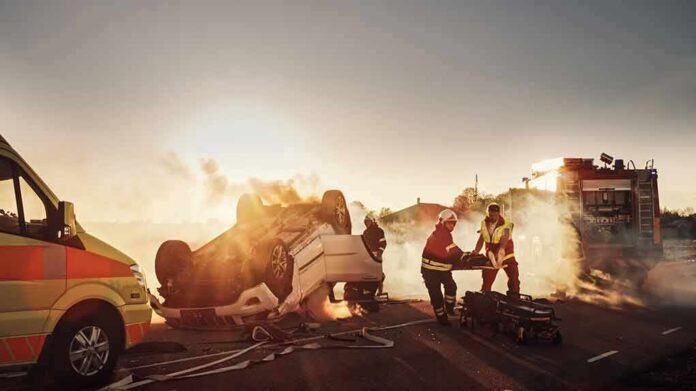
When an SUV carrying two young children plunged 20–25 feet off Coffey’s Cliff in Chattanooga, investigators said the crash wasn’t a mystery of bad luck; it was the foreseeable end of a short drive that continued past a dead end, down a dirt path, and over an embankment—with a driver they concluded was extremely impaired and children injured in the wreck.
The Short Version
- Arrest records place the mother behind the wheel of a 2020 Honda CR‑V that left a dead-end street, traveled onto a dirt path, and went over Coffey’s Cliff, landing by railroad tracks.
- Investigators documented slurred speech, a strong odor of alcohol, combative behavior with medics, and wine bottles inside the SUV; the affidavit concluded impairment was a major factor.
- One child suffered a fractured forearm and pulmonary contusions; authorities charged the driver with DUI, child neglect, child abuse and neglect, and vehicular assault.
- The case sits within a broader public-safety reality: roughly one-fifth of U.S. child traffic deaths occur in crashes involving an alcohol-impaired driver.
What investigators say happened at Coffey’s Cliff
According to the arrest affidavit as reported by local outlets, the Honda CR‑V traveled west on Stuart Street, reached a dead end, continued down a dirt path, and went off Coffey’s Cliff, falling approximately 20–25 feet before coming to rest upside down near railroad tracks. First responders extricated the occupants. The driver—identified in coverage as the children’s mother—was cited in the affidavit as the person behind the wheel at the time of the fall. The physical consequences were severe: one child was hospitalized with a fractured forearm and pulmonary contusions, injuries consistent with a high-energy rollover and secondary impacts in a confined cabin space.
From a crash-reconstruction lens, the path described—dead end to dirt spur to cliff—suggests a sustained failure to recognize or respond to conspicuous cues in the driving environment. Even at modest speeds, going beyond the terminus of a roadway and onto an unimproved path requires multiple seconds of continued throttle or coasting, during which a sober, attentive driver would typically brake, steer off-line, or stop. The affidavit’s narrative does not read like a split-second misjudgment; it reads like a chain of missed decisions culminating in an unsurvivable trajectory.
Indicators of impairment and the charging decision
Investigators documented multiple contemporaneous indicators of alcohol impairment: slurred speech, a strong odor of an alcoholic beverage, and combative behavior with medics—classic signs that field officers and emergency clinicians are trained to recognize. Reported inventory of the passenger compartment recorded an empty wine bottle and another unopened, cold bottle—details that, taken with observations of the driver, reinforced the working conclusion of recent consumption. The arrest affidavit reportedly states in unambiguous language: the driver’s “ability to operate a motor vehicle was extremely impaired and was a major contributing factor in the crash.”
Hamilton County authorities charged the driver with DUI, two counts of child neglect, child abuse and neglect, and vehicular assault, and set bond at $10,000. Those counts track the alleged conduct and harm: DUI for impaired operation, child neglect and abuse linked to placing minors at risk as passengers, and vehicular assault tied to serious bodily injury arising from the incident. The legal structure matters. Vehicular assault in Tennessee hinges on proof that intoxication proximately caused serious bodily injury; child neglect and abuse turn on endangerment and harm to minors under a caregiver’s duty. On the facts reported publicly, prosecutors aligned their charging language with the elements those statutes require.
Mechanism, not mystique: why this crash pattern is so dangerous
Driving impairment degrades three functions that matter most when roads end: hazard detection, judgment, and motor control. Alcohol delays the recognition that a roadway is terminating, erodes the judgment needed to slow or stop decisively, and blunts the fine steering inputs that prevent a tire from climbing a soft shoulder or continuing onto an unengineered path. Once a vehicle leaves a graded surface, the physics turn quickly. Mass, angle, and vertical drop compound, and modern occupant-protection systems are optimized for forward impacts, not inverted falls onto uneven ballast beside rail lines. That mismatch helps explain why a 20–25 foot drop can yield fractures and pulmonary injuries even when seatbelts and airbags deploy.
The bottles in the cabin are not determinative on their own—containers are circumstantial evidence—but they are probative when paired with observed signs and crash conduct. In DUI investigations, officers look for converging indicators: driving pattern, personal demeanor, physical signs, and physical evidence. Here, the path beyond a dead end, the odor, the slurred speech, and the interior finds formed a coherent picture for charging. Forensic toxicology, when available, provides the objective anchor; until then, the law permits charges grounded in probable cause supported by trained observations and contemporaneous facts.
The wider public-safety frame: children and impaired drivers
Is this case anomalous? Sadly, no. National roadway data show a durable and troubling pattern: about one in five child traffic fatalities in the United States occur in crashes involving at least one alcohol-impaired driver. The Centers for Disease Control and Prevention has also reported that when children die in crashes tied to alcohol-impaired drivers, they are more likely to have been unrestrained than in crashes without impairment—a compounding risk that turns a bad decision into a catastrophic outcome. Statistics don’t adjudicate individual guilt, but they do explain why police, prosecutors, and child-welfare systems treat suspected DUI with children on board as an urgent public-safety problem rather than a private lapse.
The Chattanooga cliff crash fits that risk profile with precision: a caretaker behind the wheel, young passengers, a driving path inconsistent with safe operation, and injuries that elevate the matter from traffic offense to felony-level harm. Communities understand this intuitively—hence the visceral reaction when children are involved—and the data justify that intuition.
What accountability and prevention look like
Accountability proceeds on two tracks. The criminal case tests the government’s allegations against legal standards: proof of impairment, causation, and endangerment. That process runs through evidentiary rulings and, if not resolved by plea, trial. Separately, child-safety systems assess ongoing risk to minors and support recovery from injury and trauma. Even one rollover with injuries can precipitate a lifetime of pulmonary vulnerability or orthopedic complications; pediatric follow-up is not just compassionate, it is medically prudent.
Prevention is more prosaic and more powerful. Impaired driving with children in the car is a preventable event: designate a sober driver before the first drink, use rideshare or taxis, and maintain child restraints correctly on every trip, no exceptions. The barrier is not technology; it is decision-making under social pressure and routine convenience. Communities that pair consistent enforcement with unglamorous supports—safe-ride programs, childcare options that don’t require a late-night pickup, and relentless messaging that riding with an impaired driver is never acceptable—see better outcomes. Data-driven checkpoints and swift license consequences for DUI with minors onboard sharpen the incentives and save lives.
🚨 Meet Chase Ryan Klinedinst – Another Possible Lindsay Clancy Copycat
Chase Ryan Klinedinst is a 30-year old mother from Chattanooga, TN, who was just recently arrested and charged after allegedly driving an SUV off a cliff while intoxicated with her two young children inside.… pic.twitter.com/5RALFWHBOw
— A New Wave Right (@ANewWaveRight) October 14, 2026
One final caveat, and why the core facts still matter
In many DUI cases, laboratory toxicology arrives after the first wave of reporting; that does not blunt the core public-safety lesson captured here. The probable-cause foundation—crash path over a cliff after a dead end, observed signs of impairment, injured children, and interior alcohol containers—is precisely the scenario the law is designed to interrupt. When a vehicle carries children, the margin for error vanishes. The cliff is unforgiving; so is physics.
Sources:
nj.com, local3news.com, noticias.foxnews.com, ground.news, idahonews.com