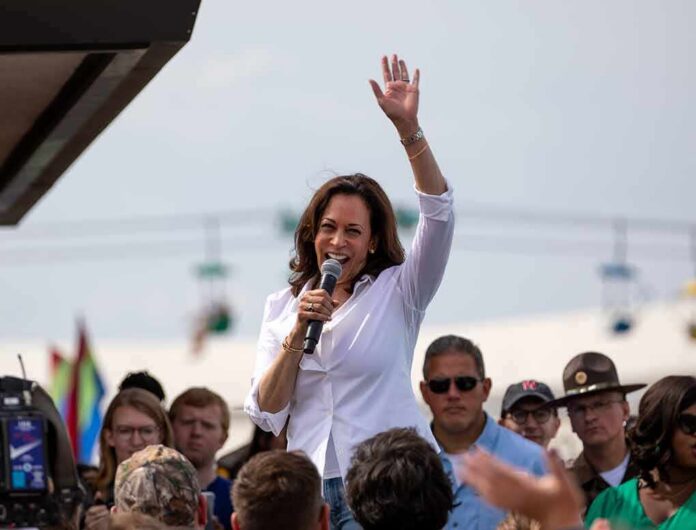
The power of a political endorsement is rarely about moving raw vote share; it’s about who can credibly signal party alignment, unlock money and media, and avoid becoming a liability where local conditions punish national brands. Kamala Harris’s recent endorsement record illustrates that truth in full.
The Short Version
- Harris’s endorsements are real interventions: statements, fundraising pushes, and voter-contact tools that campaigns actively deploy when they judge the benefits outweigh the risks.
- In several competitive Senate contests, Democrats treated her backing as establishment validation and fundraising fuel; in others, candidates kept their distance, reading their states as inhospitable to a polarizing national figure.
- The research consensus: endorsements act as elite cues and attention engines, not guaranteed vote boosters; effects are context-dependent, often short-lived without reinforcement.
- The right frame is not “always an asset” or “pure liability”; it’s strategic selectivity—where, when, and how to use the brand.
What endorsements actually do in modern campaigns
Endorsements operate through three main channels. First, they provide elite cues—shortcuts that help partisans and loosely engaged voters infer ideological fit and party unity. Second, they mobilize resources: a well-placed statement can catalyze small-dollar contributions, volunteer sign-ups, local media coverage, and list-building. Third, they shape narratives—“establishment confidence” or “too controversial”—that can either stabilize a candidacy or offer opponents fresh attack lines. Political science bears this out: endorsements affect attitudes and sometimes vote intent, but the direction and magnitude depend on the endorser’s credibility, perceived alignment with the electorate, and media environment; effects often decay unless campaigns convert the burst of attention into field and fundraising gains.
On that terrain, Harris’s activity is legible. When she endorses, campaigns tend to distribute and translate the signal into direct voter contact or money calls. That’s not incidental; it’s the practical use case endorsements are built for.
Harris’s recent pattern: targeted, operational endorsements
Consider Texas. Harris didn’t just sign a press release; she recorded a robocall for Jasmine Crockett ahead of a competitive Democratic Senate primary, telling voters Texas could send “a fighter” to the Senate. Robocalls are transactional tools—cheap per-contact and effective at delivering a recognizable voice to a targeted list. Campaigns only commission or accept them from high-profile surrogates when they anticipate a net positive with primary electorates and donors; Crockett’s team circulated the message and reporters framed it as notable establishment support that could calm electability worries among Democrats.
In Maine, Harris endorsed Troy Jackson immediately after his nomination and amplified the appeal via fundraising email—precisely the channel optimized for small-dollar conversion within hours of earned-media spikes. The Associated Press summarized the move as an explicit effort to rally Democrats around a crucial Senate contest, a predictable step when a national figure seeks to stabilize a ticket and mobilize in-cycle resources. In Michigan and New Hampshire, she cast endorsements for Abdul El-Sayed and Chris Pappas in terms of building a Democratic Senate majority and confronting rising costs and Washington corruption—issue-framed cues that campaigns can reuse across ads, emails, and surrogacy kits.
Where the limits show: selective distancing and the red-state problem
Endorsement value is not universal. In Alaska, Mary Peltola’s campaign publicly said it was not seeking Harris’s support and had not approved a related appeal—a clear signal that, in that electorate, national Democratic branding risked more harm than help. Broadly, reporting in this period documents Democrats in conservative states telegraphing that they did not want Biden or Harris in their races, citing the need to court independents and moderate Republicans who saw the national ticket as a liability. These are not stray anecdotes; they match decades of campaign practice in polarized environments, where candidates run “off-brand” to preserve local viability.
Even inside the party, elites telegraphed caution about overexposure. Some donors and strategists described Harris as a liability in tough states; others urged avoiding signals that looked like a preordained national standard-bearer, preferring visible process over coronation. Those judgments, whatever one makes of their tone, are strategic assessments about fit and timing, not factual refutations that her endorsements exist or lack utility where aligned.
How to read mixed signals without manufacturing a false binary
Two things are simultaneously true. First, campaigns that welcomed Harris’s help treated it as useful currency—emailable text, a recognizable voice for calls, and a validator headline. Texas, Maine, Michigan, and New Hampshire all featured endorsements that were quickly operationalized into voter contact or fundraising appeals. Second, in places where national Democrats poll poorly, candidates either kept their distance or declined help, and coverage emphasized the optics of a polarizing brand. That divergence doesn’t mean she is “forced to admit” Democrats are “better off without her”; it means professional campaigns do what they always do—optimize endorsements to local incentives and avoid imports that complicate coalition-building.
The research lens helps adjudicate the rhetoric. Endorsements are most effective with in-party or unaligned voters seeking cues; they are least effective, even counterproductive, when the endorser’s brand is cross-pressured against local ideology or salient grievances. Effects can be positive, neutral, or negative depending on that match—and they dissipate unless converted into field activity or fundraising momentum. Reading the Harris record through that model explains both the enthusiastic deployment in some states and the studied distance in others.
What evidence would settle questions about causal lift
The present record documents that endorsements occurred and were used, but it offers little about causal lift—no clean before-and-after spikes in small-dollar donations attributable to a single email, no voter-file analyses tying call universes to turnout changes, no swing-region polling showing movement on favorability among target blocs. To evaluate effects rigorously, you would want post-endorsement ActBlue and FEC-mapped inflows within 24–72 hours, campaign CRM logs on volunteer sign-ups, and randomized contact experiments measuring persuasion or mobilization in targeted precincts—all standard analytics in modern campaigns, seldom public. Until such data surface, the honest read is functional: Harris’s endorsements are tools with demonstrated deployment in select races, while strategic non-use elsewhere reflects local constraints rather than a universal indictment.
Practical implications for campaigns and observers
For campaigns, the rule is simple: pull the lever when the coalition payoff exceeds the backlash risk. Use the endorser’s assets—name recognition, mobilizing message, donor reach—in channels you can measure (email, SMS, calls), and convert the earned-media bump into bankable resources within days. For observers, stop treating endorsement stories as personality verdicts. Instead, ask three questions: Is the electorate aligned with the endorser’s brand? Is the campaign operationalizing the endorsement beyond a headline? And is there any traceable movement in money, manpower, or message penetration afterward? Those answers, not the temperature of national commentary, tell you whether an endorsement did real work.
Bottom line
Harris’s endorsement record is neither an unalloyed boon nor a standing embarrassment. It is a case study in how contemporary endorsements function: as selective, tactical instruments that create opportunities in friendly terrain and headaches in hostile ones. That’s not a flaw of the tool; it’s how the game is played—and why savvy campaigns keep one eye on the validator and the other on the map.
Sources:
redstate.com, wmur.com, boston.com, axios.com, upi.com, cnn.com, washingtonpost.com, ballotpedia.org, thehill.com, politico.com, nypost.com
(The Hill) Kamala Harris on some Democrats shunning her: “I would expect nothing less”
Former Vice President Kamala Harris said Thursday she was not surprised by some red-state Democrats not wanting her endorsement, arguing those candidates are doing what it takes to win.
“We…
— Politics & Poll Tracker 📡 (@PollTracker2024) September 3, 2026