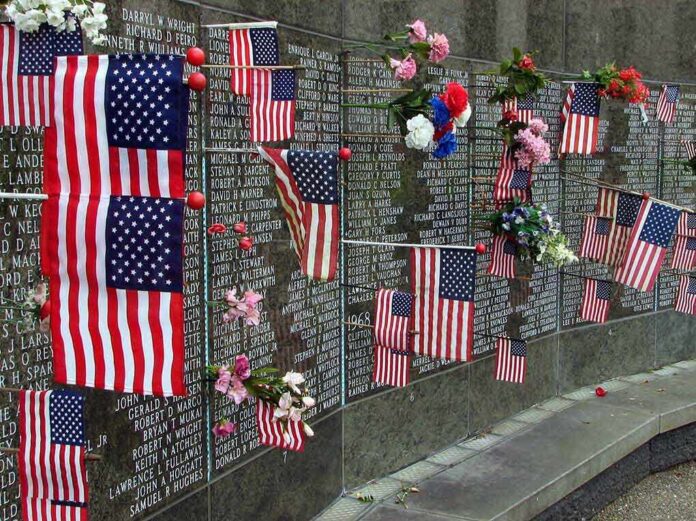
At Ground Zero, the real power of September 11 commemoration has never been who speaks, but who bears witness; that is why the recurring fights over which elected officials should attend misread the ceremony’s design and the civic function it serves.
At a Glance
- The 9/11 ceremony has, by longstanding practice, centered families reading names while elected officials attend as silent witnesses, not performers.
- Mayor Zohran Mamdani has stated repeatedly he will attend to honor victims, survivors, and first responders, aligning with that witness role.
- Petitions from some 9/11 families and retired officers seek to bar the mayor, arguing his presence would cause pain and distract from remembrance.
- Institutional custom and past precedent favor inclusive attendance without speeches; the debate reflects a broader struggle over who polices public memory.
The ceremony’s core architecture: families at the microphone, officials offstage
Since the early 2010s, organizers of the National September 11 Memorial ceremony have resolved a perennial problem—how to honor the dead without turning grief into politics—by drawing a bright line: family members read names; politicians do not give speeches. The resulting format is strikingly stable. Government leaders, from city hall to the White House, attend in a designated area to bear witness, but the mic belongs to the families. Contemporary coverage and institutional statements describe this as a deliberate, nonpartisan structure designed to keep the focus on remembrance rather than rhetoric. The point is not to exclude public officials; it is to neutralize their stagecraft.
That design choice does two things at once. It affirms that the state shows up—the nation remembers—without allowing any one official to commandeer the moment. And it diffuses cyclical partisan skirmishes by specifying a role for officials that is present yet quiet. Over time, this has matured into a civic custom: presidents, governors, and mayors appear respectfully, say nothing publicly, and leave the substantive expression to those who lost the most.
Mamdani’s stated intent fits the witness role, and the attendance norm is broad
Against that backdrop, Mayor Zohran Mamdani’s pledge to attend reads as continuity, not rupture. He has said he will “proudly honor the families, the survivors, the first responders” by standing alongside them at this year’s commemoration—a formulation consistent with the ceremony’s witness model rather than an attempt to insert himself into the program. His office reiterated the plan in the face of criticism, framing attendance as a matter of respect and solidarity, not a platform.
Coverage of past commemorations underscores that the presence of high officeholders—across parties and offices—has been routine within this non-speaking framework. Organizers and spokespeople have emphasized that officials attend across “the political spectrum” precisely to bear witness, not to deliver remarks; it is a design feature, not a loophole. In short, attendance as a quiet observer is the norm, not an indulgence. Arguing over whether a sitting mayor may be physically present misconstrues what presence means at Ground Zero.
The counterargument: pain, propriety, and the contested gatekeeping of grief
The sharpest objections are not procedural but moral: some 9/11 family members and retired Port Authority officers have petitioned to bar the mayor, contending that his public positions or associations conflict with the ceremony’s solemn purpose and would cause additional pain. Petition language captures the thrust—organizers should consider whether his participation “would align with the intention of the ceremony and the expectations of the families most directly affected”. The effort drew substantial signature counts across several weeks, a signal of real mobilization even as it cannot stand in for every family voice. The retired officers’ statement is blunter, warning his attendance would inflict “deep pain” on survivors and first responders.
These are genuine sentiments from people with standing in the community of loss, and they deserve to be heard straight. But as a governance matter, they raise a hard question that recurs in public-memory fights: who gets to define the boundary of belonging at a civic rite—particularly one intentionally structured to prevent any one faction, including officeholders, from dominating the proceedings? The ceremony’s architecture tries to reconcile two truths at once: the primacy of families’ voices at the microphone, and the state’s obligation to bear witness, physically present but silent.
Precedent and policy weigh toward inclusion with constraint, not exclusion
When institutions manage volatile remembrance—war memorials, national tragedies, sites of atrocity—the durable solution they adopt, again and again, is not personality screening but role definition. The Ground Zero ceremony’s family-centered program is precisely that kind of institutional guardrail. Reporting over the years describes it as nonpartisan by design, with officials attending regardless of ideology, and with the programming and microphones controlled apart from them. Everything about that schema argues for inclusion-with-constraints: invite the whole of the body politic to show up, keep the performative moves off the table, and let the families speak.
There is a practical wisdom here. Screening attendance based on petition-driven tests of worthiness would force organizers to become adjudicators of political legitimacy—the very posture the 2012 reforms were meant to avoid. By contrast, the witness model treats the presence of elected officials as a civic obligation, not a personal honor. It tells the grieving: your loved ones are remembered by the nation itself; and it tells the nation’s representatives: you may be here, but you may not make this about you.
How to hold the line: principles for future controversies
Three principles keep the ceremony true to its purpose. First, maintain the non-speaking rule for officials without exception; nothing invites politics back into a sacred space faster than a microphone. Second, be transparent about the protocol—who attends, where they sit, what they may and may not do—so that attendance cannot be spun as endorsement or betrayal. Third, acknowledge pluralism inside the community of loss. Petitions and statements make clear there is no monolithic “families’ view,” and prudence requires organizers to listen respectfully while upholding the institutional design that protects families’ primacy at the lectern and preserves the state’s duty to stand witness.
On that ground, Mamdani’s decision to attend as a silent observer is neither a provocation nor a privilege. It is participation in a civic ritual deliberately engineered to keep the focus where it belongs: on the names read aloud and the lives behind them. The hard work, for organizers and officials alike, is to keep that architecture intact when the pressure to turn mourning into a referendum inevitably returns.
Sources:
redstate.com, nypost.com, cityandstateny.com, foxnews.com