When a U.S. president says an adversary now faces “the easy way or the hard way,” that is not mere rhetoric; it is coercive statecraft in plain language, signaling that diplomacy and force are being weighed in the same breath — and that the choice Tehran makes will determine which tool Washington reaches for next.
At a Glance
- President Trump publicly framed Iran’s options as a binary — “the easy way or the hard way” — while stating he would soon decide on next steps.
- The remark came amid active U.S. policy deliberations and Pentagon assurances that military options remain on the table.
- The Strait of Hormuz remains the pressure point: even limited disruption reverberates through shipping, energy prices, and alliance politics.
- Both Washington and Tehran historically mix escalation signals with openings for talks; the leverage contest often runs through maritime risk and sanctions pressure.
What Was Said, and Why It Mattered
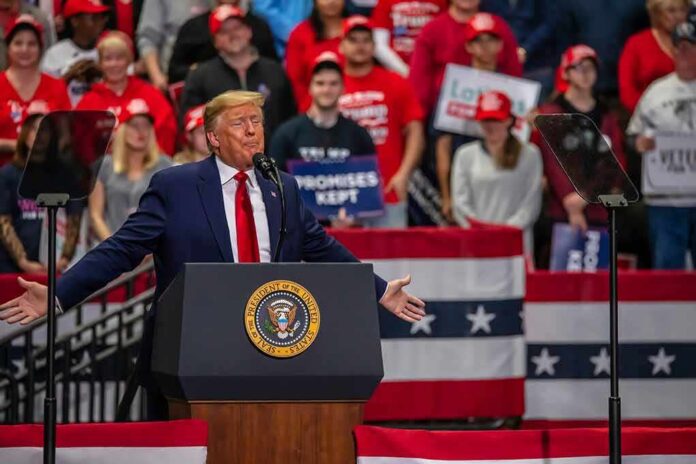
On the record and across multiple outlets, President Trump told reporters he had “a decision” to make about Iran and that Tehran would face the “easy way or the hard way,” adding that “Iran’s been decimated.” The timing wasn’t incidental theater: CBS linked the remark to same-day senior-level meetings on Iran policy, underscoring that the message accompanied live decision-making rather than retrospective spin. Reporting from Iran-focused outlets paired the statement with continued insecurity around the Strait of Hormuz and noted that the Pentagon, through Defense Secretary Pete Hegseth, was intent on giving the president “all the options” he might require if Iran pressed ahead with nuclear ambitions. The throughline is consistent: diplomatic off-ramps are not foreclosed, but coercive leverage is openly foregrounded.
The phrase lands with weight because it compresses the logic of compellence into a single sentence. Coercive diplomacy depends on credibility — the adversary must believe you can and will escalate — and on clarity about preferred outcomes. By presenting a choice and tying it to an imminent decision, the administration signaled both. The “decimated” predicate, whether referring to economic attrition under sanctions or degradation of military capacity, serves to tell Tehran the cost curve has already shifted and will worsen if it misreads the moment.
The Mechanism: Hormuz as Leverage, Sanctions as Force Multiplier
The Strait of Hormuz is the fulcrum because maritime risk there transmits instantly into global prices, insurance premiums, and alliance cohesion. That is why the corridor has repeatedly become the operational theater for signaling; measured interference with transit can create outsized geopolitical effects, even absent large-scale combat. For Washington, pairing heightened naval posture with financial sanctions compounds pressure: insurers reprice voyages, shippers reroute or delay, and the target faces both liquidity strain and reputational risk. Treasury has used guidance and enforcement to warn of sanctions exposure tied to shipping decisions around Hormuz — an administrative lever that shapes industry behavior without a single shot fired.
The result is an elastic contest. Iran can threaten or attempt disruption using mines, drones, and anti-ship missiles with short warning times; the United States can blunt, deter, or punish with escorts, interdictions, targeted strikes, and banking restrictions. Neither side needs to “win” militarily in a conventional sense to gain bargaining leverage; each needs to convince the other and key third parties — Gulf producers, Asian buyers, and London insurers — that time and risk are working in its favor.
How We Got Here: A Recurrent Playbook of Pressure and Signaling
Cycles of U.S.–Iran escalation tend to follow a recognizable script. Washington tightens sanctions and signals readiness to use force; Tehran tests the perimeter with harassment, seizures, or threats to “close” Hormuz, while amplifying nuclear bargaining chips. In parallel, both sides float negotiation channels or intermediated “packages” to probe the other’s price for de-escalation. Analysts have long emphasized that Hormuz’s chokepoint status makes even temporary uncertainty strategically useful to Tehran but corrosive to the maritime order when routinized as a tool of statecraft. Shipping data, insurance pricing, and industry advisories become the practical ledger of the contest; when premiums spike and convoys form, leverage is moving.
In this context, a presidential ultimatum rarely operates alone. It is typically synchronized with defense posture adjustments, alliance consultations, and messaging that narrows Tehran’s perceived set of viable moves. That is why the Pentagon’s “options on the table” assurance is not generic boilerplate; it is a capability-backed reminder that the threshold between sanctions pressure and kinetic action can be crossed quickly if the president’s decision tips that way.
Where the Disagreement Actually Lives
The real debate is not whether the United States can coerce Iran — it can — but which mix of tools produces durable outcomes at acceptable cost. Proponents of maximal pressure argue that visible readiness to escalate, plus sustained financial constriction, can compel Tehran to curb nuclear activity and maritime adventurism. Critics warn that Hormuz brinkmanship imposes systemic risk on global trade and invites asymmetric retaliation across the region. Even within Iran’s political system, signaling cuts two ways: officials oscillate between defiance and openness to talks, a pattern captured in reporting that Tehran simultaneously telegraphs readiness for “negotiation or resistance,” depending on the audience and week.
Energy markets and insurers arbitrate some of this in real time. When war risk premia soar or shipmasters refuse escorted transits, pressure rebounds on all stakeholders, not just Iran. Industry commentary has argued that the oil market’s apparent resilience can mask a deeper normalization of insecurity — flows continue, but at a higher underlying risk that can widen suddenly with a single incident. That volatility is precisely why presidential words, when paired with operational moves, can move the risk curve quickly.
Implications: Reading the Signal Correctly
What should policymakers, executives, and allied governments take from a head-of-state “easy way or hard way” framing? First, it is a deliberate compression of options designed to focus Tehran’s calculus: pursue a negotiated path that addresses nuclear and maritime behavior, or absorb additional pressure with a credible prospect of force. Second, it highlights that Washington views Hormuz security and the nuclear file as interlocking problems — control of the chokepoint amplifies bargaining power over centrifuges and vice versa. Third, it reminds third parties that neutrality has costs: banks, insurers, and shippers that “bow” to coercive demands risk falling under U.S. sanctions authorities, which can be as decisive as a naval blockade in shaping choices.
For U.S. allies and industry leaders, the practical posture is twofold. Harden operations and contingency plans for a protracted period of elevated maritime risk — minesweeping timelines are measured in weeks, not days, and convoy systems are capacity constrained. At the same time, support channels that can translate de-escalatory gestures into verifiable steps: ship releases, reduced IRGC naval presence near traffic separation schemes, and measurable pauses in enrichment activities. The strategy only works if the off-ramp is as legible as the threat. The president’s message, anchored by active interagency deliberation and Pentagon readiness, was crafted to make both visible.
The Bottom Line
Presidential language is a policy instrument. By publicly setting a binary for Tehran while convening decision meetings and ensuring credible military options, Washington aimed to tighten the leverage loop that runs from Hormuz to the nuclear file to global markets. History suggests Tehran will test the boundary; the point of such signaling is to convince it that the “hard way” is real and proximate, and that the “easy way” — verifiable steps on nuclear and maritime behavior — remains available. That is how coercive diplomacy is supposed to work, and why words like these, when backed by capability and timing, change calculations on both sides of the strait.
Sources:
zerohedge.com, iranintl.com, cbsnews.com, rudaw.net, atlanticcouncil.org, home.treasury.gov, thenationalnews.com, usnews.com, gcaptain.com, strausscenter.org