
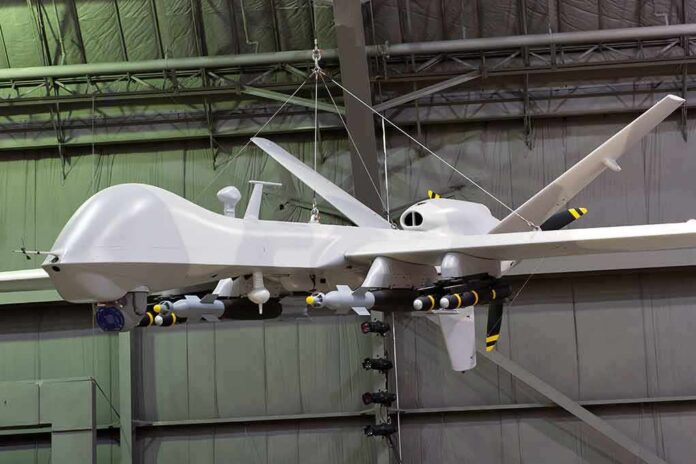
America’s munitions base is quietly rewiring itself for the drone age: a legacy bomb plant in Oklahoma is now building and loading warheads for a new generation of small, expendable aircraft—pairing government-owned capacity with startup speed to turn airframes into battlefield munitions.
At a Glance
- The Army’s McAlester Army Ammunition Plant (MCAAP) has entered a formal production partnership with Perennial Autonomy, a drone maker.
- Under the arrangement, MCAAP will manufacture, load, and deliver explosive payloads for Perennial’s drone fleet, leveraging its Load–Assemble–Pack expertise.
- The move exemplifies the broader push to modernize the U.S. organic industrial base and adapt bomb lines for drones and other rapid-turn munitions.
- Public-facing materials emphasize capabilities and outcomes, while contract vehicles, quantities, and schedules typically remain undisclosed.
What the McAlester–Perennial partnership actually does
McAlester Army Ammunition Plant hosted a ribbon-cutting to launch what the Army itself called a transformative defense production partnership with Perennial Autonomy, a firm that develops specialized drones for the battlefield. In practical terms, the government facility will serve as the munitions provider for Perennial’s aircraft—manufacturing components where appropriate and, critically, loading and delivering the warheads that convert a small unmanned airframe into a true munition. That mission aligns with MCAAP’s core Load–Assemble–Pack (LAP) capability set, long used for bombs, projectiles, and warheads, now applied to lighter, modular payloads suitable for attritable drones.
Think of this as dividing labor by comparative advantage. Perennial focuses on the flight platform—airframe, propulsion, guidance—and the Army’s organic industrial base provides the explosive effect safely, at scale, and to a military standard. The pairing shortens lead times by avoiding redundant private explosive lines while tapping a plant designed to make, integrate, and ship munitions across the force.
Why an old bomb plant is central to a new drone era
MCAAP is not a boutique lab; it is a cornerstone of the ammunition enterprise that receives, stores, ships, produces, renovates, and demilitarizes conventional ammunition. Established in World War II and repeatedly modernized since, the site has the infrastructure, safety culture, and logistics that matter when the product is energetic and the margin for error is zero. As the Army adapts from traditional massed “metal” to software-driven, distributed, and expendable weapons, facilities like McAlester are being refit to move from unitary bombs to a spectrum of effects—blast-fragmentation, thermobaric, and specialized warheads—scaled down for drones but built to the same disciplined processes that govern larger ordnance.
This is not happening in isolation. Across the organic base, the Army is investing in capacity expansions and modernization—from new 155 mm projectile lines to updated energetics—precisely to increase surge responsiveness and resilience in the face of sustained demand. The McAlester–Perennial partnership is a visible instance of that broader shift: use proven government facilities to handle the energetic core, let private partners iterate rapidly on platforms and autonomy, and integrate the two on production tempo rather than bespoke, one-off prototyping cycles.
How the public–private production model works
The Army’s ammunition plants exemplify a government-owned, contractor-operated (GOCO) or allied partnership model—public infrastructure and safety regimes paired with private management, tooling, or specific product lines to meet demand efficiently. These arrangements vary in form, but the logic is consistent: preserve critical national capacity in facilities that would be uneconomic for industry alone to maintain, then flex that capacity with commercial partners when technology or threat conditions change. For small unmanned systems, whose unit costs and attrition rates make them more akin to ammunition than to traditional aircraft, the GOCO framework allows warhead lines, explosive loading bays, and shipping operations to be repurposed without building redundant private energetics plants.
The Army typically describes such partnerships in capability terms—what a plant can do, what problem it will solve—and not in the granularities of the contracting vehicle or monthly quantities, which often remain in program documentation. The substance, however, is clear enough: McAlester will build and load explosive payloads for Perennial’s aircraft and deliver them as configured munitions, ready to integrate with the company’s guidance and airframe subsystems.
From drone “airframes” to munitions: the technical handoff
Turning a small UAS into a munition is an integration problem as much as a manufacturing one. The warhead must match the platform’s mass, center of gravity, power budget (if fuzing is electronic), and aerodynamic envelope; fuzing must be safe, arm reliably under defined conditions, and function as intended upon impact. Plants like MCAAP have decades of process discipline around explosive fill, case design, initiation trains, and environmental conditioning—competencies now applied to lighter, modular effects packages that can be swapped across multiple airframes and mission sets.
The result is a family of “payloads-as-products” that can be qualified and produced on lines with known safety and quality controls, then mated to different drones as tactics evolve. In contemporary conflicts, small drones have been used for interception, precision strike on soft targets, and even anti-armor roles with shaped or explosively formed penetrator charges; aligning those effects with reliable, repeatable builds is exactly what an organic ammunition plant is designed to do.
The airframe came from a 2023 startup. The warhead comes from Oklahoma.
McAlester will load payloads for Perennial's drones. The plant already has the chemists and the load-assemble-pack crews, and the Army says partnerships like this one help pay for its infrastructure…
— Tate Williams (@Tate_Williams86) October 6, 2026
Strategic consequence: capacity, tempo, and resilience
The lesson from recent wars is not subtle: demand for low-cost guided munitions—particularly small drones and their warheads—rises faster than traditional aerospace lines can surge. The Army’s modernization drive seeks to close that gap by converting legacy capacity into flexible, modular production that treats many drones as consumables rather than exquisite assets. McAlester’s role in producing, loading, and shipping the explosive component standardizes the most safety-critical work, while startups iterate on autonomy and airframes at software speed. That division of labor shortens the loop from design to fielding and increases the odds that supply can track operational consumption.
There is also a logistics dividend. Ammunition plants sit inside established distribution networks for storage, handling, and theater movement. By bringing small-drone warheads into that ecosystem, the Army can manage them like other munitions—serialized, inspected, rotated, and replenished—rather than as ad hoc kit bolted together at the edge. Over time, that discipline is what turns promising prototypes into dependable capability.
The information gap versus the industrial reality
Public announcements about these partnerships are necessarily selective. They highlight mission alignment and visible ceremonies; they rarely spell out specific lot sizes, delivery cadences, or contract clauses that procurement professionals track internally. That asymmetry can make a routine production alignment look more dramatic than it is—or, conversely, obscure how significant a capability shift can be when a legacy bomb line starts turning out thousands of small warheads instead of hundreds of heavy ones. The important signal is the institutional choice: the Army is putting its energetic core to work on drones, declaring by action that small UAS belong in the munitions family and should be produced with the same rigor.
What to watch next
Three indicators will tell you how far this model scales. First, line-rate expansion—investments in fixtures, test equipment, and shift schedules at MCAAP and sister plants—will reveal whether small-drone warheads become a standing product line or remain a boutique run. Second, payload modularity—common interfaces, fuzing standards, and environmental specs—will determine how easily different airframes can share effects and logistics. Third, integration tempo—how quickly Perennial and peers field platform updates to exploit new payloads—will show whether the public–private split is producing the responsiveness the battlefield now demands.
Sources:
zerohedge.com, army.mil, defensecommunities.org, 163.com, oklahoma.gov, aschq.army.mil, mcaap.army.mil