A single rally line about a WNBA role player exposed a larger fault line in how we talk about women’s sports economics: star power unquestionably moves demand, but the mechanism that actually fills arenas is performance-driven narrative and visibility, not an athlete’s looks.
At a Glance
- At an October 2026 rally in Youngstown, Ohio, President Trump praised Indiana Fever guard Sophie Cunningham and quipped that she would help “attendance” more than “points.”
- Multiple outlets reported substantially identical wording; the core quotation is not in dispute.
- Research backs a “superstar effect” in women’s sports attendance, with outsized demand impacts from high-profile players—driven by performance and storylines, not sexualization.
- The line blurred two separate questions: what makes fans show up, and what kind of attention actually sustains growth for women’s leagues. Evidence points to athletic excellence and visibility as the durable engine.
What Happened: The Quip Heard Beyond the Arena
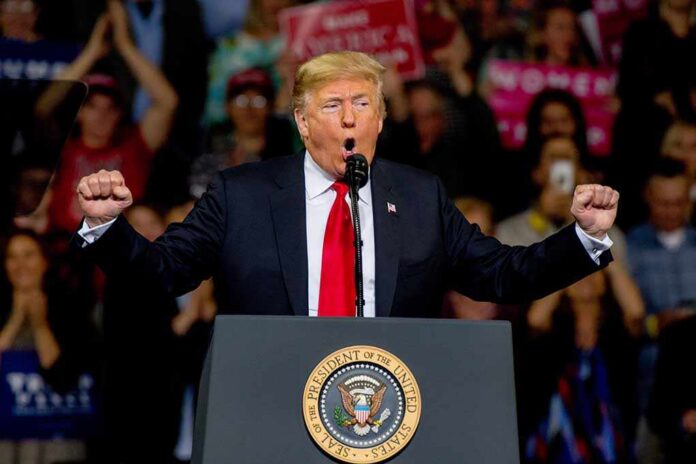
At a campaign rally at the Covelli Centre in Youngstown, Ohio, President Trump highlighted Sophie Cunningham—then with the Indiana Fever—and said teams would like to have her “not to help you with points, but to help you with attendance.” He also called her “a beautiful young woman.” The framing traveled quickly across mainstream sports pages and general-interest tabloids, all quoting the same attendance-versus-points contrast. The incident’s facts are clear; the phrasing was attributed directly to Trump and covered in consistent form by Yahoo Sports and others.
Why this one-liner mattered had little to do with the box score. It tied an individual player’s market value to perceived appearance and, by implication, suggested a business case in a league where the evidence increasingly shows something else: when women’s sports draw in volume, it is because stars perform, win, and sustain a narrative arc that TV and social media can carry from game to game. In short, demand follows meaning, and meaning follows excellence—magnified by coverage.
The Economics: What Actually Drives Attendance
Sports economists use the shorthand “superstar effect” to describe how certain athletes increase demand beyond what their contribution to wins alone would predict. The mechanism is straightforward: a marquee player lowers the search cost for casual fans (you know why tonight matters), raises the entertainment certainty (you’re likelier to see something memorable), and turns an otherwise replaceable date on the calendar into an event. That dynamic is measurable in the women’s game. A peer-reviewed analysis of the WNBA’s 1997–2024 attendance found that star players—most prominently Caitlin Clark—produced large, game-level demand jumps at home and on the road.
Those results matter because they clarify cause. The incremental headcount rides on salience and production: highlight plays, competitive stakes, and a story fans can enter in the middle and still follow. Television ratings, resale markets, and merchandise sales tend to echo the same pattern—performance and visibility are complements. The NBA literature shows a parallel effect in men’s leagues, providing a comparable mechanism across contexts.
Appearance, Attention, and the Misread Incentive
Trump’s aside conflated two distinct vehicles for attention—appearance and athletic value. Marketing scholarship and media analyses are remarkably consistent on which one scales. When female athletes are presented as athletes first—skill foregrounded, story coherent—interest and sponsor value rise. When sexualized imagery dominates, it generates cheap clicks, not durable demand, and can even repel potential viewers who came for competition rather than titillation. Experimental and content-analysis work points the same direction: audiences reward demonstrated expertise and competitive stakes far more than aesthetic framing.
This is not moralizing; it is market function. Sports are scheduled drama. The plot is skill development and rivalry, the stakes are standings and legacy, and the protagonists are those who alter outcomes. Beauty does not alter outcomes; skill does. That is why a high-usage rookie who bends defenses can move ten thousand tickets, and a photogenic reserve cannot—unless she also becomes a protagonist in the competitive story.
The Cunningham Case: Role, Voice, and Visibility
Sophie Cunningham is not a novelty character on the margins of the league; she is a known commodity with a defined role and a public voice on hot-button issues around women’s sports. That voice has elevated her visibility. It has not, however, turned her into the sort of must-see draw economists study under the superstar rubric. The rally quip implicitly credited her with the wrong kind of gravity—the kind that spikes mentions but not turnstiles.
Consider the post-2024 WNBA environment: winning brands with ascendant stars drove a step-change in both live attendance and broadcast audiences, with a season tracking toward five-figure average gates. Those gains correlate strongly with on-court excellence, rivalry structure, and constant national exposure. ESPN documented audience milestones consistent with that thesis, reflecting a flywheel in which media coverage follows performance and then compounds it.
What Research Says About Sustainable Growth in Women’s Sports
Three durable levers show up across studies and commercial practice:
First, athletic performance and competitive context. Empirically, fans pay to see skill mastery expressed in consequential games—stars raising ceilings, not just raising eyebrows. That is the superstar effect’s sinew, visible in both men’s leagues and the WNBA.
Second, narrative visibility. Media representation that frames female athletes as protagonists in a competitive arc unlocks sponsorship and audience development; coverage that reduces them to aesthetic objects may draw transient attention but weakens brand equity and alienates core fans over time.
Third, accessibility and repetition. Supply consistent broadcast windows, ticket packages priced to habit, and locally resonant storylines, and casual curiosity hardens into fandom. That is why teams that convert one-off surges into season-ticket bases do so by deepening competitive stakes—playoff pushes, rivalries, individual award races—rather than leaning on superficial hooks.
The arrogant pontificating left wants everything to be ugly.
That’s why these people hate Melania Trump, Sydney Sweeney, Eva Vlaardingerbroek, Sophie Cunningham and always praise these women instead…. pic.twitter.com/Xzpb2mwLlE— Filippo Maria O di B (@filippomaria60) October 9, 2026
How to Read the Rally Line—And Move On
As political theater, the line worked: it was provocative, it generated headlines, and it latched onto a player already in the cultural conversation. As an account of how women’s basketball grows, it misses the mark. Attendance is not a beauty contest; it is a relevance contest, and relevance is earned in the standings and amplified on screen. If a player wants to convert notoriety into sustained demand, the path is ruthless and public: higher usage, efficient production, clutch possessions, repeat it under brighter lights, let television do the rest.
The WNBA’s next decade will be decided by boring fundamentals that never make a rally speech—youth pipelines, player development, schedule optimization, data-informed ticketing, and the continued elevation of stars who alter outcomes. The more teams and media lean into that model, the less oxygen there is for the old trope that women’s sports need aesthetic shortcuts to sell. The marketplace has already answered. The product sells when the protagonists decide games and the cameras are rolling.
Sources:
thegatewaypundit.com, rawstory.com, dailymail.com, sports.yahoo.com, themirror.com, hitc.com, athlonsports.com, egarp.lt, sage.cnpereading.com, gala.gre.ac.uk, digitalcommons.murraystate.edu, ideas.repec.org, espn.co.uk