Security ejections at modern campaign events are rarely about a single shouted phrase; they are the predictable flashpoint where a speaker’s need for an orderly forum collides with a protester’s desire to be heard, and the Michigan episode involving President Trump illustrates exactly how that boundary is drawn in practice.
The Short Version
- During President Trump’s speech at General Motors’ Milford Proving Ground in Michigan, a protester repeatedly yelled “pedophile protector,” interrupting the remarks.
- Trump paused to respond, the crowd tried to drown out the heckler, and security then escorted the protester out.
- Multiple outlets reported the removal and the crowd dynamic; footage captures the audible disruption and the escort that followed.
- The incident exemplifies a routine event-security decision: stopping sustained interruption so the program can continue.
What happened at the Milford event
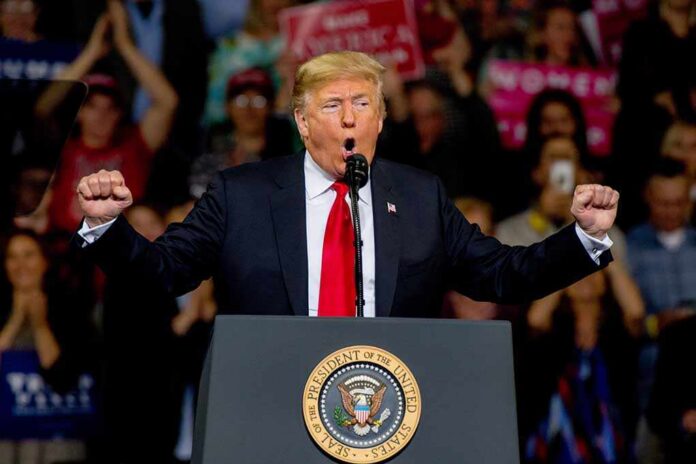
Reports from the July 27, 2026 address at General Motors’ Milford Proving Ground describe a sustained disruption: a protester repeatedly yelled “pedophile protector” while President Trump was speaking, prompting him to halt his prepared remarks and address the interruption. The crowd responded with chants intended to overpower the heckler; within moments, security personnel escorted the protester out of the venue. Coverage consistently characterizes the removal as a response to continued heckling rather than a silent or symbolic protest, and contemporary video accounts capture both the audible shouts and the subsequent escort from the seating area.
The Independent’s segment notes that Trump labeled the protester “a communist” as the interruption unfolded and that the heckler was removed from the venue; The New Republic’s account similarly emphasizes the repetitive shouts and crowd reaction before security acted. Several aggregations of the footage relay the same sequence—interruption, candidate response, crowd counter-chant, and removal—creating a cohesive picture of how the program regained control after the disruption began.
How security ejections work at political events
To understand why this kind of removal is commonplace, you have to distinguish between viewpoint discrimination (silencing a perspective) and disruption management (enforcing rules that let an event proceed). Courts have long recognized the legitimacy of neutral, content-agnostic rules that keep a program audible and on schedule—especially when a speaker, whether an incumbent officeholder or a candidate, is addressing a ticketed or otherwise controlled audience. The “heckler’s veto” doctrine runs the other way: it restricts government from shutting down a speaker because the audience is hostile. The operational norm at rallies and factory-floor addresses sits between those poles: sustained, repeated interruption that prevents speakers from continuing typically triggers graduated responses—warnings from staff or ushers, relocation if feasible, and, when the interruption persists, removal as a last resort.
The Milford episode fits that pattern. Reporting indicates repeated, audible interruption and a pause in the speech while the protest played out; security then restored order by escorting the individual out, allowing the event to continue. That is not a marginal call in a noisy room; it is the core function of event security at campaign-style appearances. Whether the venue is municipally owned or privately controlled matters at the margins for constitutional analysis, but the operational logic—stop a persistent disruption that drowns out the scheduled speaker—remains the same in practice.
The setting and why this venue matters
The location—a General Motors proving ground—explains both the speed and the discretion with which security acted. Corporate and campaign events typically use pre-credentialed press and controlled entry for attendees, establishing house rules about signage, noise, and conduct designed to keep an audiovisual program on track. When a disruption becomes sustained and the microphone cannot compete with the interruption, escorts are standard; they minimize the duration of the incident and the risk of escalation in a crowd. That discipline also protects the broadcast product: factory-floor acoustics and open bays amplify heckling; brief, decisive escorts prevent a minute of interruption from becoming ten.
It also explains the choreography visible in the reports and footage: the candidate acknowledges the interruption (a near inevitability when it is audible over the microphone), the crowd counters with a chant that aligns with the event’s theme, and security completes the escort swiftly so the stump line can resume. That is not spectacle for spectacle’s sake; it is the practiced cadence of stage management under duress.
Why repeated heckling crosses the line from dissent to disruption
Political speech thrives on friction—vigorous counter-speech is a feature of American rallies, not a bug. The inflection point comes when counter-speech stops being parallel (outside the venue, in designated protest zones, or during audience Q&A) and becomes serial interruption that monopolizes the floor. In that moment, security is not choosing a side in a debate; it is restoring the conditions under which any side can be heard. The principle grows out of decades of First Amendment doctrine: the government must protect a speaker from being shouted down, but it may also enforce neutral rules against those who prevent the orderly use of the forum. Scholarship on the heckler’s veto makes that balance explicit, and operational guidance for event managers distills it to a simple mandate—warn, isolate, remove if necessary so the program can continue.
That is why the content of the shouted phrase—however provocative—does less work here than the form of the conduct. The reports focus on the repetition and the fact that the speech could not proceed cleanly while it continued. In short: the removal was about the interruption, not the slogan.
The broader pattern: interruptions as campaign theater
Episodes like Milford rarely happen in isolation. High-salience events with broadcast lighting attract protesters who understand how sound carries and how quickly a single shout can become a viral clip. Campaigns and incumbent offices, in turn, plan for it; staff spotters position themselves near cameras, security teams rehearse escort routes, and principals are coached on whether to ignore, deflect with a one-liner, or confront. In Michigan, the choreography followed the familiar script—interruption, a sharp rejoinder from the principal, a unifying chant from the crowd, and a clean reset of the program. To audiences at home, the beat may read as spontaneous drama; to veteran advance teams, it is a contingency drill executed as designed.
What to take away
The Michigan incident is not a constitutional crisis or a novelty; it is a case study in the boundary between dissent and disruption at a modern political event. The evidence is straightforward: a protester repeatedly disrupted President Trump’s speech, the candidate and crowd responded in real time, and security removed the individual so the program could continue. That outcome reflects standard practice at controlled-access venues and the speech-protective logic that undergirds it. For citizens who care about both robust protest and the ability to hear from those who govern, the lesson is clear: the right to speak and the right to be heard both require rules—and enforcement—when the microphone is live and the room is full.
Sources:
ground.news, radaronline.com, independent.co.uk, newrepublic.com, mediaite.com, globalfreedomofexpression.columbia.edu, govinfo.gov