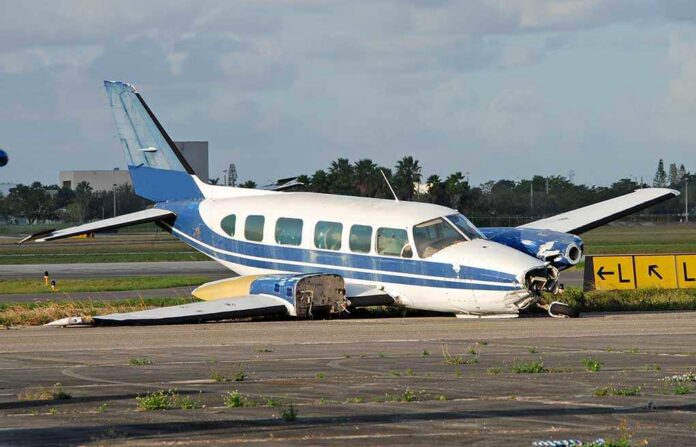
Survivability in small-aircraft engine failures is not luck; it is the product of control, airspeed discipline, and using whatever the environment offers to absorb energy—exactly what unfolded when a Piper PA-32 lost power at night and a pilot flew it into the treetops rather than the ground.
The Short Version
- A husband, wife, and two dogs aboard a single‑engine Piper PA‑32 survived a nighttime forced landing after an engine power loss.
- The FAA acknowledged mechanical trouble before the aircraft struck trees, which arrested the descent and left the airframe perched above the ground.
- The pilot described a deliberate final pull‑up to reduce impact energy, consistent with survivable forced‑landing technique.
- Injuries were reported as minor; investigators continued to examine the exact cause of the power loss.
What happened: a controlled crash that favored life over metal
On a night flight over eastern North Carolina, a Piper PA‑32 with pilot Dustin Davis, his wife Autumn, and their two dogs aboard lost engine power. Davis told reporters the engine “wasn’t producing power” at roughly 6,000 feet, prompting immediate troubleshooting and a call to air traffic control. With altitude unwinding and no runway within gliding reach, Davis flew a forced landing into trees. News outlets that visited the site described the aircraft caught in the treetops and set down just above the ground—close enough that photos showed the nose inches from soil—rather than a cratered impact. All four occupants, including the dogs, got out. Local reporting characterized the couple’s injuries as minor.
The Federal Aviation Administration subsequently verified the aircraft had mechanical trouble before colliding with trees, aligning with the pilot’s account of a power loss. Accounts from the scene are consistent with a “tree‑supported” landing: the airplane contacted upper branches, decelerated rapidly, and came to rest slightly elevated—about six feet off the ground in one description—rather than striking terrain at terminal descent speed.
Why the trees—and the pilot’s choices—mattered
In a forced landing, energy management is destiny. Touching down under control at the slowest attainable speed, wings level, and with the fuselage—not the cabin occupants—absorbing the load turns a lethal descent into an injury accident or better. Davis described an intentional last‑moment pull‑up after sighting trees, a textbook trade of airspeed for reduced vertical speed that lets the airframe’s underside and non‑habitable structure take the hit. Separate reporting emphasized that belly‑first contact allowed the structure to absorb much of the impact. That technique, coupled with the compliance of tree canopies—nature’s crush zone—can bleed off kinetic energy sequentially instead of all at once.
The outcome also fits a broader pattern in general aviation: pilots who maintain control to touchdown and resist the impulse to “stretch the glide” typically fare better than those who stall or lose control trying to make an unreachable runway. FAA risk guidance and training materials emphasize exactly this priority hierarchy in off‑airport landings: aviate first, accept the landing area you can reach, and fly the airplane through the crash.
Engine failures in small aircraft: common pathways, consistent priorities
“Engine failure” is a catch‑all outcome, not a single cause. Power losses can stem from fuel starvation or contamination, mechanical breakage in the powerplant, induction or ignition faults, or maintenance errors. FAA and NTSB safety material, as well as training organizations, repeatedly highlight two intertwined facts: engine‑related problems are recurring contributors to accidents, and the deadliest accidents frequently involve loss of control in flight rather than the initial mechanical event. Forced landings, by contrast, are survivable at far higher rates when pilots keep the wing flying and manage energy into crushable terrain—fields, brush, even trees that give rather than concrete that does not.
Tree landings, specifically, occupy a counterintuitive place in survival data and lore. Unlike rigid obstacles, trees can behave like a layered energy absorber: leaves, branches, limbs, and trunks each take a fraction of the impact. While the strategy will scar metal and break wood, it can spare people. Training literature and case histories reiterate the same lesson: avoid stall, minimize vertical speed at contact, and accept damage to the machine if it preserves the cabin envelope and controls.
Night, workload, and the discipline of checklists
This event unfolded in darkness, a condition that compounds stress and narrows visual cues. The couple reported running troubleshooting steps and coordinating with air traffic control, a flow that aligns with checklist discipline in engine‑out scenarios: best glide, identify and attempt restart if altitude permits, configure for landing, and commit to the best reachable site. FAA risk management guidance underscores that at night, depth perception degrades and obstacles are harder to see; pilots must guard against fixating on distant lights and instead fly the known numbers—best‑glide speed, stabilized approach cues, and a controlled flare into whatever terrain can be reached.
The description of a last‑moment flare into trees at reduced speed fits that discipline. ATC cannot conjure a runway within glide distance, but it can help with headings, lighting requests, and emergency coordination, which is why that early call matters. Pilots who divide cockpit workload between flying the airplane and handling communication buy themselves seconds and options—time that, in forced landings, converts directly into lower impact energy.
What investigators typically determine after the walk‑away
When everyone survives, the work is not over; it just shifts to root‑cause analysis. The FAA and the National Transportation Safety Board typically document the aircraft identity, maintenance history, fuel state, and engine condition, then correlate pilot accounts with physical evidence—propeller signatures, engine teardown findings, and marks on trees and terrain that map the energy path. Some failures trace to discrete component breakage; others point to fuel mismanagement or contamination; still others remain “undetermined” when post‑impact signatures are ambiguous. The public takeaway, however, rarely changes: regardless of cause, maintaining control to touchdown is the decisive safety act.
In this case, published reporting establishes three anchors: a power‑loss event aloft, a tree‑supported landing that prevented a ground slam, and a survivable outcome for all aboard, humans and dogs alike. The specific failed part or fuel mechanism can take weeks to months to confirm; the operational lessons—for pilots and passengers—are available immediately.
Practical lessons for pilots and passengers
For pilots: rehearse the engine‑out flow until it is muscle memory, fly best glide, pick a reachable site early, and fly the flare, even if the landing surface is trees. For passengers: survival odds improve dramatically when the pilot keeps flying the airplane; tighten restraints firmly, assume the brace position on command, and remain belted until the aircraft stops. For everyone: forced landings are controlled crashes—the control is what saves you.
Sources:
nypost.com, wsoctv.com, wwaytv3.com, foxsanantonio.com, aopa.org, us.headtopics.com