When a death occurs in a highly trafficked public space, clarity depends on two distinct systems working in sequence: police assess the scene for crime, and the medical examiner determines cause and manner. Near Disneyland’s south entrance in Anaheim, those tracks ran as they usually do—quietly, efficiently, and without evidence of foul play.
The Short Version
- Anaheim Police reported a 65-year-old man was found unresponsive Sunday afternoon on a sidewalk near Disneyland’s south entrance; he was pronounced dead at the scene.
- Officers restricted foot traffic briefly while Anaheim Fire and Rescue and the Orange County Coroner responded.
- Police said the death appeared to be from natural causes and that foul play was not suspected, pending coroner findings.
- Media headlines emphasized proximity to Disneyland, though reports differed on whether the spot was on resort property or adjacent public right-of-way.
What Happened: A straightforward response, not a criminal scene
According to Anaheim Police, officers responded to a report of an unconscious person near the resort’s south entrance off Katella Avenue on a Sunday afternoon and found a 65-year-old man on the sidewalk. Paramedics pronounced him dead at the scene. The department’s on-record spokesperson stated that, based on initial observations, the death appeared to be from natural causes and no foul play was suspected. Coverage describing the response identified the specific location as the 800 block of West Katella Avenue and noted the presence of Anaheim Fire and Rescue and the Orange County Coroner, standard practice in unattended deaths outside hospital care.
Scene management followed routine protocol: officers temporarily restricted the immediate sidewalk area, redirected pedestrians, and held the scene until coroner personnel arrived to take custody of the decedent. That limited closure is typical when authorities must preserve the integrity of observations and ensure dignity and privacy while a body remains in a public setting.
Police assessment versus coroner determination: two roles, one sequence
Law-enforcement and medicolegal roles diverge by design. Patrol officers and detectives evaluate whether a crime occurred; they read a scene for signs of violence, disturbance, or external causes. Medical examiners and coroners make the medical-legal call on cause (the disease or injury leading to death) and manner (natural, accident, suicide, homicide, or undetermined). A patrol sergeant’s statement that “no foul play is suspected” is an investigative judgment—an absence of crime indicators—not a medical conclusion. A coroner’s classification of “natural” requires evidence of disease progression sufficient to explain death; accidental requires an external mechanism; undetermined is used when evidence remains equivocal.
In Anaheim, police communicated their preliminary view: nothing at the scene suggested a criminal event. Formal cause and manner await the coroner’s examination and, if indicated, toxicology. That staggered cadence—police triage and scene control first, medical-legal work next—is how most public-space deaths proceed.
Location, proximity, and why headlines fixate on brand landmarks
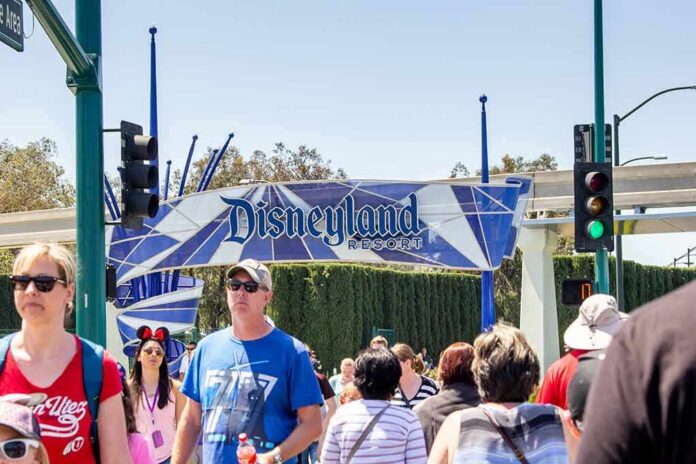
The reports agree on the basic geography—near Disneyland’s south entrance along Katella Avenue—but differ on whether the exact spot was on Disneyland property or on the adjoining public sidewalk. One outlet pinpointed 800 West Katella, adjacent to the resort boundary; another said the property status was unclear. For the incident’s substance, the distinction changes little: the same responders arrive, the same protocols apply, the coroner takes custody all the same. Yet proximity to a marquee destination often becomes the headline’s center of gravity. It translates quickly for readers, and it amplifies attention far beyond a typical public-space fatality. In this case, the branding effect risks implying a connection to theme-park operations where none is evidenced in the police account.
That pattern is not unique to Anaheim. Public incidents near stadiums, campuses, or transit hubs are almost always framed around the place brand first, which can overshadow the most important operational fact: investigators saw no indications of foul play and treated the death as likely natural, pending routine medical confirmation.
What we know, what was appropriately left pending
Certain details remained undisclosed at the time of initial reports. The decedent’s identity had not been released publicly, a standard privacy protection until next of kin are notified. The precise property line—resort parcel versus city sidewalk—was not resolved in the early coverage. And while one outlet noted a beer can near the scene, there was no basis to tie that object to cause of death without laboratory work or corroborative findings, which are the coroner’s purview. These are not gaps so much as the normal contours of early, factual reporting on an unattended death.
The single substantive on-record assessment came from an Anaheim Police sergeant: the death appeared natural, with no suspicion of foul play. That statement narrows the universe of concern in practical terms—it steers away from violent crime scenarios—while leaving medical specifics to the coroner. In medicolegal terms, a natural death refers to one caused by disease processes such as cardiac arrhythmia, stroke, or other physiological failures, as opposed to injury, poisoning, or external forces that would trigger accident, suicide, or homicide classifications.
How public-space death investigations typically proceed
In a public, high-foot-traffic location, first responders prioritize immediate medical assessment and scene safety. If resuscitation is not possible and death is pronounced, officers establish a limited perimeter to preserve the environment for observation and protect passersby from graphic exposure. The coroner’s office, responsible for custodial transfer and postmortem inquiry, is summoned. Once the body is removed, law enforcement clears the site unless indicators of a crime require extended processing. Meanwhile, the coroner’s casework may include medical history review, external and internal examinations, and, when appropriate, toxicology. Final cause and manner can take days to weeks, depending on the need for lab results and records integration. That timeline is routine; speedy certainty is neither expected nor indicative of thoroughness.
Where alcohol containers, medications, or personal effects are present, their evidentiary status depends on documented chain-of-custody, fingerprints or DNA, and consistency with medical findings. The presence of an item, without more, rarely bears interpretive weight. Investigators avoid overstating such artifacts until laboratory results warrant it.
Dead body found near Disneyland
65-year-old man was found dead on a sidewalk outside the Disneyland Resort in Anaheim, California on Sunday, October 25, 2026. (Note: The park in Anaheim, California is Disneyland Resort, while Walt Disney World is located in Orlando, Florida)… pic.twitter.com/6kHdv08jar
— SubX.News® (@SubxNews) October 26, 2026
The signal amid the noise: reading coverage of deaths near major venues
When a death occurs within sight of a world-famous sign, the venue’s name dominates search results and social scrolls. Yet the operational core of this Anaheim incident is clear and uncontroversial: officers and paramedics responded to an unresponsive 65-year-old man; he was pronounced dead at the scene; the area was briefly cordoned as the coroner took custody; and police said the circumstances appeared natural, with no foul play suspected, pending the medical examiner’s final classification. That is a sober, standard sequence, not a public-safety alarm or a signal of risk to park visitors.
Sources:
nypost.com, latimes.com, sandiegored.com, people.com