What matters in Port Huron is not that a rally was interrupted—that’s routine in American politics—but that President Trump paired a visible ejection of a heckler with a concrete allegation of paid orchestration, complete with a dollar figure and named sponsors; the interruption is on tape, the allegation is not.
The Short Version
- A protester interrupted President Trump’s October 25, 2026 rally in Port Huron, Michigan and was escorted out within moments.
- Trump labeled the interrupter a “paid protester,” told security to remove the person, and claimed protesters receive $250 from partisan funders.
- Video and local coverage corroborate the disruption and removal; they do not establish payment or sponsorship for this individual.
- Claims of “paid protesters” are a recurring feature of U.S. political conflict; prior fact-checks of similar, broad allegations have found no substantiating evidence.
What happened in the arena: interruption, removal, allegation
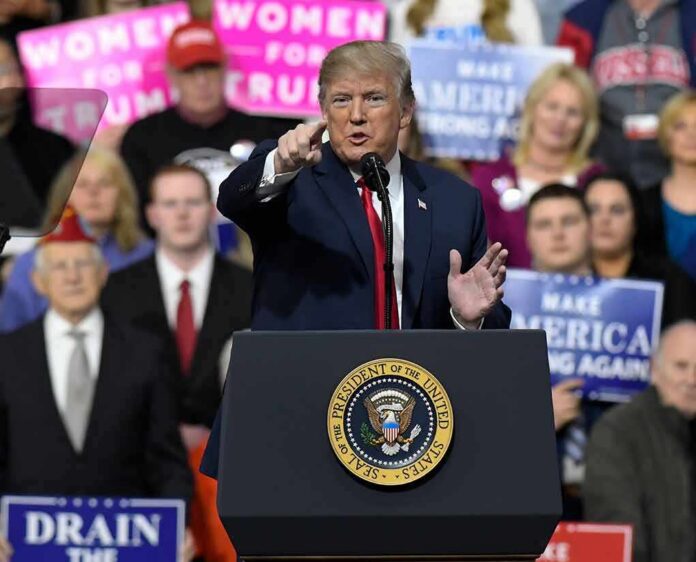
Shortly after President Trump began speaking at McMorran Place Sports and Entertainment Center in Port Huron, a protester interjected from the crowd. The interruption was brief; event security moved quickly to escort the individual out as the audience reacted vocally. On the microphone, Trump called the person a “paid protester” and directed security: “Just get ’em outta here, please.” Multiple outlets and videos captured the sequence—disruption, crowd response, ejection—providing clear, contemporaneous evidence of the removal itself. Local reporting described the person as shouting opposition to Trump and being escorted from the arena; imagery from the event showed the escort in progress. Those facts are uncontested in the record of that night’s rally environment.
Trump’s remarks went further than labeling, asserting a specific going rate and sponsors: “You know they get paid $250, we found out, $250 paid by the Dumocrats and the Soros people and other people.” The audiovisual record places those words at the scene, alongside the removal. The statement, however, stands alone as an assertion; no reporting tied the Port Huron individual to a payment, recruiter, financial transaction, or named organization at the time of the incident. The video shows disruption and removal; it does not prove compensation, which is a separate claim requiring different evidence.
How these episodes typically unfold: what’s observable, what isn’t
Rally security dynamics are straightforward. Campaigns coordinate with venue staff, private security, and local law enforcement to manage ingress, maintain order, and respond to disruptions. When a heckler shouts from the stands, the security response is designed to be swift and minimally disruptive to the program: identify the source, move in pairs to the location, establish a corridor, and escort the individual to a secondary screening space or exit. The public sees the loudest and most visible portion of that protocol—the ejection. What the public does not see, and what rarely exists on the spot, are the investigative artifacts that would prove coordination or payment: communications trails, payment-app transfers, vendor invoices, routing through political committees, or statements by the participant. Removal is an operational decision; proof of pay is an evidentiary one.
In practice, those evidentiary trails are hard to surface in real time. They often depend on a willing subject, a formal complaint, or an investigative body with subpoena power. Absent such mechanisms, most rally-night coverage confines itself, appropriately, to what can be verified on the scene: the interruption, the president’s words, the escort, and the continued program. That is exactly the backbone the Port Huron coverage provides.
The specific claim of “paid protesters”: what the broader record shows
Allegations that opponents bankroll protest activity recur across election cycles. When evaluated in broad terms—not a single person at a single venue but claims of widespread organized pay-for-protest—independent reviews have typically failed to find substantiating evidence. Fact-checks of high-salience accusations in recent years, including assertions about anti-ICE and “Hands Off” demonstrations, reported no proof that protests were staged or that participants were compensated to appear; experts interviewed for those reviews emphasized that the dominant pattern in mass demonstrations is local, voluntary participation, sometimes aided by professional organizers but not underwritten by per-head payments. Those findings do not adjudicate the identity or motives of a lone heckler in Port Huron; they do establish the base rate against which sweeping pay-for-protest claims are often tested.
The Port Huron allegation is more specific than a generic “outside agitators” trope because it names an amount—$250—and posits sponsors. Specificity can be a virtue: it generates falsifiable leads. Yet specificity by itself is not evidence. Following the money would require a named intermediary, a documented transaction, or corroboration from the individual involved. None appeared in the immediate accounts of the rally. The coverage records the president’s words; it does not convert those words into proof of payment by repetition.
How we got here: political theater, crowd management, and rhetoric
Presidential rallies are, by design, stage-managed performances that depend on rhythm: a buildup, applause lines, and call-and-response beats that consolidate identity among attendees. Hecklers, whether sincerely motivated or seeking attention, break that rhythm. The modern rally playbook has an answer: fold the disruption into the performance. Leaders taunt the interrupter, cue the crowd, and highlight the removal as confirmation of control. That is not unique to any one politician; it is a genre convention. Trump is particularly fluent in this idiom. He tends to personalize the moment—assigning motives, narrating backstory, and offering a moral—while security executes a preplanned ejection protocol. The Port Huron episode followed that script closely.
Accusing a protester of being “paid” also fits a longer rhetorical tradition: it delegitimizes dissent by implying it is manufactured rather than organic. Historically, similar claims have surfaced across movements and eras; some have later been matched to organized campaigns, while many have faded when documentation failed to materialize. In the past several years, the preponderance of high-profile “paid protester” accusations examined by fact-checkers has landed in the latter category. That broader pattern frames how reasonable observers interpret new, uncorroborated pay allegations even when the underlying disruption is indisputable.
What the Port Huron record supports—and what would deepen it
The record supports four firm points. First, a protester interrupted President Trump’s remarks at Port Huron. Second, Trump labeled the person a “paid protester,” added a $250 figure, and attributed funding to political opponents. Third, crowd and security quickly facilitated an ejection; the rally continued. Fourth, contemporary reporting and video document the disruption and removal, not a payment chain. Those are the facts available from the arena floor and immediate coverage.
If further documentation were to emerge—venue incident logs, arrest or trespass records, identification of the individual, corroborated financial transfers, or communications showing recruitment—the claim about pay could be assessed on evidentiary grounds rather than as a rhetorical flourish. Until then, the analytical distinction holds: the Port Huron episode is a clear instance of a rally disruption ending in removal, paired with a pay allegation whose specificity generates questions but whose proof is not present in the public record from that night. That distinction is not hair-splitting; it is how responsible readers keep performance, policy, and proof in separate, intelligible lanes.
Protester removed from Trump rally in Port Huron, Michigan https://t.co/mTX5WKZ8T1 via @YouTube
— carl (@carlmatsx1) October 26, 2026
Bottom line
Port Huron delivered two different kinds of facts at once: observable crowd control and an untested claim about why the disruption happened. The first is settled on tape. The second, if true, would rest on a paper trail that reporting from the rally does not supply. Understanding that difference is the key to reading similar moments ahead: treat what you can see—interruption and removal—as the event, and treat payment theories, however vivid, as allegations that only evidence beyond the arena can resolve.
Sources:
wvnews.com, wcti12.com, foxnews.com, hollandsentinel.com