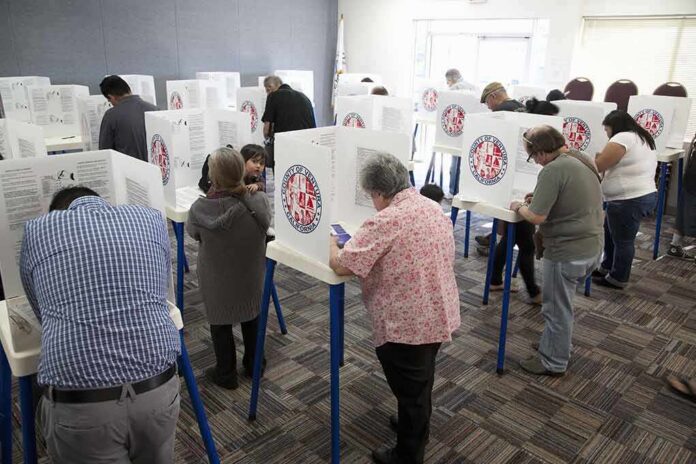
Polling places are engineered to feel apolitical and safe; when that neutrality is breached—even by ambiguous symbols—the system’s legitimacy, not just a single precinct’s decorum, is what’s really at stake.
At a Glance
- Photo-documented incident: a Minnesota poll worker wore a “Problem Solved” shirt with red splatter during early voting at a Rogers site; officials confirmed the referral for review.
- The shirt’s imagery invited comparison to the assassination of Charlie Kirk, but the design also long predates that event as a Halloween gag; intent remains unestablished.
- Minnesota law bars intimidation and prohibits political insignia inside polling places; whether non-campaign violent imagery fits those rules is the legal gray area.
- The durable lesson is administrative, not partisan: election leaders need clear attire protocols for non-campaign but potentially chilling symbols and a fast, transparent response path.
What the record supports—and what it does not
A contemporaneous photograph, circulated online and in sympathetic outlets, shows a poll worker in the Rogers fire station community room wearing a white “Problem Solved” shirt with red splatter near the collar while seated among election equipment during the weekend before Election Day. Hennepin County confirmed it had received the concern and forwarded it to the Rogers city clerk for review—an administrative, not rhetorical, response. Those two points are solid: there was a shirt; there was an official referral. The rest sits on less certain ground. Reports acknowledge the design has circulated for years as a Halloween gag, and none produce a statement from the worker or a finding from Rogers that the shirt was meant to reference or mock Charlie Kirk’s assassination. Likewise, there is no documented voter who was deterred, threatened, or unable to cast a ballot. The environment matters under Minnesota law, but proof of intent or effect is thin here.
Where do governing standards land? Minnesota’s election FAQs say plainly that no one may pressure, scare, threaten, or interfere with a voter—an important baseline for judging the polling-place environment. The state also bans political badges, buttons, and insignia in the polling place and instructs that campaign T‑shirts and literature for candidates, parties, or ballot questions are out of bounds. But these provisions are drawn around political identifiers. They do not perfectly answer whether violent or gruesome imagery—with no explicit campaign cue—crosses the legal line. The Rogers case sits in that seam: clearly incompatible with the spirit of neutrality; not clearly within the letter of Minnesota’s political-insignia prohibition.
How we got here: a narrow law in a high-salience space
Polling-place rules grew out of 19th and early 20th century reforms meant to stop intimidation and party dominance at the polls; the premise endures that voting sites justify tighter speech limits than ordinary public forums to preserve order and voter autonomy. Minnesota has been an aggressive regulator of political apparel; its approach was the subject of the Supreme Court’s Mansky decision, which invalidated a previous version for being indeterminate but left states with room to enact clear, viewpoint-neutral restrictions inside the polling place. Today’s Minnesota rules are more specific—names, logos, and slogans tied to candidates, parties, or ballot questions—but they still target campaign signifiers, not all forms of expression that might unsettle a voter.
That gap is why ambiguous symbols—shirts that evoke violence without naming a race, slogans that feel like political taunts without referencing a ballot question—produce recurring friction. Administrators know the mission: a welcoming, intimidation‑free environment. Lawyers know the constraint: the First Amendment and statutes honed to police electioneering, not every cue that might reasonably disturb someone attempting to vote. The Rogers incident presents this tension in miniature, with administrators responding through an internal review rather than a public legal determination at the outset.
Mechanism: intimidation standards versus political-insignia bans
Two distinct regulatory tools often get mashed together in public debate. First, electioneering and political-insignia rules are prophylactic, content‑specific guardrails: if your apparel names or clearly promotes a candidate, party, or ballot question, it is out. Minnesota’s current language hews to that frame. Second, intimidation prohibitions are effects‑driven: conduct that pressures, threatens, or interferes with a voter is barred regardless of whether it carries a campaign label. Allegations under the first tool turn on what the message says. Allegations under the second turn on what the behavior does.
Applied to Rogers, the shirt does not, on the reported record, include a candidate or party marker—so a clean 211B.11 violation is not obvious. The intimidation lens asks a different question: would a reasonable voter feel pressured or afraid? That inquiry is fact‑intensive and sensitive to context, including worker role, proximity to check‑in, and the imagery’s foreseeable meaning in the community. Without voter complaints, disruptions, or a formal finding, the claim remains unproven. Hennepin County’s statement—that polling places must be welcoming and free from intimidation for voters and election workers alike—tracks that standard while avoiding premature legal conclusions.
Competing interpretations, weighed by evidence strength
The interpretation most amplified online is that the shirt mocked or referenced Charlie Kirk’s assassination. The photo’s blood‑like splatter at the neck and the “Problem Solved” caption give that narrative traction. Yet the counter‑record, though modest, offers a plausible non‑assassination origin: the shirt as a preexisting Halloween gag. A local candidate publicly framed it as Halloween “spirit,” and multiple reports concede the design’s prior circulation. No statement from the worker or a finding by the city clerk surfaced to anchor an assassination intent. On the available evidence, the assassination‑mockery claim is speculative; the Halloween provenance is documented; and the undisputed administrative fact is the referral for review, not a violation finding.
If you care about institutional legitimacy more than internet point‑scoring, that hierarchy matters. Election officials must act on appearance of impropriety because trust is fragile; they must also ground personnel or legal outcomes in evidence that will withstand scrutiny. Rogers appears to have done the former promptly and, in the absence of further public records, stopped short of the latter—consistent with how ambiguous‑symbol cases typically proceed.
Official statement from City of Rogers MN on FB regarding t-shirt worn by poll worker. “Problem Solved.”@HennepinAtty @MaryMoriarty is this what you mean by intimidation at the polls? @AlphaNews pic.twitter.com/UiHDJlcXAk
— Minnesota McMurphy🦮🐾🦴 (@DogDad_MN) November 3, 2026
What good administration looks like the next time
Three operational steps reduce the odds that a photo becomes the precinct’s public identity. First, tighten attire guidance for election workers beyond campaign insignia. A short, pre‑briefed standard—no violent, gruesome, or weapon imagery; no messages reasonably construed as celebrating harm; no slogans likely to be interpreted as partisan taunts—gives judges and supervisors a bright line that complements, but does not depend on, political‑insignia language. Minnesota’s statutory scheme can coexist with internal codes of conduct that exceed the legal floor for staff and volunteers.
Second, build a rapid, written response protocol. When a complaint arrives, the lead judge removes the worker from voter‑facing duties, offers neutral cover garments kept on site, documents the incident, and elevates to the clerk. The jurisdiction posts a brief same‑day notice confirming action taken to preserve a welcoming environment—without outing personnel or prejudging intent. That public tick‑tock is not performative; it inoculates trust by showing process.
Third, maintain a clean evidentiary record. If claims of intimidation are made, capture time‑stamped photos, witness names, and any voter assistance or departures. If none occur, say so. The law’s effects‑based prohibitions depend on facts; administrators should not be left litigating vibes months later.
The bottom line for voters and officials
Voters are entitled to a calm, neutral space to cast a ballot. Minnesota’s rules already forbid political insignia and any conduct that pressures or scares voters; what the Rogers episode exposes is the seam between those regimes when the issue is not a slogan but a symbol. On the record available, the incident prompted a proper administrative review, not a documented legal violation or intimidation finding. That does not make it trivial. The system lives or dies by how it handles ambiguity—swiftly, transparently, and with standards that anticipate the next edge case rather than improvising under viral glare.
Sources:
pjmedia.com, sos.mn.gov, redstate.com, revisor.mn.gov, ag.state.mn.us, twitchy.com