
Debates over taxes, border security, and voter identification are not three separate arguments; they are one conflict over how a nation defines fairness, sovereignty, and trust in its institutions—and the evidence shows where rhetoric ends and measurable policy begins.
The Short Version
- Trump’s criticism that Democrats resist photo ID and proof-of-citizenship requirements aligns with long-standing Democratic platform language prioritizing access and opposing “onerous” ID rules; the dispute is about means, not whether citizenship should be verified.
- The administration’s early-term border crackdown corresponded with sharp declines in encounters, but “zero crossings” and “25 million” under the prior administration are not supported by government data.
- Trump’s tax messaging rests on concrete proposals—no tax on tips and overtime, no tax on Social Security for seniors, and targeted deductions—though the broader claim that Democratic opposition equals “raising taxes” isn’t established without full fiscal scoring.
- Energy prices moved materially during this period; attributing those swings primarily to border policy oversimplifies global and geopolitical drivers.
How the claims line up with documented positions
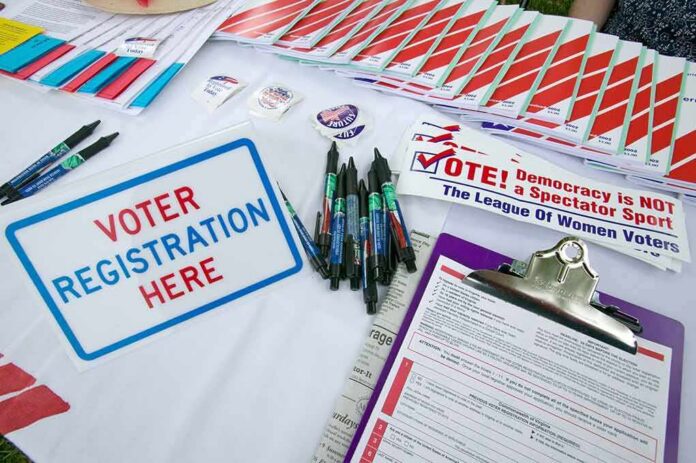
When President Trump charges that Democrats oppose voter ID and proof-of-citizenship rules, he is pointing at a real and traceable policy divide. His rally transcripts repeatedly frame Democrats as blockers of those measures, citing votes and procedural fights to argue resistance is categorical. On the other side, Democrats have for years articulated an explicit, consistent rationale: protect eligible voters’ access, resist rules they deem discriminatory, and verify citizenship through existing infrastructure—such as motor-voter database checks—rather than narrow document lists like passports and birth certificates. Senator Raphael Warnock’s remarks during debate over the SAVE Act make that case directly, supporting verification while rejecting a single-document pathway as the only valid proof. In short, the fight is not over whether noncitizens should vote (they should not) but over which verification mechanisms minimize both error and disenfranchisement.
That distinction matters because it sets the evidentiary bar. Trump’s transcripts show what he and his allies asserted on the stump; Democratic platform and congressional statements show what they say they are trying to avoid—discriminatory burdens on eligible voters—and how they propose to verify citizenship instead. The accusation that Democrats prefer laxity to enable cheating is not substantiated by the cited materials; the opposing record argues the reverse: security with access, using alternate verification tools.
Border enforcement: what changed, what didn’t
On border security, the administration’s claim of decisive action has a clear policy basis. Independent summaries note that, on day one, the administration implemented a rule functionally barring asylum applications at entry—a legal and operational pivot designed to reduce releases into the interior and to move quickly to detention or removal for those apprehended. Border-encounter metrics—imperfect but widely used—fell sharply relative to the prior year, with FactCheck.org reporting large declines compared with the final 12 months of the previous administration. Those structural choices explain how a change in rules could plausibly yield rapid changes in flow: raise the probability of swift removal, and attempted entries fall in tandem. Mechanism and measurement, at least at the level of encounters, align.
But the numbers must be kept honest. Two overstatements—“25 million” crossings under the prior administration and “zero” under the current one—do not map to government data. NPR reported hundreds of thousands of encounters in 2025, explicitly rejecting any notion that crossings reached zero. PBS likewise placed the 25 million claim well beyond immigration researchers’ estimates, citing ongoing apprehensions and contextualizing August activity at the southwest border. The strongest case for the current enforcement posture is the measurable decline in encounters under stricter rules; it is not the claim that inflow vanished or that past totals were tens of millions beyond recorded experience.
Taxes: real proposals, incomplete conclusions
Trump’s tax message is unusually specific for rally rhetoric, anchored in discrete exemptions and deductions: no tax on tips, no tax on overtime, elimination of federal tax on Social Security benefits for seniors, and an interest deduction for qualifying American-made auto loans; he pairs those provisions with the claim that every Democrat opposed them. The proposals themselves are documented in presidential addresses and rally transcripts, which is why they have salience—voters can understand what “no tax on tips” means at a paycheck level.
Two caveats keep the analysis grounded. First, opposition votes—if and where confirmed on bill text—do not, by themselves, prove Democrats are “raising taxes”; they may reflect disagreements over design, offsets, or deficit impact. Second, distributional and fiscal effects require formal scoring: what do these exemptions cost, who benefits by income decile, and how are they paid for or not? Without Joint Committee on Taxation and Congressional Budget Office estimates, sweeping conclusions about overall tax burdens outpace the evidence, even if the underlying proposals are real.
Energy prices and the temptation to oversimplify
Energy is where political messaging most reliably runs ahead of causal complexity. Gasoline and electricity prices clearly rose during the period at issue; PBS reported gasoline up roughly 41% from January 2025 by mid-September, with electricity up more than 8%. FactCheck.org documented weekly averages peaking around $4.50 per gallon in May and remaining above $4 into October. Those are meaningful increases for households. Yet tying them primarily to Democrats’ border posture confuses correlation with cause. Reporting during the period pointed to shifting global oil dynamics, OPEC pressure, tariffs that raised import prices, and the Iran war’s shock to energy markets—factors that hit pumps far from any immigration rulemaking. Assigning accountability for prices must follow the barrel, not the podium.
Why these arguments persist: legitimacy, security, deservingness
At bottom, these fights turn on which risks the public is asked to prioritize. Voter ID is framed as integrity versus access; border enforcement as sovereignty versus humanitarian and economic flows; tax exemptions as relief versus fiscal cost. The academic literature on voter ID undercuts some of the alarm on both sides: a large nationwide panel study found no measurable negative effect on turnout or registration, overall or by race, gender, age, or party, across 2008–2018. Meanwhile, research syntheses repeatedly find that documented voter fraud is exceedingly rare; public confidence tracks beliefs and elite cues more than courtroom evidence. That combination—low underlying incidence and high partisan signaling—helps explain why the same facts can sustain incompatible political narratives.
On immigration, semantics complicate public understanding. “Encounters,” “apprehensions,” “releases,” “removals,” and “successful entries” are related but not interchangeable. A crackdown that cuts encounters may still leave nonzero attempted or successful entries. Conversely, a spike in encounters can reflect enforcement intensity as much as underlying flow. Any fair reckoning has to separate categories and time frames; otherwise, rhetoric conditions the metric instead of the other way around.
What to watch to cut through the noise
Three items bring clarity fast. First, for elections, focus on the mechanism: what specific ID or proof-of-citizenship documents are permitted, what alternatives are allowed, and what verification already occurs in registration systems. That is where this policy debate actually lives, as Warnock’s SAVE Act critique underscored. Second, for the border, compare monthly CBP encounter, detention, parole, and removal data; demand definitions and consistency across periods. That grounds claims of success or failure in commensurable series rather than applause lines. Third, for taxes, insist on official distributional tables and deficit scoring before concluding who paid less or more overall, regardless of how compelling an exemption sounds in isolation.
Sources:
democrats.senate.gov, factcheck.org, rev.com, singjupost.com, npr.org, democrats.org, pmc.ncbi.nlm.nih.gov, misinforeview.hks.harvard.edu