When a president turns a ritual celebration of press freedom into an hour-long blend of condemnation of violence, rare praise, and sustained personal ridicule, the result is not just a “bombed” speech; it is a revealing stress test of the relationship between the White House and the media.
Key Points
- The rescheduled White House Correspondents’ Dinner followed an April shooting near the original event, sharply heightening the stakes and expectations for President Trump’s remarks.
- Trump opened by condemning political violence and honoring a wounded Secret Service officer, briefly adopting a civic, unifying tone before pivoting into jokes and rally-style attacks.
- The core of the speech mixed praise for some journalists with repeated personal insults, body-shaming and derisive nicknames directed at reporters and political rivals.
- Contemporaneous accounts consistently describe the room’s reaction as muted or stunned, with many jokes meeting silence and the overall performance framed as a failure to match the dinner’s traditional tone.
- The episode crystallizes a broader tension: the Correspondents’ Dinner is built on managed friction between presidents and the press, but Trump’s approach pushed that friction toward open antagonism rather than shared satire.
From Assassination Attempt to Rescheduled Gala: Why This Dinner Was Different
The 2026 White House Correspondents’ Association dinner was not an ordinary black-tie Washington ritual; it was the sequel to a night when gunfire cut the event short and sent hundreds of guests scrambling for safety. In April, a gunman tried to breach a Secret Service checkpoint at the Washington Hilton; prosecutors later said he was attempting to assassinate President Trump. The attack wounded at least one Secret Service officer and abruptly halted a gathering that traditionally celebrates press freedom with a mix of awards and comedy.
In the immediate aftermath, Trump used a briefing-room appearance to praise reporters for “responsible coverage” of the shooting and promised the dinner would be rescheduled “bigger and better and even nicer.” WHCA president Weijia Jiang announced the postponement at the request of law enforcement, underscoring that the incident was treated as a serious assault on democratic ritual, not merely a security scare. That context—an event explicitly framed as a rebuke to political violence and a reaffirmation of democratic norms—meant expectations for Trump’s address at the rescheduled dinner were unusually high and unusually fraught.
Opening Notes of Unity: Condemning Violence and Praising the Press
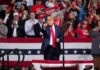
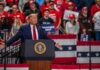
When Trump finally took the stage at the Waldorf Astoria, a former Trump-branded hotel now serving as the fallback venue, he began where many of his critics had hoped he would: with the attack. “As I said three months ago, the show must go on,” he told the room, describing the April incident as “attempted mass murder” and “an assault on our democracy itself.” He declared that “in America, we do not yield to political violence,” framing the dinner’s return as proof of institutional resilience.
The early portion of the speech also carried something rare for this presidency’s dealings with the press: explicit praise. He commended Secret Service officer Victor Gonzales, wounded while stopping the gunman, as well as hotel staff who helped guests during the chaos. He acknowledged the journalists in the room as doing an “amazing job” covering the shooting and said the dinner honored not just the correspondents but the Constitution itself. At one point, he nodded to differentiated treatment of the media, saying the room contained “a lot of people that I like, some I don’t like at all, but I respect most of them.” For a few minutes, the ritual looked familiar: president, press, shared shock, and a reaffirmation of basic democratic guardrails.
From Roast to Rally: How the Speech Shifted Tone
The unity frame did not last. After the opening tributes, Trump moved steadily into what multiple outlets described as a “rambling, hourlong” routine blending campaign rhetoric, grievance, and personal mockery. He joked that the speech he had originally prepared for the April dinner would have been “a doozy,” telling the audience he had “scrapped the most biting parts” in light of the shooting; “I was going to rip people,” he said, presenting his delivered remarks as a toned-down version of an even more aggressive script.
In substance, however, the speech still leaned heavily on the familiar architecture of Trump rallies. He recycled nicknames for political rivals, revisited disputes over coverage, and repeatedly cast the press as adversaries rather than partners in democratic debate. Reporters in the room and later analyses describe a string of jokes about public figures’ weight and intellect, barbs at entertainers like Bruce Springsteen and Jane Fonda, and pointed insults aimed at individual journalists. Kaitlan Collins of CNN, present as an award-winning reporter, was singled out again for “not smiling enough,” an echo of earlier clashes.
Trump peppered the performance with constitutional edge-play. He quipped about a third presidential term—“Just like my presidency, the second time is always better, and the third time will be better yet … I’m only kidding”—and casual references to a fourth, remarks that his supporters framed as jokes and his critics saw as revealing comfort with flirting at the limits of constitutional norms. The White House itself had previewed the address as “unifying yet vicious,” a phrase that turned out to be a reasonably literal description of its mix.
Insults, Identity Jabs, and the Limits of ‘Just Roasting’
What turned an edgy roast into a flashpoint was not simply the presence of criticism; it was the specificity and target selection of the insults. Accounts from ABC, CNN, The Advocate, and others describe Trump using the platform to mock not just political opponents but gay and transgender public figures, including two prominent gay journalists and actress Dylan Mulvaney, in ways framed as antigay and anti-trans. He told Representative Ilhan Omar to “Get out of our country,” according to contemporaneous clips and social reactions, sparking accusations of racist and xenophobic rhetoric at what is nominally a press-freedom gala.
The body-shaming and appearance-based jokes, frequently aimed at journalists in the room, landed particularly poorly. CNN’s media analysis characterized the speech as containing “far more insults than assertions of fact,” noting an “unusual number of unamusing jokes about body weight.” Fortune and regional outlets likewise described the address as “insult-filled,” highlighting the seesawing tone: brief nods to working together with the press followed by extended stretches of derision. In this sense, Trump did not just criticize coverage or institutional behavior—both common fodder at such dinners—but repeatedly personalized the conflict, making individuals’ bodies, identities and presence in the country the butt of the joke.
Reception in the Room: Laughter, Silence, and the Feeling of Hostility
Presidential speeches at the Correspondents’ Dinner are judged as much by the room’s energy as by their text. On that metric, the consensus is stark: Trump’s performance largely fell flat. Deadline’s inside-the-room account described the atmosphere as “the sounds of silence,” noting that attempts at Don Rickles–style insult comedy rarely drew more than scattered laughs and often met dead quiet. CNN said he “bombed,” not in the sense of a scandal but as a comic failure: a meandering performance that never found the audience’s rhythm.
Social and broadcast reactions captured a similar mood. One journalist said it “felt like a hostage situation,” characterizing the experience as being trapped while the president berated the press. Others noted the contrast with prior presidents—Barack Obama in particular—whose sets combined sharp jabs with self-deprecation and carefully managed warmth. The absence of genuine self-mockery in Trump’s remarks amplified the sense that the insults were not part of a shared ritual but an assertion of dominance in a room that could not simply walk out.
A Ritual Under Strain: The Dinner’s Tradition and Trump’s Approach
The deeper story here is not whether a single speech succeeded or failed as comedy; it is how this dinner illuminates a broader pattern in American political communication. The White House Correspondents’ Dinner has long functioned as a complicated ritual: a press-freedom celebration built on managed tension between presidents and the journalists who cover them. Its comedy segments are explicitly designed to allow pointed satire—presidents mocking themselves, the press, and their opponents—without destabilizing the underlying acceptance that a free press is legitimate.
Trump’s history with the dinner made this year’s event structurally sensitive. He skipped the gala throughout his first term, castigated it as an elite media party, and repeatedly attacked major outlets as “fake news” and “enemies of the people.” When an “anti-press president” walks into a “pro-press dinner,” as one Guardian preview put it, the margin for error narrows: the same line can be heard as either a witty jab or an institutional threat depending on who says it and how. Against that backdrop, a speech advertised as “unifying yet vicious,” delivered after an attempted assassination and freighted with identity-based insults, naturally tilted the interpretive balance toward “inappropriate” rather than “just roasting.”
How Coverage Split—and Where the Evidence Converges
Consistent with contemporary polarization, coverage of the dinner split into familiar frames. Some outlets and commentators emphasized Trump’s early homage to law enforcement and his rare praise for responsible reporting on the shooting, casting the address as an imperfect but legitimate attempt to engage a hostile press on a night dedicated to resilience. Others foregrounded the insults, the length and the muted reaction, arguing the speech turned a unifying ritual into a platform for grievance and norm-breaking attacks.
Where the evidence converges, however, is on structure and mix. Across mainstream and regional reporting, the speech is described as: about an hour long; opening with condemnation of violence and praise for a wounded officer and the press; and then shifting into a combination of accomplishments-touting, personal insults, and jokes about future terms in office. Video recordings and full-speech uploads corroborate that attendees heard both praise and attack, often in close succession. The disagreement is not over what he said but over how that blend should be judged—satire within ritual bounds or evidence of deepening institutional hostility.
What This Episode Tells Us About the Presidency–Press Relationship
Viewed as an evergreen case study, Trump’s Correspondents’ Dinner speech illustrates a structural truth: in high-conflict settings, satire and hostility are not clearly separable categories; they track institutional trust more than content alone. When a president with a record of anti-press rhetoric delivers a “unifying yet vicious” address at a press-freedom gala just months after an attempted assassination, many journalists will hear the vicious more loudly than the unifying, even if the script contains both.
For future presidents and media institutions, the lesson is less about specific jokes and more about context. The Correspondents’ Dinner can absorb sharp critique and pointed humor; it has done so for decades. What strains the ritual is sustained personalization—body-shaming, identity-based jabs and commands to “get out of our country”—that treat individual journalists not as professional adversaries but as illegitimate participants in public life. In that sense, the stunned silence that greeted much of Trump’s set was not merely a verdict on his timing; it was an audible record of a relationship under stress and a reminder that democratic rituals survive only when all sides still recognize themselves in the joke.
US President Donald Trump used the rescheduled White House Correspondents’ Association dinner on Friday night to lash out at political enemies, boast about his pressure campaign on Iran and joke that Senate Minority Leader Chuck Schumer had "turned Palestinian", in a speech that…
— The New Arab (@The_NewArab) July 25, 2026
Sources:
feedpress.me, nbcnews.com, c-span.org, youtube.com, deadline.com, cnn.com, theguardian.com, newindianexpress.com, reuters.com, wtop.com, abc13.com, unn.ua, advocate.com, facebook.com, wsj.com, independent.co.uk, presidency.ucsb.edu