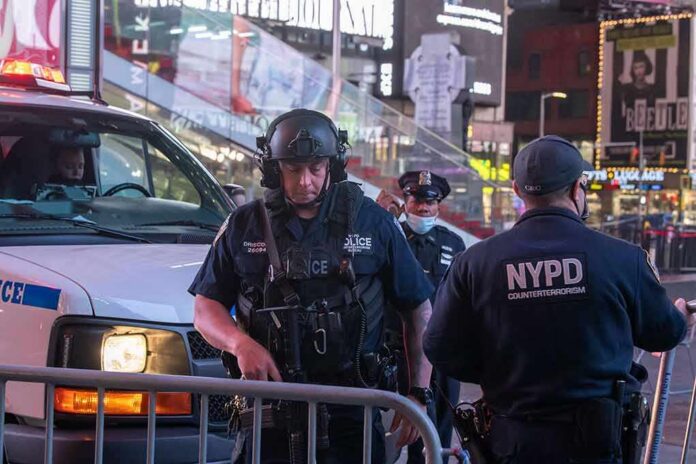
A former U.S. Army soldier is accused of showing up at a New York federal building with fire, weapons, and anti-government rage, raising fresh questions about how safe Americans really are around their own government buildings.
Story Snapshot
- Officials say Andrew Arrabaca, 43, set off an incendiary device and started a fire outside 26 Federal Plaza in Manhattan, home to immigration and federal offices.
- The FBI describes him as an anti-government extremist who arrived with gasoline, fireworks, pellet guns, axes, knives, and other weapons, allegedly looking to injure people.
- Three people suffered minor injuries, but the incident is now under federal investigation as a possible act of domestic terrorism by the FBI New York Joint Terrorism Task Force.
- Officials say Arrabaca carried “ICE Off Our Streets” signs and anti-Immigration and Customs Enforcement material, linking the attack to growing anger at federal immigration enforcement.
What Officials Say Happened at 26 Federal Plaza
On Monday morning, around 8:30 a.m., officials say Andrew Arrabaca wheeled a cart up to the entrance of 26 Federal Plaza in lower Manhattan, a major federal building that houses immigration court and federal law enforcement offices. According to the Federal Bureau of Investigation (FBI), he doused a stairwell or entrance area with gasoline, then used a lighter and a large firework or similar device to ignite it, sending flames and thick smoke up the front of the building. Video from the scene shows a large plume of white smoke and fire as officers rush to respond and tackle the threat.
FBI leaders say the fire was not the only danger. After starting the blaze, Arrabaca allegedly pulled out an airsoft rifle or pellet gun and fired five to seven rounds toward the building’s north side. Federal Protective Service officers, New York City police officers, and FBI agents quickly moved in, contained the scene, and took him into custody before the situation grew worse. Authorities report three people received minor injuries, including at least one federal employee and one civilian, and they have since been released from the hospital.
Who Andrew Arrabaca Is and Why Officials Call Him an Extremist
Officials identify Arrabaca as a 43-year-old former U.S. Army soldier who served from 2001 to 2005 as a mechanic on Patriot missile systems. At the time of the attack, police say he wore a military-style helmet and pushed a cart that held incendiary devices, flammable liquid, and weapons. FBI Assistant Director James Barnacle said Arrabaca “came armed with bad intentions” and was “looking to injure people and harm people.” Barnacle called him an “anti-American, anti-government extremist” and described the incident as an “anti-government attack on a federal facility.”
Officials say Arrabaca’s cart carried a sign reading “ICE Off Our Streets” and “anti-ICE literature,” tying his motives to anger at Immigration and Customs Enforcement. When officers arrested him, Barnacle and others report that he shouted derogatory statements about ICE and made clear his hostility toward the government’s immigration enforcement. Investigators say he had two pellet or airsoft rifles, two axes, a hammer, a machete, three fixed-blade knives, several fireworks or incendiary devices, and other “destructive items” with him when he approached the building. The New York Police Department bomb squad later examined his cart to make sure no other dangerous devices remained.
Why This Incident Feeds Growing Public Distrust
The FBI New York Joint Terrorism Task Force is leading the case, with help from the New York City Police Department and federal prosecutors, and is treating it as a possible act of domestic terrorism. Charges had not yet been announced in early briefings, but investigators say they have no sign of a broader ongoing threat to the public at this time. Still, the attack touches deep nerves. The building at 26 Federal Plaza has long been seen as a target for extremists, because it combines immigration enforcement and other federal offices in one busy downtown tower.
Researchers have tracked a steady rise in anti-government plots and attacks on government buildings, police, and military sites since 2020, driven mostly by people angry at their own government rather than by foreign terrorist groups. Another report found hundreds of planned attacks against “state targets,” including government offices and law enforcement, over the last three decades. For many Americans on both the left and the right, this trend fuels a sense that the system is breaking down. Some see a federal government that feels distant, unresponsive, and more focused on protecting itself than serving regular citizens.
The Shared Worry Behind Anti-ICE Anger and Federal Security Fears
Many conservatives have long felt that federal immigration policy is too loose, encouraging illegal crossings and straining towns and cities. Many liberals feel federal immigration enforcement is harsh, unfair, and targets vulnerable people trying to build a better life. Attacks like the one officials describe at 26 Federal Plaza turn that anger into violence and push the debate into a space where nobody wins, least of all the workers and citizens placed in danger just trying to do their jobs or attend hearings.
Video shows suspect Andrew Arrabaca allegedly pouring gasoline and setting a fire outside Manhattan's 26 Federal Plaza, home to New York's immigration court and ICE offices.
Arrabaca is now in custody. Sources tell FOX News he had "anti-ICE stuff on him" at the time of the…
— Alhaji Mobola Ajagbe (@alhajimobola2) July 21, 2026
Arrabaca’s case highlights a painful truth both sides increasingly share: when people stop trusting that government can solve hard problems fairly, some turn that distrust into rage at the system itself. Experts say more anti-government extremists now focus on federal buildings, courts, and police as symbols of a country they believe has turned against them. The result is more risk for everyday Americans who must walk past those buildings, and more pressure on a government many already believe protects its own power better than it protects the public it claims to serve.
Sources:
youtube.com, police1.com, nbcnewyork.com, foxnews.com, zerohedge.com, case-law.vlex.com, policeforum.org, csis.org