When a high-profile figure is arrested on suspicion of impaired driving, the real stakes extend well beyond a single traffic stop: it exposes how quickly an arrest record can shape public judgment long before any court has said what, if anything, the law was actually violated.
At a Glance
- Milwaukee County Sheriff’s records show Tony Romo was stopped on I-43 and taken into custody on suspicion of operating while intoxicated (OWI).
- Multiple outlets, citing the same arrest-detention report, say Romo “performed poorly” on standardized field sobriety tests before being booked and released.
- Romo received a September 21 court date, consistent with a formal first-offense OWI process under Wisconsin law, which is typically handled as a civil, not criminal, matter.
- The publicly available reporting is built on a single law-enforcement narrative; there is no disclosed chemical test result and no on-record response from Romo or his counsel.
The Arrest: What the Records and Reporting Actually Say
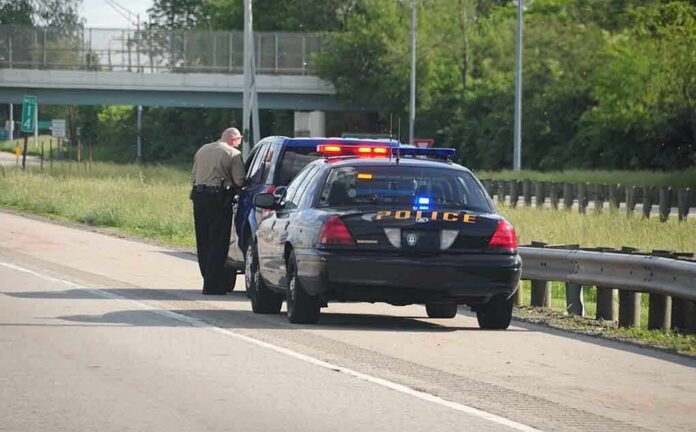
According to an arrest-detention report obtained by Milwaukee television station WISN and then widely echoed by national outlets, former Dallas Cowboys quarterback and current CBS NFL analyst Tony Romo was stopped by Milwaukee County sheriff’s deputies on Interstate 43 on a Thursday evening in late July. The report places the stop on the southbound lanes of I-43 in Milwaukee County; secondary accounts variously list the time as shortly after 6 p.m. or closer to 8 p.m., a minor discrepancy typical of early syndicated coverage. What is consistent is the core allegation: Romo was operating a vehicle, was pulled over, underwent roadside sobriety assessment, and was then arrested on suspicion of operating while intoxicated (OWI).
Media descriptions of the arrest rely on two key elements from that sheriff’s document. First, deputies reportedly noted that Romo “performed poorly” on standardized field sobriety tests, a phrase that appears verbatim or near-verbatim across ABC, ESPN, The Athletic, Fox 6 Milwaukee, and later sports sites that cite the same report. Second, the report indicates that he was taken into custody, booked in the Milwaukee County Jail, and then released later that night, rather than merely being cited at the roadside and allowed to depart. NBC Sports’ ProFootballTalk, among others, describes the incident as an arrest for OWI, first offense, tied directly to the sheriff’s documentation.
The paperwork also includes a court date. Romo is scheduled to appear in court on September 21 at 8:30 a.m., a detail carried consistently across ABC’s national coverage, The Athletic, Fox 6, and other outlets that obtained or reviewed the same record. That date falls within the early weeks of the NFL regular season, raising practical questions for CBS and for Romo’s broadcasting schedule, though there has been no public indication of how the network intends to handle the matter.
OWI in Wisconsin: Law, Penalties, and Why “First Offense” Matters
To understand the legal posture of Romo’s case, it helps to separate the headline word “arrested” from the underlying category of offense. In Wisconsin, a first-offense OWI is generally treated as a civil violation rather than a criminal charge, barring aggravating factors such as injury, extremely high blood alcohol content, or a minor passenger. The Wisconsin Department of Transportation guidance, cited by The Athletic and local Milwaukee coverage, indicates that a typical first-offense OWI carries a fine in roughly the $150–$300 range, plus a mandatory surcharge of $435.
Despite that civil classification, the enforcement process can look and feel very much like criminal procedure to the driver involved. Deputies may conduct roadside investigations, administer field sobriety tests, arrest on probable cause, and book the individual into jail even for an eventual civil OWI citation. Romo’s experience tracks that pattern: stop, field tests, custody, booking, release, and a scheduled court appearance. In legal terms, the state is asserting that his driving met the statutory threshold for “operating while intoxicated,” but has not yet proved that claim in court.
One notable gap in the public record is the absence of any documented chemical test result. Coverage that derives from Fox 6’s access to the arrest-detention report explicitly notes that the report does not specify whether Romo submitted to breath testing or declined, leaving open whether a blood alcohol concentration (BAC) number exists in the case file at all. Without that figure, the public narrative rests largely on the officers’ observational notes and the field sobriety performance rather than a quantified measure of impairment.
Field Sobriety Tests and the Limits of Early Information
The phrase “performed poorly on standardized field sobriety tests” carries weight because these assessments—such as the horizontal gaze nystagmus test, the walk-and-turn, and the one-leg stand—are designed and validated to give officers a structured way to detect possible impairment. However, the description in Romo’s case is purely summary. None of the available reporting specifies which particular tests were administered, how many “clues” of impairment were recorded, whether any non-alcohol factors (fatigue, medical conditions, weather, roadway slope) were noted, or how long the interaction lasted.
This is typical of celebrity arrest coverage: local outlets obtain a concise arrest narrative meant for internal law-enforcement and court use, then translate that into a short public-facing story that highlights the arrest, the suspicion, and the upcoming court date. When that story involves a nationally known figure, it is rapidly picked up by sports networks, entertainment sites, and general news organizations, each of which reiterates the same core facts, often with minor stylistic variations but no new underlying data. The result is a strong public impression of impaired driving based on a narrow slice of the evidentiary record.
None of the surfaced coverage includes a statement from Romo, from any attorney representing him, or from CBS as his employer. The sheriff’s office report speaks through its institutional voice; the media relay that voice; the defendant’s perspective, potential explanation, or legal strategy remains unknown at this stage. That asymmetry is not unusual immediately after an arrest, but it does mean that the narrative currently visible to the public is one-sided and provisional.
From Local Record to National Story: How Celebrity Arrests Scale
Romo’s situation illustrates how quickly a localized enforcement action can become a national talking point. The initial document is a Milwaukee County Sheriff’s Office arrest-detention report, obtained by WISN, a local ABC affiliate. Within hours, that report’s key phrases—“stopped on Interstate 43,” “performed poorly on standardized field sobriety tests,” “taken into custody,” “booked and released,” “court date set for Sept. 21”—appear in coverage by ABC News, ESPN, The Athletic, NBC Sports, Fox News, Page Six, and a range of sports blogs and social accounts.
Because each outlet is citing either WISN’s reporting or Fox 6’s access to the same underlying record, they are effectively syndicating a single law-enforcement narrative rather than independently verifying additional facts. That repetition increases confidence that the basic arrest details are accurate—stop location, time window, custody and release, court date—while simultaneously limiting the public’s exposure to nuance. The officer’s full narrative, any dashcam or body-worn camera footage, any chemical test logs, and any later court filings are not part of this first wave of coverage.
For someone like Romo, whose professional life now depends on public trust and on-air credibility as much as physical performance once did on the field, that amplification has reputational consequences. An OWI arrest is a legally bounded event: it is a suspicion-based custodial response to alleged impaired driving. In the public imagination, particularly for a figure associated with discipline and preparation in sports, it can be read more broadly as a judgment on character or judgment, even before any adjudication occurs.
Legal Process Ahead and the Distinction Between Arrest and Guilt
The scheduled September 21 court appearance is the point at which Romo’s case will move from a sheriff’s narrative into a judicial proceeding. For a first-offense OWI in Wisconsin, that appearance typically involves either entering a plea, challenging the citation, or negotiating a disposition under state law. The range of outcomes spans from upholding the citation with fines and license-related consequences, to amending charges, to dismissals where the evidence does not meet the required standard.
At this stage, there is no publicly available indication of how Romo intends to respond. No charging document beyond the OWI allegation has been highlighted in the reporting, and no enhancement factors (injury, high BAC, minor passengers) have been mentioned; the case is consistently framed as a first-offense OWI associated with poor field sobriety performance and a routine booking and release. That framing aligns with the law’s treatment of many first-offense impaired-driving allegations, but it does not answer the underlying factual question of whether Romo was, in fact, legally intoxicated while driving.
The distinction matters. An arrest is based on probable cause—a comparatively low evidentiary threshold grounded in reasonable belief. A conviction or sustained citation requires proof that meets the applicable standard, which in civil OWI proceedings still entails a structured evaluation of evidence. Public coverage tends to be loudest at the arrest stage and quieter at resolution; if the case is later narrowed or dismissed, those developments may not travel as far as the initial headlines.
Impaired Driving, Public Figures, and Responsible Interpretation
From a broader perspective, Romo’s arrest sits within a longstanding public concern about impaired driving and its consequences. Local and national media frequently juxtapose relatively routine OWI citations with catastrophic DUI cases involving serious injury or death, reinforcing the message that operating a vehicle under the influence can have devastating effects even when a particular incident does not result in a crash. Commentary around Romo’s case has already begun to draw those comparisons, pointing to the spectrum of legal penalties and life impacts associated with impaired driving.
For an informed reader, the challenge is to hold two truths at once. First, impaired driving is a serious public safety issue, and an OWI arrest—particularly for someone with the resources and visibility to avoid putting themselves in that position—deserves scrutiny. Second, an arrest report is a starting point, not a final judgment. Without access to the full law-enforcement file, chemical test data, and court proceedings, the public sees only a thin slice of the story: a stop, a set of tests summarized as “poor,” a booking, and a future date on the calendar.
The responsible stance, especially with high-profile defendants, is neither excusal nor premature condemnation. It is to recognize the gravity of the allegation, understand the legal framework that governs it, and wait for the legal process to clarify what happened on that July night on Interstate 43—while remembering that the long tail of search results and headlines will continue to shape perception long after the court has spoken.
Tony Romo being arrested on suspicion of OUI is a shocking headline. Hopefully no one was hurt, and the legal process will establish exactly what happened.
— leo (@_belikeleo) July 24, 2026
Sources:
thegatewaypundit.com, nytimes.com, abcnews.com, youtube.com, yardbarker.com, sportsmediawatch.com