
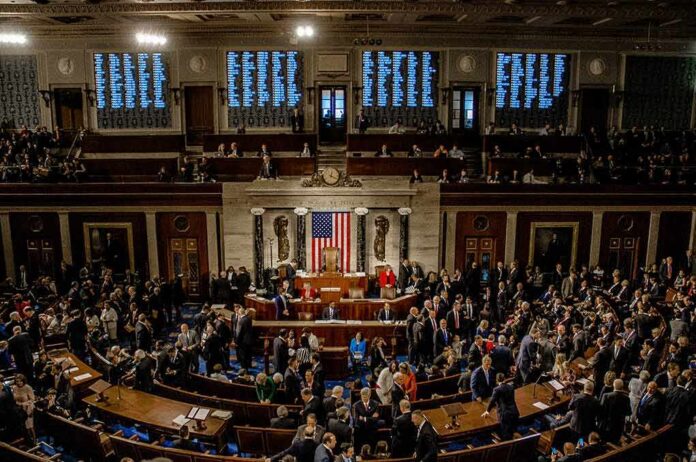
The fight over Hakeem Jeffries’s speakership is not really about Hakeem Jeffries. It is about who gets to decide what a governing majority owes its most energized supporters once an election has actually been won — and that question has outlasted every Congress that has ever faced it.
Key Points
- A faction of incoming progressive Democrats withheld commitment to Jeffries’s speakership bid, backed by a petition that crossed one million signatures and a surge of constituent calls to House offices.
- The objections center on specific policy grievances — Medicare for All, corporate influence, military assistance to Israel, and the pace of oversight into Trump — not personal animus toward Jeffries.
- Jeffries’s own public record shows a consistent, affordability-first strategy paired with concrete opposition to tariffs, Medicaid cuts, and the Iran war, directly rebutting the charge that he is simply passive.
- The congressional math behind the revolt remains undefined: reporting documents undecided members and loud online pressure, not a verified bloc capable of blocking his election.
- This pattern — ideological wing versus institutional leadership at a speakership transition — has recurred in American politics since the Cannon revolt of 1910, and it rarely resolves in favor of the insurgents.
What The Opposition Is Actually Arguing
The case against Jeffries, as it has surfaced in reporting from early November 2026, is more substantive than a simple personality clash. Newsweek identified Claire Valdez as undecided and Melat Kiros as the clearest holdout among incoming progressives, while Reuters reported that Jeffries still needed to lock down support from members-elect including Darializa Avila Chevalier. Common Dreams quoted Corbin Trent, a former senior aide to Representative Alexandria Ocasio-Cortez who now leads the organizing group A Fight Worth Having, declaring that “the Democratic leadership we have today is completely ill-suited for this moment”. CNN’s reporting traced the skepticism to two recurring flashpoints: Jeffries’s record on Medicare for All and his posture toward military assistance to Israel.
That grievance list has teeth because it is specific, not vague dissatisfaction dressed up as principle. It names policies, cites voting history, and points to donor relationships that critics argue shape Jeffries’s priorities. But specificity in the complaint is not the same as unity in the remedy. The sourcing does not establish that anti-corporate activists, Israel-policy critics, Medicare for All advocates, and Trump-accountability hawks share one preferred alternative Speaker or one legislative program — they are allied in opposition, not necessarily in vision, which is historically the fault line where insurgencies against sitting leadership tend to fracture before a floor vote ever happens.
Jeffries’s Own Words Undercut The Passivity Charge
The most quotable piece of ammunition for Jeffries’s critics is his own language: Fox 5 Atlanta reported that he urged Democrats to focus on lowering costs rather than getting “even” with the Trump administration. Progressive organizers read that as a confession of timidity. But set against Jeffries’s documented public record, that reading collapses under its own selectivity. In his formal candidacy letter to colleagues, Jeffries called for reversing Medicaid cuts, restoring SNAP funding, extending Affordable Care Act tax credits, eliminating the Trump tariffs, and ending “the reckless war of choice in Iran” within the first hundred days of a Democratic majority. He has repeated, nearly verbatim, across a Brooklyn press conference, a Bloomberg interview, and an NPR appearance, that Trump tariffs “have increased costs on everyday Americans by thousands of dollars per year” and that House Democrats are “uniformly and strongly opposed” to the Iran war.
That is not the language of a leader avoiding confrontation. It is the language of a leader choosing which confrontation to foreground — economic grievance over impeachment theater — because he calculates it carries a broader coalition. The Atlantic’s postmortem on the 2026 midterms credited exactly this discipline: Jeffries “repeatedly emphasized affordability” and argued that “hostility toward Trump will not displace Democrats’ focus on lowering costs”. Whether that strategy satisfies activists demanding aggressive oversight is a legitimate disagreement about tactics. Whether it proves Jeffries is unwilling to pursue accountability is a claim the record does not support — he has simply bet that affordability, not confrontation, is what won Democrats their majority in the first place.
How Big Is This Revolt, Really
Numbers matter more than noise here, and the numbers are genuinely ambiguous. Common Dreams reported the anti-Jeffries petition surpassed one million signatures, while Axios described Democratic House offices as “inundated” with calls and emails opposing his speakership. That is real mobilization energy. But a petition signature is not a vote, and nothing in the available reporting discloses deduplication methods, geographic distribution, or confirmation that signers are even constituents of the members whose votes matter. Online intensity has misled observers before — it measures enthusiasm, not leverage.
The congressional side is thinner still. Reuters and Newsweek together name a handful of undecided or skeptical members-elect, not a confirmed bloc large enough to deny Jeffries the gavel. Reuters’ framing — Jeffries “poised to become” Speaker — signals that institutional expectation still runs decisively in his favor, even as it acknowledges his need to manage the coalition’s edges.
A Fight The House Has Had Before
Readers inclined to treat this as unprecedented dysfunction should know better. The Speaker’s office has always carried a built-in tension — presiding officer, party leader, and administrative head rolled into one person who must simultaneously represent an ideological wing and assemble a working majority. Progressive Republicans broke Speaker Joseph Cannon’s near-dictatorial control in 1910 and extracted rules concessions from Fredrick Gillett before letting him take the gavel in 1923. Two dozen House Democrats ran for reelection in 2010 pledging to oppose Nancy Pelosi’s return as Speaker; she won anyway. The Freedom Caucus hounded John Boehner and then Paul Ryan through years of internal rebellion before finally toppling Kevin McCarthy in 2023 — an ouster NPR’s historian guest called unprecedented in scale, even if the underlying grievance was familiar.
The lesson of that history is not that insurgencies always fail — Cannon’s authority was permanently diminished even though he kept his title. It is that ideological factions rarely unseat an institutional favorite outright; they extract concessions, reshape rules, or wait for the next vacancy. Jeffries enters this moment with the advantages every presumptive Speaker enjoys: whip operation, committee assignments as leverage, and a caucus more interested in governing than in martyrdom. The progressive wing’s realistic ceiling is influence over his agenda, not his removal — unless the undecided bloc proves larger than anything currently documented.
What This Means Going Forward
The durable story here is not whether Jeffries survives a first ballot — by every available account he is heavily favored to. It is whether his affordability-and-accountability framework can absorb activist energy on Medicare for All, Israel policy, and Trump oversight without fracturing the coalition that just delivered Democrats a majority. That tension will outlive this particular vote count, resurfacing at every committee assignment, every oversight letter, and every spending fight for the length of his speakership. Leaders who manage that tension well get a long tenure; those who don’t get challenged again, sooner than they’d like.
Sources:
pjmedia.com, newsweek.com, fox5atlanta.com, cnn.com, commondreams.org, english.elpais.com, axios.com, jeffries.house.gov, npr.org, history.house.gov