
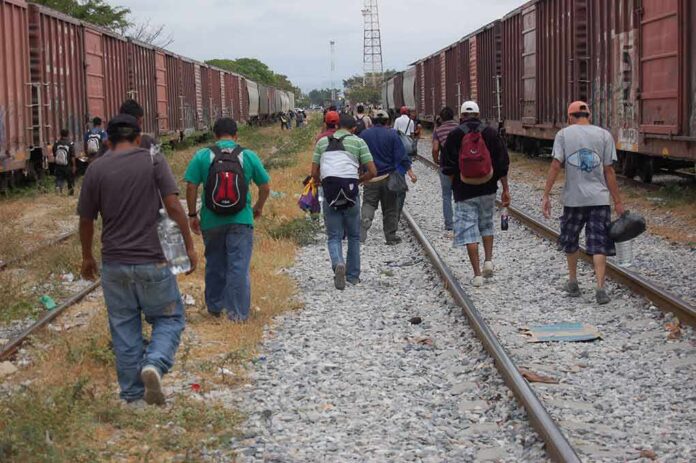
Small, highly visible migrant caravans are best understood as a recurring instrument of survival and signaling—not the main artery of regional migration—and the latest group leaving Tapachula after the U.S. midterms fits that pattern precisely.
At a Glance
- A caravan of roughly 1,000–1,500 people departed Tapachula, Mexico, on November 10, 2026, moving north toward the United States.
- Participants cited hopes tied to the U.S. election while also pursuing familiar drivers: safety, work, family reunification, and onward transit.
- Caravans gather outsized political attention but represent a small fraction of total northbound migration through Mexico.
- Most caravans splinter, are partially detained, or accept permits long before reaching the U.S. border; the journey is long, slow, and contingent.
What Happened: A Post-Election Departure With the U.S. in Mind
Shortly after the U.S. midterm elections, a caravan set out from Tapachula, the gateway city on Mexico’s southern border with Guatemala that routinely absorbs large inflows from Central America, the Caribbean, and increasingly South America. Wire reports on November 10 documented the group’s northward movement and its mixed composition—single adults, families, and children pushing strollers—consistent with prior Tapachula departures. Participants said they hoped the election outcome would translate into a more accommodating environment in the United States, a now-familiar belief that surges whenever policy change seems plausible or imminent.
The estimates clustered around 1,000–1,500 people at departure—well above “a few hundred”—and the stated aim was straightforward: proceed through southern Mexico and ultimately toward the U.S. border. Public discussion often jumps from such a departure to talk of an imminent arrival, but geography and enforcement intervene. From Tapachula, even an uninterrupted overland trek to the nearest legal ports of entry is measured in weeks and more than a thousand miles. In practice, caravans slow, fragment, accept transit documents, or are met by Mexican authorities who redirect, detain, or bus subsets elsewhere.
How Caravans Work: Safety in Numbers, Visibility as Leverage
The modern “caravan” is a tactical response to two realities on Mexico’s migration corridor. First, travel is dangerous: robbery, extortion, sexual assault, and kidnapping are recurrent risks. Groups offer mutual protection, shared information, and a measure of deterrence against crime. Second, visibility can be leverage. A massed group walking by day forces governments to engage in the open rather than through opaque interdictions. This does not guarantee passage; it does create opportunities to secure humanitarian visas, temporary transit documents, or transport away from border bottlenecks. Those incentives explain why caravans may swell along the route as individual travelers join.
Despite their salience on cable news, caravans account for a small share of total migration. A Rice University Baker Institute review identified roughly 30 caravans between 2017 and 2022—an increase in frequency across those years—but emphasized that most northbound movement still occurs outside such formations, often via buses, trucks, and smugglers operating out of public view. In other words, caravans are the visible tip of a much larger, more complex system of mobility.
Election Optics vs. Migration Realities
This Tapachula caravan’s timing—leaving days after the U.S. midterms—and the on-the-record quotes about hopes for a friendlier policy environment created a clean narrative line for political actors on both sides of the border. It also invited a familiar misreading: that U.S. election results mechanically cause caravans. People on the move regularly update their expectations as they absorb rumors, headlines, and WhatsApp snippets about U.S. rules; those expectations shape how they talk to reporters and each other. But decisions to uproot rarely rest on one factor. Chronic insecurity at home, collapsed labor markets, family already in the United States, and prolonged waits in Tapachula’s asylum pipeline create steady pressure. Electoral moments simply surface that pressure—and give it a quote and a date stamp.
U.S. leaders, for their part, respond to the visibility. Public threats to increase tariffs on Mexico to compel stronger enforcement—most recently reprised as the caravan advanced—turn a dispersed humanitarian issue into a bilateral bargaining chip. That linkage is not new, and it often produces short bursts of intensified Mexican enforcement, targeted bus transports, and temporary dispersal rather than a durable change in the region’s migration calculus.
Routes, Risks, and Why Most Caravans Don’t Reach the U.S. Border Intact
From Tapachula, the standard path leads through Chiapas and Oaxaca, then into Veracruz and Puebla, or alternatively westward toward Oaxaca’s Isthmus and up to Mexico City. Each segment imposes attrition. Families slow; children get sick; municipal shelters fill and empty; National Guard and migration officials steer columns away from highways; opportunistic crime spikes at choke points. The arithmetic of distance and fatigue is relentless. Even the largest, most publicized caravans typically fragment, with only a fraction of original walkers reaching northern border cities many weeks later, often no longer as a single mass but as a trickle by bus or train. Contemporary coverage of this caravan underscored the distance left and the obstacles ahead, even as day-one imagery suggested momentum.
That pattern explains why local Mexican records—shelter logs, municipal intake tallies, and sporadic enforcement memos—often tell a story of scatter and slowdown, not linear advance. For travelers, that can still be success: a temporary transit paper, a bus ride north, or a safer leg than moving alone. For policymakers, it is the opposite of a made-for-television surge; it is the mundane, administratively taxing work of processing thousands of individual cases in dozens of towns.
The "Dios con Nosotros" migrant caravan is stalled in Arriaga, Chiapas, on Mexico's border with Oaxaca, after walking about 340 km in 21 days from the Guatemala border.
The group of Honduran, Guatemalan and Salvadoran migrants, now estimated at roughly 500 to 800 people, down…
— Patrick Hacker (@HackerPdhacker) November 24, 2026
What the Data Say About Caravans’ Broader Significance
Researchers who track the phenomenon converge on two conclusions. First, caravans are episodic expressions of ongoing flows, not their driver. Remove the spectacle, and the baseline continues: asylum seekers and economic migrants navigate a patchwork of Mexican and U.S. policies, humanitarian parole programs, transit permits, and enforcement bursts. Second, outsized media focus on caravans tends to distort public understanding and policy response. The Baker Institute work argues that punitive, election-timed measures do little to alter aggregate migration and may, paradoxically, reshape caravan behavior without reducing total entries; the flows adapt, often in more dangerous forms, while the cameras move on.
Why This Matters Now—and Next
The Tapachula departure is not an anomaly; it is the latest iteration of a form that blends protection, protest, and passage. Its visibility will again be drafted into partisan narratives about deterrence and sovereignty. The practical stakes are different on the ground. Municipalities along the route will juggle shelter capacity, health care, and policing. Mexico’s federal agencies will decide whether to fragment, transport, or regularize subsets. In the United States, the policy instruments that actually shape outcomes—processing capacity at ports of entry, asylum adjudication timelines, targeted labor pathways, and coordinated repatriation—will matter far more than televised threats or a single caravan’s headcount.
Sources:
efs.efeservicios.com, reuters.com, aljazeera.com, dawn.com, news.rice.edu