The real significance of the FCC’s drone move is not that it targets gadgets; it is that Washington is treating drone access as a homeland-security control point, not merely a consumer-electronics question. Once a platform can carry sensors, transmit data, and scale from hobby use to military utility, the debate shifts from product quality to supply-chain sovereignty, and that is exactly where the FCC has chosen to draw its line.
Intro Header
- The FCC’s action is rooted in a national-security determination, not a conventional product-safety recall.
- The policy is broad in principle, but its operation is narrower than the loudest public framing suggests.
- It blocks new FCC authorizations for covered foreign drone models and critical components, while leaving existing authorized hardware in use.
- The government has also built exemptions and conditional approvals into the framework, which matters because this is not a pure blanket ban in practice.
The Core Logic: Why Drones Became a Security Problem
The FCC’s Covered List mechanism is built for technologies the government believes can expose U.S. persons, infrastructure, or communications networks to unacceptable risk. In the drone context, that concern is unusually elastic because a drone is not just an aircraft; it is a flying computer, a sensor package, and a data link. That combination creates three distinct vulnerabilities: physical threat, unauthorized surveillance, and the possibility of sensitive data exfiltration through the device’s hardware or software stack.
That is why the FCC’s December 2025 action landed so hard. The agency did not merely discourage foreign drone imports; it placed foreign-produced unmanned aircraft systems and critical components on the Covered List, which cuts off new FCC equipment authorizations and therefore blocks market entry for covered models. The legal effect is decisive even when the policy rhetoric is broad: without authorization, the product cannot be introduced into the U.S. market through normal regulatory channels.
The practical meaning of “critical components” is also broader than casual readers often assume. Compliance summaries describe it as including data transmission devices, communications systems, flight controllers, ground control stations, navigation systems, sensors and cameras, batteries and battery management systems, and motors, so long as they are designed primarily for UAS use. That matters because a drone supply chain is modular; control the modules, and you control the platform. The policy is therefore aimed as much at the parts ecosystem as at the finished aircraft.
How the FCC Built the Rule
The December action did not emerge in a vacuum. It followed an executive-branch national security determination that foreign-produced UAS and critical components pose unacceptable risks to U.S. national security and the safety of U.S. persons. The FCC then translated that determination into a market-access restriction by adding the category to its Covered List, the same regulatory tool it uses for other communications equipment deemed too risky for authorization.
The key structural point is that this is an authorization regime, not a retroactive confiscation regime. According to compliance analyses, the FCC’s rule does not prohibit continued use, sale, or importation of drone models that were already authorized before the Covered List action. DroneDeploy’s summary is even more explicit: the FCC is prohibited from authorizing new foreign drone models for the U.S. market, but existing authorized hardware remains legal to purchase, own, and fly. That distinction is central to understanding the policy honestly. It is severe, but not universal.
Subsequent follow-on guidance made the picture more nuanced still. Law-firm analyses report that the FCC created temporary exclusions for Blue UAS-cleared products and for qualifying domestic end products, and that those exemptions are time-limited. In other words, Washington did not simply declare every foreign-made drone equally dangerous; it created a framework that assumes some products can be screened, cleared, or grandfathered for a period of time. The policy is categorical at the point of authorization, but conditional in its exceptions.
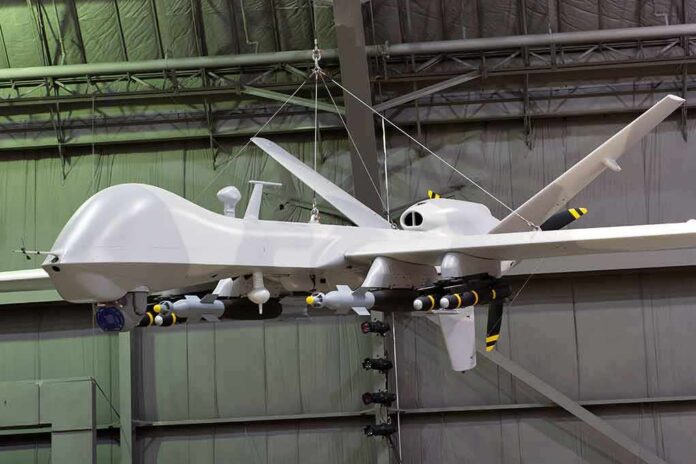
The July 2026 reporting on military-grade drones sharpened that distinction rather than dissolving it. Reuters reported that the FCC tentatively decided to ban the import of some foreign-produced military-grade drones, specifically including swarming drones and drones with infrared technology, while excluding non-military-grade drones and federal-government purchases. That narrower proposal matters because it shows the agency is increasingly differentiating between ordinary commercial airframes and platforms with obvious battlefield utility. The policy is becoming more discriminating, not less.
This is where the strongest counterargument sits. The public framing of “foreign drone ban” is broader than the operational record. The FCC’s own framework includes exemptions, conditional approvals, and category-based carveouts, and Reuters reported that the military-grade proposal does not apply to all drones. Those facts do not defeat the government’s national-security rationale, but they do refute the simplistic idea that Washington has imposed an undifferentiated embargo on every foreign drone in every context. It has not.
Why the Government Chose Market Access as the Lever
The deeper logic here is familiar across U.S. technology policy. When lawmakers and regulators believe a foreign technology may create coercion, espionage, or infrastructure dependence, they increasingly intervene upstream—at the level of procurement, authorization, and component sourcing—rather than waiting for a post-incident remedy. The drone fight belongs in that family. The issue is not whether a particular unit works on day one; it is whether the vendor, firmware, data pathway, and parts pipeline leave the United States structurally exposed over time.
That is also why this debate keeps returning in adjacent sectors such as telecom gear and apps. Once a technology becomes dual-use—valuable in commerce, useful in surveillance, and adaptable for military purposes—the government’s instinct is to manage access rather than adjudicate every individual use case. The FCC’s drone move reflects that doctrine almost perfectly. It is a supply-chain policy dressed as a communications rule.
Critics are right to say the public record does not include a declassified technical appendix proving that every foreign drone is unsafe. The supplied materials do not show a court finding, forensic audit, or incident-by-incident proof that would settle the matter in public. But that absence does not erase the government’s case. National-security regulation often advances on a different evidentiary footing than ordinary consumer law; agencies act on risk concentration, foreign control, and the difficulty of verifying complex systems at scale, not only on publicly litigated failures.
The Real Tradeoff: Security, Choice, and Industrial Policy
The policy’s economic effects are not incidental. By blocking new foreign models from authorization, the FCC reshapes the market in favor of authorized pathways and domestic-end-product categories, which inevitably benefits some suppliers and constrains others. That does not prove the rule is a disguised industrial-policy play, but it does mean the commercial consequences are inseparable from the security rationale. In a market as concentrated as drones, the two cannot be cleanly separated.
There is also a subtler consequence: the rule may accelerate U.S. and allied drone manufacturing by making reliance on foreign supply more costly and less predictable. The DoW-aligned exemption structure, especially the Blue UAS and domestic-end-product pathways, suggests the government wants a resilient domestic base rather than permanent dependency on screened foreign imports. That is not an accidental byproduct; it is part of the design.
Still, the strongest disciplined reading of the evidence is this: the FCC has imposed a serious and far-reaching restriction on foreign drone market access, but it has not issued an absolute ban on all foreign drones in all circumstances. The policy is prospective, selective in operation, and anchored in a national-security judgment that the available public record does not disprove. The lingering controversy is therefore not whether the agency acted; it is whether its chosen line is broader than necessary, and whether exemptions can remain a durable substitute for a more granular technical standard. On the record available now, the government has the stronger case on security, but critics have a real argument about scope.
"Safeguard Our Homeland": FCC Moves To Ban Foreign Military-Grade Drone Imports https://t.co/FsJjvy03kp #Money #Finance #Economics #Market
— Alen Karabegovic (@AlenKarabegovic) July 21, 2026
Sources:
zerohedge.com, reuters.com, gtlaw.com, dronelife.com, cbsnews.com, politico.com, washingtonexaminer.com, dronedeploy.com