
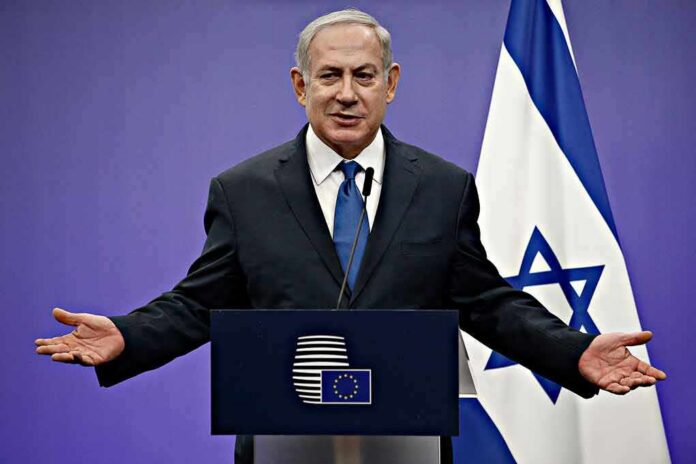
Israel’s deliberate courtship of Europe’s nationalist right is not a series of photo-ops; it is a structured bet that issue-based alignment on countering radical Islam, border control, and national identity can outweigh the reputational baggage these parties carry and deliver tangible diplomatic dividends.
At a Glance
- Israeli officials have framed engagement with Europe’s far right as a pragmatic alliance on security, migration, and national identity.
- The shift is policy, not rumor: diplomats were instructed to open talks with previously boycotted parties in France, Spain, and Sweden.
- Contacts span multiple countries and figures, from France’s National Rally to Spain’s Vox and the Sweden Democrats; a high-profile British invitation underscored ministerial backing.
- The strategy is selective and contested: harsh pushback from major Jewish communal bodies in Britain shows the reputational risks are real.
What changed: from arm’s-length caution to selective engagement
For two decades, Israel approached Europe’s nationalist right warily, wary of parties with histories entangled in illiberalism or antisemitism. After the October 7 attacks and the subsequent regional shock, senior Israeli officials began to argue openly for rebalancing. The logic they voiced is uncomplicated: on the central issues animating Israel’s security and public diplomacy—opposition to Hamas and broader currents of radical Islamism, skepticism of multicultural assimilation, and defense of a strong nation-state—segments of Europe’s right are reliable allies. That conviction translated into action. In early 2025, Israel’s foreign minister directed envoys to initiate contacts with France’s National Rally, Spain’s Vox, and the Sweden Democrats—parties previously kept at arm’s length under a boycott posture.
This was not an isolated outreach in a single capital; it mapped across multiple theaters. Reporting documented contact with named figures and parties in France, Spain, Sweden, Britain, and discussions about the German landscape—evidence of a coordinated, if selective, posture rather than one-off freelancing. Officials closest to the effort articulated the rationale with unusual clarity, praising leaders who positioned themselves as uncompromising on Hamas and as standard-bearers for national identity against transnational ideologies.
How the policy works in practice: coalition-building by issues, not treaties
Israel is not building a formal bloc with joint communiqués and standing councils; what we see is “issue-based normalization.” Parties that once trafficked in exclusionary rhetoric now highlight solidarity with Israel as part of a broader civilizational frame—against jihadism, porous borders, and supranational overreach. Israeli officials, in turn, reward that support with access, meetings, and public validation. The point is less to create binding alliances than to thicken the political ecosystem across Europe with actors ready to endorse Israel’s positions during acute debates—whether over war conduct, sanctions, or antisemitism definitions in EU fora.
Concrete episodes make the mechanism visible. Israeli ministers amplified figures they deemed outspoken against Hamas and supportive of Israel’s military aims; Paris and Madrid became test cases as National Rally and Vox offered unambiguous rhetorical support after October 7, prompting Israeli outreach that would have been unlikely a few years earlier. The British file offered an even starker illustration: a minister extended an invitation to Tommy Robinson, a controversial anti-Islam activist, underscoring that the initiative carried ministerial imprimatur rather than operating as a fringe campaign.
The selective line-drawing: not every “far-right” is equal
Critics often treat “far right” as a monolith; the policy does not. Israel has drawn a deliberate red line around specific parties whose legacies, leadership, or present platforms remain incompatible with engagement. Germany’s AfD has been the clearest example: even as contacts grew elsewhere, Israeli officials continued to signal that Berlin’s nationalist right remained off-limits. This asymmetry is not inconsistency; it is curation. The calculus weighs the depth of past antisemitism, contemporary rhetoric, internal purges and reforms, and the likelihood of governmental responsibility. When those variables trend acceptably, doors open; when they do not, they stay shut.
This curation also reflects institutional memory. Israel once downgraded ties with Austria’s Freedom Party when it entered government in 2000; two decades on, engagement is no longer binary. It is contingent, transactional, and designed to harvest support where it exists while limiting exposure where risks remain unmanageable. That is why the map of contacts looks uneven across Europe—and why it will likely remain so.
The criticism that bites: diaspora backlash and reputational risk
The strongest counterpressure has not come from centrist European governments—who mostly treat these contacts as Israel’s internal choice—but from Jewish communal leadership, especially in Britain. The Robinson invitation triggered an unequivocal rebuke from the Board of Deputies of British Jews and the Jewish Leadership Council, who called him “a thug” representing “the very worst of Britain,” and castigated Israel’s minister for, in their view, ignoring mainstream British Jewish sentiment. Their argument was straightforward: legitimizing a figure with a record of inflammatory rhetoric and convictions undermines efforts to combat extremism and fractures community cohesion. The critique widened into principle—support for Israel, they said, cannot sanitize a broader politics they deem corrosive to liberal societies where Jewish life depends on robust pluralism.
That backlash matters. Israeli diplomacy depends not just on parliamentary tallies in Europe but also on the health of relationships with diaspora institutions that mobilize public support and intercede with governments. When those institutions charge that engagement choices “slap” their communities, the cost-benefit ledger shifts. In Britain, the Robinson episode became a case study in how a tactical alliance can impose immediate reputational costs without delivering clear policy wins.
So this is your comment on the issue as opposed to the alarming trend of Israeli diplomats making "channels" with far right groups/people both in Europe and in Latin America?
I understand Israel needs allies in an increasingly hostile world, but I would hope they would find…
— Jewish Gentleman (@JewishGentle7) October 3, 2026
Does the bet pay? Measuring outcomes versus signaling
The immediate gains are easiest to see: statements from nationalist parties backing Israel’s military aims; resistance to anti-Israel resolutions in European fora; friendlier airtime in partisan media ecosystems. These matter in coalition governments and European Parliament groupings where a few votes can shape outcomes. Yet the long-term returns remain unproven. There is, to date, no public doctrinal paper laying out thresholds, guardrails, or metrics for success—no cabinet minute that would let outside observers audit whether the outreach produces legislative victories, budget lines, or durable realignments beyond rhetoric. That does not mean the strategy is illusory; it means its success criteria are implicit and therefore politically vulnerable.
A hard-nosed assessment must separate proof of contact from proof of consequence. The record clearly shows invitations, meetings, and reciprocal praise across several countries. What it does not yet show is a systematic tally of outcomes: specific votes swung, concrete policy concessions in EU bodies, or bilateral deliverables achieved because of this strategy. Until such a ledger is made public, advocates will emphasize momentum and access; critics will stress normalization costs without commensurate gains.
Strategic prudence going forward: codify, clarify, calibrate
If Israel intends to sustain this posture, three steps would increase its resilience. First, codify criteria—publicly. Define which factors can lift a boycott and which still disqualify engagement: leadership changes, repudiations of antisemitism, voting records on Jewish security, and governance readiness. Publishing such criteria would turn selective engagement from an impressionistic practice into a doctrine, reducing speculation about hidden ideological alignment. Second, clarify objectives and metrics: whether the aim is narrow (votes on specific resolutions) or expansive (shaping Europe’s security debate), and how progress will be counted. Third, calibrate execution with diaspora partners. Where community leaders judge a figure beyond the pale, solicit their input early; where engagement proceeds nonetheless, explain why the strategic gain justifies the risk and what mitigation is in place.
The underlying wager—that on core security questions, segments of Europe’s right are more dependable than a fraying progressive consensus—will continue to tempt Israeli policymakers. Whether it matures into a durable pillar of foreign policy or remains a high-variance tactic will hinge less on who gets invited next and more on whether the state can demonstrate, with specificity, that the alliances it courts deliver concrete protections and political wins without corroding the communal relationships that have long sustained its standing across Europe.
Sources:
feedpress.me, thejc.com, afp.com, middleeastmonitor.com, timesofisrael.com, newarab.com, washingtonpost.com, foreignpolicy.com, jpost.com, middleeasteye.net, wsws.org