
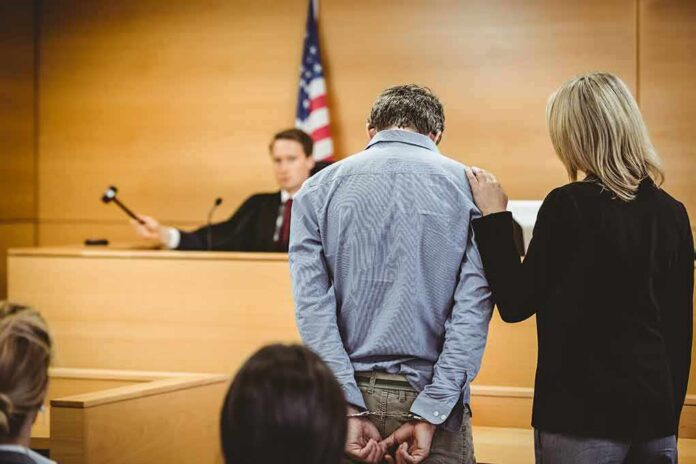
When a terrified 17‑year‑old, barefoot and handcuffed, had to convince police that a well‑liked local businessman was a serial predator, it exposed how easily “respectable” power can outweigh a working‑class victim’s word in America.
Story Snapshot
- A teenage sex‑trade survivor, Cindy Paulson, escaped Alaskan serial killer Robert Hansen and ran for her life through Anchorage.[1][2]
- Multiple later accounts agree on the core facts of her escape, but most rely on retellings rather than original 1983 records.[1][2][3]
- Police initially doubted Paulson’s story and released Hansen, reflecting a system that often discounts vulnerable victims.[2]
- The way her story is “canonized” through TV, podcasts, and films shows how media can blur the line between evidence and dramatization.[1][3][5]
The Night Cindy Paulson Escaped the “Butcher Baker”
On June 13, 1983, Anchorage baker Robert Hansen offered 17‑year‑old Cindy Paulson two hundred dollars for oral sex, then pulled a gun and drove her to his home, where he raped and tortured her before chaining her by the neck in his basement.[1][2] Later, he forced her into his car and took her toward Merrill Field airport, telling her he planned to fly her to a remote cabin near the Knik River only accessible by boat or bush plane.[1] These details appear consistently across major reconstructions of the case.[1][2][3]
According to these accounts, Paulson sat crouched in the back seat, wrists cuffed in front of her, as Hansen loaded his Piper PA‑18 Super Cub on the tarmac.[1][3] When he turned his back, she crawled across the seat, slipped out the driver’s door, and ran barefoot toward Sixth Avenue, leaving her blue sneakers on the floorboard as proof she had been inside his car.[1] A passing driver, often identified as Robert Yount, picked her up and drove her to safety, first to a motel known as the Mush Inn.[1]
How Police and Institutions Handled a Working‑Class Survivor
Despite the specificity of her story, including the plane model, location, and her missing shoes, police did not immediately treat Paulson as a definitive witness against Hansen.[1][2] She was a teenage sex worker accusing a married small‑business owner with standing in the community, a power imbalance many Americans on both left and right recognize across institutions today.[2] Investigation Discovery and other accounts describe Anchorage police supervisors shrugging off her report at first, which allowed Hansen to walk free while detectives hesitated.[2]
Only later, as Alaska State Troopers connected Paulson’s story to a pattern of missing women and a security guard’s report from Merrill Field, did her account become the turning point in the serial killer investigation.[1][2] Hansen would ultimately be charged with the abduction and rape of Cindy Paulson alongside multiple murders, and he later admitted to a long series of killings in which he flew women into the wilderness to hunt them like game.[1][2] Paulson’s escape, and her insistence on being believed, stopped a predator that official systems had missed for years.[1]
Media, Myth, and the Risk of Losing the Evidence Trail
Today, most people know Paulson’s story not from police files but from television dramas, podcasts, and articles that repeat the same vivid details of her barefoot, handcuffed sprint across Anchorage.[2][3][4][5] The film “The Frozen Ground,” the Casefile podcast, and numerous true‑crime shows all describe her fleeing while Hansen loaded his bush plane, then aiding law enforcement in bringing him down, reinforcing a powerful, almost cinematic narrative.[2][3][5] These retellings highlight a real act of courage but rarely show where each detail comes from in the original record.[1][3]
Researchers who have tried to reconstruct the case point out that publicly available information still lacks critical primary documents: the full Anchorage Police Department report, the original taped interview, medical exam records, airport logs, and the first written statement from driver Robert Yount.[1][3] Without those, the public must rely on layered summaries rather than direct evidence, and every new documentary risks hardening one version of events into unquestioned “truth.”[1][3] For citizens already skeptical of government, media, and elites, Cindy Paulson’s story is a reminder to demand both justice for survivors and transparency about the facts.
Sources:
[1] YouTube – Cindy Paulson Ran For Her Life | People Magazine Investigates: …
[2] Web – Robert Hansen – Wikipedia
[3] Web – Robert Hansen – Criminal Minds Wiki – Fandom
[4] Web – Case 190: The Butcher Baker (Part 2/2) – Casefile: True Crime Podcast
[5] Web – The Real-Life Most Dangerous G…–Crimehub: A True Crime Podcast