
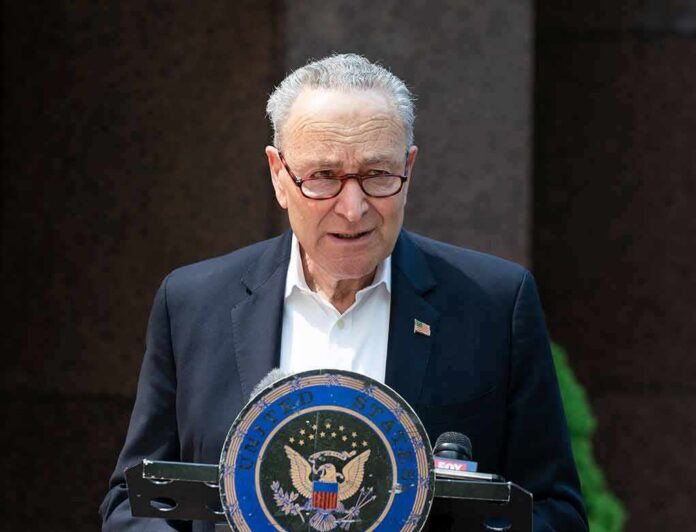
The presidency’s real leverage in nominations is front-loaded: initiative belongs to the White House, but endurance belongs to the Senate. Understanding that simple asymmetry explains why a headline-grabbing nomination can both display presidential resolve and still be throttled by an opposition-led chamber.
At a Glance
- Presidents can initiate nominations unilaterally; Senate Democrats control time, hearings, and votes.
- Trump’s public confrontation with Senator Schumer made the procedural tug-of-war explicit rather than tacit.
- Democrats’ post-midterm majority positioned them to slow-walk or block confirmations and to advance their own agenda by reconciliation.
- Polarization and divided government reliably lengthen confirmations; electoral headwinds further limit presidential bargaining power.
Presidential Initiative Versus Senate Endurance
Start with the mechanics. Article II gives presidents the power to nominate; the Senate’s advice and consent turns that paper nomination into authority. No statute requires a president to pre-clear a pick with the opposition before transmitting the name to the Senate, and administrations of both parties regularly announce selections without minority-party blessing. The practical constraint is not initiation but disposition: committee scheduling, floor time, and ultimately a confirmation vote. Under divided government, the Senate’s institutional tools—hearings delayed, holds honored, calendars crowded—can turn an announced “move” into a languishing file.
History bears this out. Across more than a century of executive-branch nominations, confirmations stretch when polarization rises and the president faces an opposition Senate; delays are not outliers but the modal experience of divided government. Initiative is cheap, time is dear, and the Senate controls time.
The Politics of Going Public
Presidents sometimes try to compensate for weak institutional position by going public—naming an opponent as obstructionist to raise the political cost of delay. Trump did exactly that, signaling that working with Senator Schumer would be “very hard” and framing Democratic leaders as the problem to solve rather than partners to court. That rhetorical choice is a deliberate trade: publicity can energize allies and clarify accountability, but it also hardens lines and narrows the space for transactional deals that move nominees across the finish line.
The trade looked even starker after the midterms. Independent polling showed Trump’s standing depressed heading into the elections, a context in which attempts to pressure the Senate by mobilizing public opinion carry less weight; weak popularity blunts the megaphone. Democrats’ subsequent gains shifted leverage from the White House to the majority leader’s office, where docket control becomes dispositive.
What Schumer’s Majority Could Do
Senate majorities have two levers in nomination fights: tempo and threshold. Tempo is the power to schedule—or not. Threshold is the vote count required to end debate and confirm. Recent rules changes lowered the cloture threshold for most nominations, but a majority can still slow proceedings, bundle priorities, and demand concessions. Democrats also outlined a parallel strategy: prosecute their own legislative agenda via budget reconciliation, which circumvents a filibuster and forces presidential veto choices on high-salience issues like health subsidies and Medicaid. In practice, that plan converts Senate control into bargaining power by making delay costly to the president in other arenas.
Layered atop nominations, that agenda-setting posture turns the chessboard: rather than simply reacting to White House names, an opposition Senate can make the president react to its bills. If the bills are framed around broadly popular cost-of-living themes, the political price of a veto rises, weakening the president’s capacity to use public pressure to pry a nominee loose.
Unilateral Action Without Guaranteed Payoff
The distinction between announcement and outcome matters. A president can name a consequential figure and reap a news cycle’s worth of resolve—but confirmation, implementation, and policy effect depend on Senate cooperation. In this case, the evidentiary record documents the public clash and the Democrats’ institutional position; it does not establish that the contested nomination cleared committee, secured a floor vote, or yielded measurable policy results. In divided government, that gap between spectacle and substance is common rather than exceptional.
Political context compounds the structural hurdles. When an opposition party controls both chambers, the White House’s bargaining chips are limited: personnel trades, calendar swaps, and policy concessions. If the president’s approval is soft, extracting those concessions becomes harder; going public may rally the base but rarely flips a hostile chamber. Contemporary polling placed Trump near his approval floor ahead of the midterms, which is precisely the environment in which opposition leaders are least likely to yield on high-profile confirmations.
How Opposition Leadership Converts Leverage
Opposition leaders rarely rely on a single tactic. Schumer and Senate Democrats described a layered strategy: aggressive oversight and investigations to raise the reputational cost of executive unilateralism, targeted legislation to claim agenda ownership on prices and healthcare, and reconciliation to force simple-majority passage and confront the president with discrete veto choices. The point is not merely to block; it is to redefine the negotiating baseline so that the president pays a political toll to move personnel or policy. That multidimensional posture increases the opportunity cost of each White House demand.
On nominations specifically, a majority can also condition movement on unrelated concessions—an appropriations rider here, a regulatory pause there—quietly trading floor time for policy. Those bargains, when they happen, tend to occur away from cameras, which is why a loud, adversarial frame can be counterproductive: it reduces the plausible space for senators to make incremental deals without appearing to capitulate.
Why Divided Government Lengthens the Road
The political-science literature is unambiguous: divided government and polarization slow confirmations. The mechanism is straightforward. Ideological distance raises the perceived policy stakes of personnel; the Senate treats nominees as vectors for durable change, not mere administrators. Costly floor time is rationed toward majority priorities; marginal or controversial nominees slide down the queue or stall in committee. Over decades of data, the variance in time-to-confirm is large, and the tails fatten when the president lacks copartisans commanding the chamber. That is the normal physics of separation of powers, not an aberration.
Election fundamentals reinforce those physics. Midterms function as referenda on the sitting president’s performance; low approval correlates with losses and, consequently, with diminished legislative leverage. In such periods, “going it alone” on nominations can demonstrate decisiveness, but it rarely rewires the underlying incentives that govern Senate behavior.
How to Read “Unilateral” Moves Going Forward
Three rules of thumb apply. First, separate initiation from completion: a nomination announced without opposition buy-in can be strategically useful as a signaling device, but it is only the opening bid. Second, gauge chamber control and agenda strategy: a Senate majority bent on reconciliation-driven legislation and aggressive oversight has multiple ways to raise the price of confirmation, and it will use them. Third, read the popularity context: when a president’s approval is weak, going public against the majority leader clarifies blame but seldom changes votes.
Sources:
redstate.com, reuters.com, thehill.com, cpsblog.isr.umich.edu, apnews.com, npr.org, freep.com