Modern airline security works because crews are trained to treat every cockpit-security or bomb claim as real, act fast, and hand the matter to law enforcement on the ground; that is exactly what happened on United Flight 2174, which landed safely after the crew declared an unlawful-interference emergency and deputies arrested a passenger on false-threat charges.
At a Glance
- The flight crew broadcast code 7500—aviation’s hijack/unlawful-interference signal—after a passenger claimed to have a bomb and moved toward the cockpit.
- The aircraft landed safely in New Orleans; no injuries were reported, and passengers deplaned before deputies took a suspect into custody.
- Local authorities booked the passenger on charges tied to conveying a false bomb threat and terrorizing.
- Airlines must respond as if a threat is real even though most bomb claims ultimately prove unfounded; criminal liability turns on intent and what was actually conveyed.
What happened aboard United Flight 2174
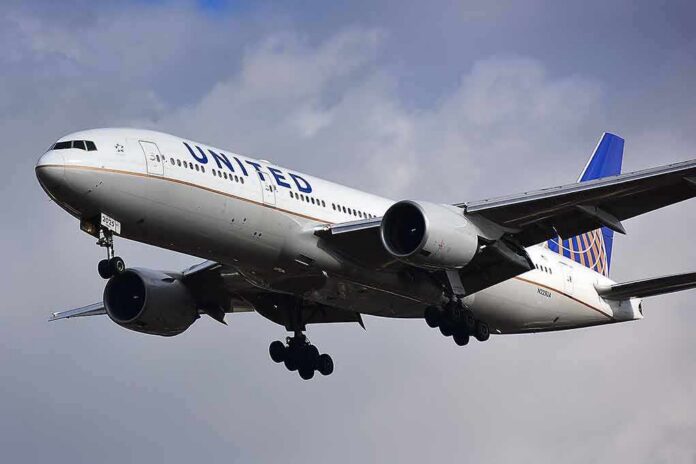
United Flight 2174 from Newark to New Orleans declared an unlawful-interference emergency midflight after a male passenger told the crew he had a bomb and moved toward the cockpit area. The pilots set their transponder to code 7500—aviation’s standardized hijack signal used to alert air traffic control that the crew perceives an ongoing interference or hijacking-type scenario—and continued to New Orleans under heightened procedures. On landing, the aircraft was met by law enforcement; passengers were transported to the terminal, and Jefferson Parish Sheriff’s Office deputies arrested the suspect without incident. United said the flight carried 46 passengers and six crew, and no injuries were reported.
Multiple reports attribute the bomb statement to the passenger and note that he was isolated toward the rear of the cabin before landing. Coverage drawing on reviewed radio traffic and aviation-tracking accounts describes flight attendants and crew managing the passenger away from the flight deck, with the airplane subsequently landing safely for law-enforcement intervention. Authorities later identified false-threat charges, consistent with a scenario in which the claim triggered a full safety response but did not yield an explosive device upon investigation.
How the 7500 “unlawful interference” signal works—and why crews use it
Commercial pilots use four-digit transponder “squawks” to silently convey emergency categories to air traffic control. Code 7500 is reserved for unlawful interference—shorthand for a hijacking or flight-deck security emergency. It does not certify the nature of the threat or that a weapon or device is present; it signals that the crew’s operational judgment is that they are facing a credible interference scenario and need priority handling and coordinated ground response. In practice, setting 7500 triggers a cascade: discreet controller queries, security notifications, and preparations to meet the airplane with police or federal agents. That is why the label can sound dramatic in headlines, but inside the system it is a disciplined, procedural flag designed to protect the airplane and everyone aboard.
Crews are trained—recurrently and with scenario drills—to separate the decision to declare an emergency from the later fact-finding about what actually occurred. If there is a report of a bomb or an attempt to reach the cockpit, the safe, conservative move is to treat it as real and let law enforcement resolve the facts on the ground. The alternative—discounting a threat that turns out to be genuine—carries unacceptable risk. That doctrine explains why Flight 2174’s pilots set 7500 and flew a by-the-book arrival into New Orleans, where deputies were already in position.
Why most in-flight bomb claims still demand a full response
Airline and airport security live with asymmetry: false claims are common, but the cost of ignoring the one real threat is catastrophic. Industry reporting in recent years underscores the baseline—large waves of phoned-in or verbal threats that resolve as hoaxes—while emphasizing that each must be investigated as if it were real until cleared. Reuters summarized the point bluntly: the vast majority of bomb threats are false alarms, but every one is treated as real until proven otherwise. A BBC review described dozens of bomb-threat disruptions across multiple airlines over a four‑day span; none produced explosives, all prompted emergency actions that worked as designed to safeguard flights and passengers.
That posture aligns with criminal law. Federal and state statutes distinguish between careless alarm and willful, malicious conveyance of false information about explosives in aviation. Case law addresses both the elements and penalties, from civil sanctions for knowingly passing false bomb information to felony convictions when conduct crosses into threats that endanger an aircraft and its occupants. Appellate decisions have upheld penalties where false claims forced diversions, stressed crews, and triggered costly emergency responses—exactly the chain Flight 2174’s crew worked to manage safely.
What the charges tell us—and what they don’t
Jefferson Parish Sheriff’s Office officials said the arrested passenger was booked on counts consistent with communicating false information of planned arson and terrorizing—charges that fit a verbal bomb claim on an airliner when no device is found. Booking on these statutes signals that investigators assessed the reported statement as both alarming and knowingly false, at least for charging purposes; ultimate adjudication, of course, rests with the courts. For the public, the essential takeaway is operational, not legalistic: the crew treated the claim as real, landed without injury, and handed the matter to law enforcement, which then moved it into the criminal process.
Reports noted a language barrier and that the suspect spoke little English, a factor that can matter in court when parsing “true threats” versus misunderstood utterances. But in the cabin, ambiguity does not relax the response standard; crews secure the flight deck, manage the cabin, and get the airplane on the ground. The legal system later sorts mens rea—what was meant and known—from the objective risk created in the moment. U.S. precedent reflects that division of labor: statutes and courts focus on whether the conveyed information would reasonably be perceived as a threat and whether the defendant knew it was false, not on whether any passenger or crew member suffered physical harm.
Cabin discipline and flight-deck hardening do their job
Since the early 2000s, airlines have layered defenses against cockpit intrusion: reinforced flight-deck doors, sterile-cockpit protocols during critical phases of flight, and crew drills for deflecting and delaying anyone moving forward aggressively. In parallel, cabin crews are trained to de-escalate, isolate, and, when necessary, restrain disruptive passengers with approved devices and techniques—always with the aim of keeping the threat away from the controls until the airplane is on the ground. Descriptions of Flight 2174’s cabin management—moving the suspect aft and keeping the aisle space between passenger and cockpit—fit this well‑rehearsed playbook.
It is worth noting how ordinary competence prevents extraordinary outcomes. The sterile phrase “landed safely” conceals a dozen correct choices: declaring the right emergency, coordinating with controllers, calibrating speed and arrival sequencing, keeping passengers calm while preserving cabin authority, and ensuring that first responders on the ramp know exactly what they are walking into. The absence of injuries is evidence that this choreography worked.
#BREAKING: There's been another United Airlines flight scare involving New Jersey's Newark Liberty Airport. A 34-year-old passenger on United Flight 2174 stormed the cockpit Monday night as the plane was flying to New Orleans. The man allegedly claimed to have a bomb on board.… pic.twitter.com/Y1ZKl9OfZ8
— Salem News Channel (@WatchSalemNews) November 10, 2026
What this means for travelers and airlines
For travelers, the lesson is plain: if a crew reacts decisively to a reported threat—rapid announcements, firm instructions, an immediate landing—comply. Those responses are calibrated for safety, not spectacle. For airlines and regulators, the Flight 2174 incident is another affirmation that established protocols handle ambiguous, high‑stakes claims effectively: assume the worst, protect the flight, and let the justice system handle intent and accountability afterward. This approach is why most of these stories end the same way this one did—on a gate, with everyone walking off the airplane, and the person who made the claim meeting deputies instead of flight attendants at the door.
Sources:
dailymail.com, nypost.com, wlox.com, timesnownews.com, nj1015.com, spanish.news-pravda.com, cases.justia.com, courtlistener.com, law.justia.com, bbc.com, ca1.uscourts.gov