
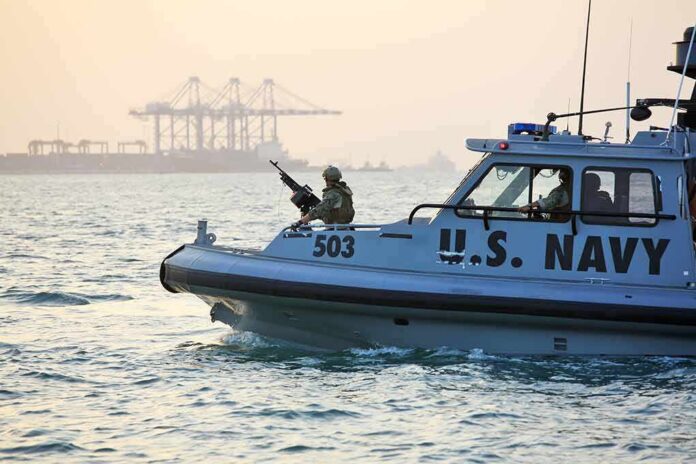
When governments reframe drug interdiction as wartime targeting, the center of gravity shifts from seizures and prosecutions to lethal force, legal authorities, and proof—what you can hit, why, and to what end. Operation Southern Spear is the most sweeping U.S. experiment in that shift at sea in a generation; understanding what it is, how it worked, and what the record shows is essential to judging both its claims and its criticisms.
At a Glance
- Operation Southern Spear was a U.S. military campaign of lethal airstrikes on small boats in the Caribbean and eastern Pacific, run under U.S. Southern Command as a counternarcotics mission.
- Officials described targets as “narco‑terrorists” and integrated the effort into a joint task‑force command structure; deployments included a carrier strike group, Marine F‑35s, and multiple destroyers.
- The Pentagon reported dozens of strikes and significant fatalities among alleged traffickers, but did not publicly release strike‑level evidence proving narcotics on board or identifying many of the dead.
- Independent reporting argues cocaine and fentanyl availability in the U.S. did not decline, sharpening the gap between “operational success” and “market outcomes.”
What Operation Southern Spear Was—Stated Aims, Command, and Method
The Defense Department framed Southern Spear as a counternarcotics campaign using lethal airstrikes against small vessels suspected of maritime trafficking within U.S. Southern Command’s area of responsibility. This was not pitched as a one‑off raid series but as a named operation with an assigned joint task force—an architecture that signals sustained tempo, joint targeting, and formal reporting to civilian overseers. The Pentagon’s own update and a subsequent report to Congress describe an integrated effort to “detect, disrupt, and degrade” illicit maritime networks, built around intelligence cueing and kinetic interdiction rather than board‑and‑seize patterns alone.
The scale matched the rhetoric. Contemporary briefings and coverage detailed an unusually large naval and air presence arrayed around the Caribbean and eastern Pacific: the USS Gerald R. Ford carrier strike group, Marine F‑35s forward in Puerto Rico, and multiple destroyers—roughly 15,000 personnel, the largest concentration in the region since the Cold War, according to on‑air reports at the time. This posture served two functions: generate persistent maritime domain awareness and surge credible strike capacity against fast, low‑profile boats operating beyond the reach—or patience—of judicial interdiction processes.
The Policy Shift: From Criminal Interdiction to Combatant Targeting
Supporters presented Southern Spear as a necessary correction: cartels and maritime smugglers operate with the speed, organization, and firepower of armed groups; treating them only as criminal suspects, the argument goes, plays to their strengths. The Secretary of Defense’s announcement cast the operation in explicitly hemispheric‑security terms, labeling targets “narco‑terrorists” and tying action to protecting Americans from drugs that kill tens of thousands annually. In doctrinal terms, that label matters. It moves the mission away from the arrest‑and‑evidence model toward rules of engagement associated with wartime targeting—shorter decision cycles, lethal effect as interdiction, and a presumption that disabling a vessel disrupts network throughput even if no contraband is recovered at the scene.
Inside the Pentagon, that shift was reflected in the mechanisms: a joint task force, a kill chain running from intelligence surveillance and reconnaissance (ISR) cueing through dynamic targeting, and periodic operational tallies—strikes executed, boats destroyed, personnel on board killed or recovered—reported up the chain and summarized in official releases. In this frame, the metric of success is operational: neutralize conveyances and operators and you degrade the network’s capacity.
The Evidentiary Gap: Proof of Target Legitimacy and Identities
The central dispute is not about what the Pentagon said Southern Spear was—that backbone stands uncontested in the public record—but about how targets were validated and who died. Multiple outlets reported that officials did not publicly release strike‑level evidence proving drugs on board for many, or any, of the destroyed vessels. Critics seized on statements acknowledging that the identities of those killed were not fully known post‑strike; human‑rights organizations characterized the pattern as extrajudicial killing outside any recognized armed conflict, and at least one report noted a Pentagon oversight review into whether established targeting frameworks were followed.
Numbers hardened the concern. Compilations derived from official tallies and media briefings cite dozens of strikes resulting in more than two hundred fatalities; absent publicly verifiable identities and contraband proof, these totals became the fulcrum of the critique, not evidence of deterrence. In short, the campaign’s own scoreboard—boats destroyed, people killed—was used to question its legality and precision rather than to validate its efficacy.
Effectiveness: Operations Versus Outcomes in Drug Markets
Every counternarcotics strategy lives or dies on the market. Here, too, the record is contested. The administration’s case emphasizes kinetic activity—repeated strikes, destroyed vessels, and disrupted voyages. Independent and defense‑industry reporting points in the other direction: cocaine reaching the United States did not decline in the period in question; traffickers adapted routes and techniques; fentanyl supply, largely a separate supply chain, remained elevated. Those claims draw on investigative summaries and expert commentary that, while not econometrically definitive, consistently argue the campaign did not bend availability or price in U.S. markets.
This divergence exposes a familiar gap in drug policy: success by operations versus success by outcomes. Disrupting boats does not automatically translate into scarcer drugs, higher prices, or fewer overdoses; networks reconstitute, logistics reroute, and upstream production scales to compensate. The Pentagon’s report‑to‑Congress posture catalogues activity; critics ask for counterfactuals and statistically grounded before‑and‑after flows—price, purity, seizure volumes, and consumption—to establish that activity mattered at the user end.
Law and Legitimacy: The Contested Basis for Lethal Force at Sea
Legality is the other pillar. Southern Spear’s defenders root authority in U.S. domestic designations and command authorities for countering transnational criminal organizations that the President labeled as terrorist entities, then fold maritime strikes into that mandate. The report to Congress presents the operation within a formal command chain and asserts compliance with applicable law and policy.
Human‑rights lawyers and several lawmakers counter that labeling alone does not create an armed conflict or satisfy international law standards for lethal force. If the presence of narcotics on a vessel was not a necessary criterion—and if imminence of threat to life was not demonstrated—then the strikes look like law‑enforcement substitutes without due process. That argument is sharpened by the government’s limited public disclosure on target selection and post‑strike identification; without a released legal memo or rules of engagement, the debate persists in the space between assertion and inference.
How We Got Here: Strategic Incentives and Communication
Why did Southern Spear take this shape? Three incentives aligned. First, speed: maritime smuggling via small, hard‑to‑interdict craft exploits the time it takes to marshal a boarding action; aircraft with precision munitions compress the decision window. Second, signaling: a named operation with heavyweight assets demonstrates resolve to domestic and regional audiences alike. Third, bureaucratic clarity: a joint task force with a reporting cadence creates ownership and measurable activity that leaders can brief succinctly. Each of these favors kinetic options over patient, arrest‑driven cases—especially in open waters where jurisdiction is contested and evidentiary chain‑of‑custody is hard to preserve.
The communications environment complicated the payoff. Official messaging stressed “narco‑terrorists” and hemispheric defense; social and investigative counter‑narratives spotlighted civilian‑status uncertainty, adaptation by traffickers, and lack of proof. In that cross‑pressure, activity counts became proxies for success, and then—when outcomes failed to corroborate—exhibits for failure. That pattern is not unique to Southern Spear; it is typical of militarized drug campaigns unless paired with transparent evidence standards and market‑outcome tracking.
U.S. Secretary of Defense, Hagest:
Media outlets that spread false information have attempted to discredit and portray the "Southern Spear" operation as illegal.
The same voices that remained silent when governments allowed an unprecedented crisis to unfold at the borders, and… pic.twitter.com/zWELPPNGNQ
— Alex kennedy (@Alexkennedy213) August 12, 2026
What Would Resolve the Dispute: Evidence, Metrics, and Oversight
The path to a durable judgment is clear and, to date, incompletely traveled. Three disclosures would let the operation stand or fall on the merits. First, release the legal foundation—Office of Legal Counsel opinions, delegated authorities, and rules of engagement—so that the use of lethal force against suspected drug vessels can be assessed against domestic and international law. Second, produce strike‑level targeting packets and post‑strike assessments, redacted for sources and methods but sufficient to establish the intelligence predicates and the identities or affiliations of those killed. Third, commission an independent narcotics‑flow analysis—DEA, CBP, ONDCP data or an academic study—with price, purity, seizure, and consumption series spanning the operational window, including a counterfactual model to test causation rather than correlation.
Absent those, the debate will continue to talk past itself: officials pointing to boats destroyed and hierarchical order; critics pointing to unbent market curves and uncertain civilian status. The most consequential claims on either side—operational necessity versus illegality and ineffectiveness—are testable with the right records.
The Strategic Lesson: Kinetics Help at the Margin, Never Alone
Even if Southern Spear’s target selection were vindicated tomorrow, history counsels modest expectations for kinetic counternarcotics campaigns. Maritime interdiction can raise costs at the margin, but networks adapt unless pressure is synchronized along the chain: precursor controls, financial disruption, port inspections, judicial follow‑through, and demand‑side treatment that reduces the revenue base. The Pentagon’s formalization of the operation proved the military can generate effects quickly and at scale; the unresolved question is whether those effects propagated into the only outcome that matters in drug policy—less harmful substance reaching people in the United States. On the public record to date, that case remains unmade.
Sources:
youtube.com, rollingout.com, thehill.com, yahoo.com, breakingdefense.com, en.wikipedia.org, jqas.org, southcom.mil