Body-worn camera footage changed the argument from “he said, she said” to “watch and judge,” and in the arrest of Oklahoma’s secretary of state outside a McDonald’s, the video anchors a straightforward legal story with outsized governance consequences: an observational public-intoxication arrest can be both legally sufficient and politically dispositive without a single breath test reading.
At a Glance
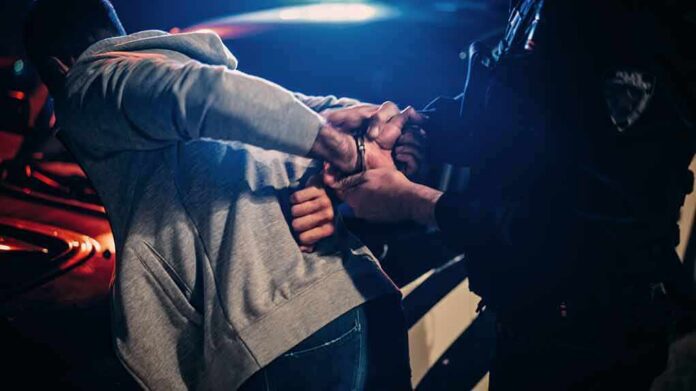
- Edmond police bodycam shows officers arresting Secretary of State Benjamin Lepak for public intoxication after observing slurred speech, odor of alcohol, and balance issues.
- The arresting officer stated the basis on camera: “You’re under arrest for public intoxication and you’re lucky it’s not a DUI.”
- Attorney General Gentner Drummond publicly reviewed the video and urged removal, saying Lepak appeared “thoroughly inebriated” and likely lied to officers.
- No breathalyzer result appears in the public record; the case rests on officer observations, video, and Lepak’s own inconsistent statements.
What the video shows and why it matters
Public intoxication cases rise or fall on the totality of circumstances a reasonable officer sees, hears, and smells in real time. In Edmond, the body-worn camera recording captures officers engaging Benjamin Lepak in the McDonald’s drive-thru area, commenting on slurred speech, the odor of alcohol, and unsteadiness, before announcing an arrest for public intoxication—punctuated by the warning that he was “lucky it’s not a DUI.” The Oklahoman and KOCO reported consistent details from the footage and arrest narrative, including Lepak’s inconsistent account of how he arrived at the scene and admissions about limited drinking at a church event earlier that evening.
The power of video evidence here is practical, not cinematic: it documents the observable cues officers say created probable cause. Courts commonly accept sensory indicators—speech, gait, odor—as part of that analysis when assessed under the totality-of-circumstances standard, particularly in non-chemical-testing contexts like public intoxication. The footage does not settle every factual question, but it fixes the tone, pace, and content of the interaction in a way paper reports alone cannot.
The legal mechanism: observational probable cause without a breath test
Unlike DUI prosecutions, which typically hinge on per se blood-alcohol thresholds or standardized field tests, public intoxication statutes rely on whether a person appears intoxicated in public to a degree that implicates safety or public order. That evidentiary posture makes officer observations central. Probable cause—the quantum of facts sufficient to warrant a prudent person’s belief that an offense has been committed—can be met through a combination of demeanor, odor, speech, balance, and coherence, even in the absence of a chemical test. Appellate frameworks emphasize the totality of circumstances rather than any single talismanic sign; video that captures those circumstances often strengthens the state’s position because it allows fact-finders to evaluate the same cues the officer reported.
This is why the absence of a breath result, while rhetorically potent, is not dispositive. Defense strategies frequently target the subjectivity of observations by proposing medical or situational alternatives, highlighting inconsistencies, or challenging the linkage between cues and intoxication. Those arguments can be persuasive in close cases, but they do not negate the sufficiency of observational probable cause when the record coherently documents multiple impairment indicators at once.
How the narrative formed: statements, inconsistencies, and institutional amplification
From the first hours after the arrest, the pieces of the narrative snapped into familiar places. Lepak told officers various versions of how he had arrived—driving to McDonald’s, then walking from a nearby church—and acknowledged some alcohol consumption after initially denying it. Those contradictions, audible in the bodycam recording, are themselves probative because shifting explanations often register to officers as consciousness of impairment. Coverage from The Oklahoman and KOCO underscored these inconsistencies alongside the sensory cues officers described.
Attorney General Gentner Drummond escalated the governance dimension by publicly stating he reviewed the bodycam video, concluded Lepak was “thoroughly inebriated,” and pushed for immediate removal. That intervention matters not as a legal adjudication but as signal amplification from the state’s chief law officer; it converts an arrest report and a video into a political judgment with staffing implications for the governor’s team. In high-profile cases, that sequence—observational arrest, vivid video, and an on-record call for consequences—often becomes outcome-determinative in the court of public opinion long before any courtroom hearing.
What the counter-arguments actually offer
The counterpoint is straightforward: Lepak’s office emphasized he was waiting for dinner and was not administered a breath test. In some tellings, he claimed to have had less than one beer at a church event and denied driving at the relevant moment. Those are not frivolous facts—chemical proof would make this simpler—but they are thin as a rebuttal when they sit alongside video-documented slurring, odor, unsteadiness, and real-time inconsistency about how he got there. Put differently, the counter-case highlights what is absent from the record rather than introducing independent evidence that contradicts what the camera captured.
There is also a natural question about selective editing of video clips circulated by newsrooms. The cleanest way to test that concern is straightforward: release the full, unedited bodycam file with synchronized timestamps and the complete incident report. In the meantime, the Attorney General’s explicit, on-record review—naming deception as a likelihood—adds institutional weight to the observational account and further weakens the rhetorical leverage of “no breathalyzer” as a defense in the public narrative.
How similar cases play out and what to watch
Public intoxication arrests of officials almost always follow the same arc: officers rely on observations; video cements impressions; political actors move faster than the docket. In that pattern, three elements shape the endpoint. First, the completeness of the record—full bodycam, dispatch logs, and reports—either confirms or complicates the edited narrative that initially ran. Second, any reliable third-party witnesses (restaurant staff, event attendees) who can attest to condition and conduct can either fortify or fracture the state’s case. Third, prior, documented alcohol-related incidents—if accurately sourced—can tilt perception even if they are not directly admissible to prove conduct this time; some reporting cited a 2022 public-intoxication plea, which inevitably colors public interpretation of the present video.
From a governance standpoint, the key question rarely waits for a verdict: can an official credibly perform a public trust role under a cloud created by a video that appears to show impairment and equivocation? In a media ecosystem primed for swift judgment, the legal sufficiency of observational probable cause is often enough to trigger personnel decisions, particularly when reinforced by a public call from the state’s top prosecutor. The law does not require a breath number to make an arrest valid; politics does not require a conviction to make a job untenable.
Sources:
foxnews.com, koco.com, youtube.com, oklahoman.com, oklahoma.gov, facebook.com, coloradojudicial.gov, govinfo.gov, chicagocriminallawyer.pro