Presidential rallies are blunt-force tools: they do not reliably change votes, but they do concentrate attention, money, and energy exactly where a party wants them—on schedule, with message discipline, and before cameras. Trump’s stop in Corinth, Mississippi, to boost Sen. Cindy Hyde-Smith exemplified that calculus.
The Short Version
- President Trump headlined a rally at Crossroads Arena in Corinth to campaign for Sen. Cindy Hyde-Smith, with doors, program, and speaking times publicly set and RSVP required.
- Local outlets documented early lines, interstate travel by supporters, and spillover effects on hotels and traffic logistics around the arena.
- The event’s stated purpose was partisan: bolster Hyde-Smith and the Republican slate heading into the final week before midterms.
- Evidence from political science suggests rallies reliably generate visibility and short-lived mobilization, while durable vote shifts for down-ballot candidates are far less consistent.
What happened in Corinth and why it mattered to Republicans
President Trump campaigned in Corinth for Sen. Cindy Hyde-Smith at Crossroads Arena, an explicitly pro-Hyde-Smith rally framed by state and local outlets as a targeted push in the final stretch before the election. The Republican National Committee confirmed the event, and local reporting specified a highly managed schedule: doors mid-afternoon, program in the late afternoon, Trump set for early evening remarks, with advance registration required—hallmarks of a modern presidential campaign stop designed to fill the building, control flows, and prime the press window for local evening news hits. The rally’s purpose was not coy: it was to strengthen Hyde-Smith and, more broadly, signal Republican momentum in Mississippi and the region.
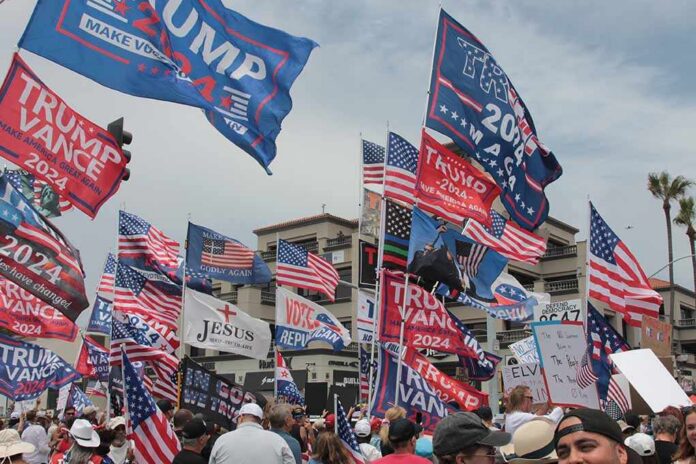
Turnout interest was visible well before Trump took the stage. SuperTalk Mississippi described pre-dawn lines and noted the venue’s seating north of 7,700, while Memphis-based WREG reported supporters traveling from Arkansas and across Mississippi, along with hotel demand linked to the event. In other words, the predictable rally footprint—regional draw, day-of logistics strain, and a saturated local media environment—was present and measurable.
The mechanics of a presidential rally: schedule, selection, and signal
Beyond pageantry, the apparatus around a presidential rally is the strategy. Registration pages identify and re-engage supporters; time blocks shape volunteer shifts and earned-media cycles; venue capacity and line management turn enthusiasm into optics. Reporting in Mississippi captured those mechanics: RSVP gating, explicit set times, and an arena-sized stage at a site large enough to showcase a crowd but manageable for the security footprint. The audience is not a random slice of the electorate; it is a curated cohort of partisans, donors, and activists, which is exactly the point for a mobilization event near Election Day.
The rally also served as a clear partisan signal: national attention and presidential time deployed to a Senate race that Republicans wanted to frame as tightening—useful both for motivating GOP turnout and for drawing Democratic resources into defense. Coverage by regional and national outlets reinforced that storyline: Trump came to boost Hyde-Smith, underscore stakes, and project strength in a state where Republicans expect to prevail but still value visible energy.
What the evidence says about rallies and down-ballot effects
The best available research is consistent on two points. First, rallies can briefly lift the headliner’s support, spur contributions, and energize turnout intention among partisans—effects that fade with time and do not automatically diffuse to other candidates on the ticket. Second, presidential involvement and endorsements in general elections often produce ambiguous or even negative net effects for endorsed candidates once you account for selection (presidents tend to show up where races are closer) and counter-mobilization by the other side. In short: rallies excel at visibility and short-run mobilization, but they are not magic wands for down-ballot vote share.
Applying that lens to Corinth sharpens the interpretation. The rally likely succeeded at what rallies do best—earning local coverage, concentrating activist energy, collecting contact data, and giving Hyde-Smith’s operation a one- or two-day surge in volunteer sign-ups and small-dollar fundraising. What it did not do, and what rallies rarely do on their own, is structurally reconfigure a Senate race’s underlying vote math. That does not diminish its strategic value; it simply clarifies the mechanism and the limit of the tool.
Context from the ground: crowd behavior and community impact
Local reporting captured the familiar community-level ripple effects: early lines, out-of-town visitors, and pressure on traffic, lodging, and law enforcement staffing. WREG’s on-the-ground segment described fans driving in from across the Mid-South and indicated hotel demand surging around the arena; SuperTalk chronicled long queues that began before sunrise. For municipal leaders, that means road plans, overtime, cell coverage augmentation, and crowd-control barricades—routine for a president’s visit, but tangible and budget-relevant for a small city hosting thousands.
Those same dynamics also influence perception: aerial shots of parking lots, lines wrapped around the venue, and a defined program cadence produce the imagery campaigns and local stations will replay for days. Even without a formal attendance figure—none was reported by fire marshal, venue, or campaign in the material surfaced—the pictures serve the mobilization script just as effectively.
How this rally fits into modern campaign strategy
Late-cycle presidential travel to friendly territory is not a contradiction; it is resource allocation. A stop in a deep-red region can be about bankable outputs—earned media in a controlled environment, volunteer harvesting, and message amplification for local candidates—without the security and programming complexity of a battleground metro. Strategists weigh those tradeoffs constantly. Corinth offered a large, indoor arena with straightforward ingress and a media market hungry for national politics; in return, Hyde-Smith’s campaign and the state party received a surge of attention precisely when turnout operations shift to execution.
Ultimately, Corinth illustrates the durable truth about rallies. They are not opinion-changers so much as energy concentrators. If you measure them by the change in persuasion among swing voters, you may be disappointed; if you measure them by contact acquisition, local news saturation, and volunteer activation in the final week, the calculus looks different—and, for parties, often worth the trip.
🚨 TRUMP REFUSES TO SLOW DOWN! 🇺🇸
Voice nearly gone. Campaign still FULL THROTTLE!
President Trump boards Air Force One for Corinth, Mississippi, heading to another major midterm rally at Crossroads Arena to back Senator Cindy Hyde-Smith.
NO REST. NO BACKING DOWN. ELECTION… pic.twitter.com/WinwpyYNc9
— Xi Znping (@XiZnping) October 27, 2026
Bottom line
Trump’s Corinth rally was an organized, purpose-built mobilization event for Sen. Cindy Hyde-Smith: scheduled, ticketed, and executed to generate a vivid show of support and a short-run operational boost. Crowd interest and community logistics tracked with what seasoned campaigns expect from a presidential stop. And as the political science literature keeps reminding practitioners, that is the point: rallies reliably create heat; converting that heat into durable electoral light is the job of the campaign apparatus that follows.
Sources:
youtube.com, cleveland.com, wapt.com, newsweek.com, uspresidentialelectionnews.com, wrdw.com, supertalk.fm, wreg.com