
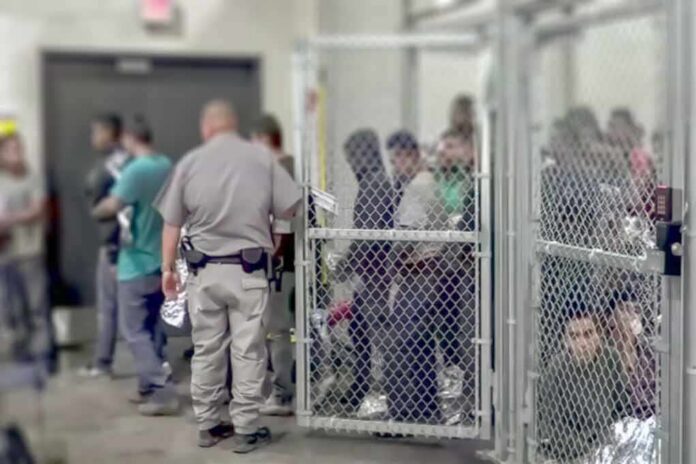
A House Judiciary Committee report built on nonpublic emails and internal training materials describes a system in which New York City prosecutors in at least two boroughs deliberately engineered guilty pleas to shield noncitizen defendants from deportation — not by dropping cases, but by rewriting the paper trail of a conviction so federal immigration law never sees what state criminal law actually charged.
Key Points
- A May 2026 email cited in the report shows a Queens prosecutor describing a plea as “immigration safe” while the defendant still pleaded to multiple crimes and served jail time.
- Bronx training materials from 2019 reportedly instructed prosecutors to “offer a non-deportable offense” and keep firearms or domestic relationships out of the conviction record.
- Queens formalized the practice through a designated office “Immigration Specialist,” a role the District Attorney’s own office describes as helping fashion dispositions that avoid unwanted immigration consequences.
- Manhattan District Attorney Alvin Bragg’s office told the committee its January 2022 policy was “outdated” and has since been revised to give prosecutors case-by-case discretion.
- The practice sits atop a real constitutional doctrine — Padilla v. Kentucky — that requires defense lawyers to advise noncitizen clients of deportation risk, which is the legal soil this controversy grows from.
What the Documents Describe
The House Judiciary Committee’s report, compiled from subpoenaed correspondence and internal training decks rather than press statements, lays out a specific mechanism. In Queens, prosecutors were told to “exercise extreme caution” when a defendant’s immigration status was in play, and to route those cases through an in-house Immigration Specialist whose job was to help “fashion dispositions” that would not trigger removal proceedings. The May 2026 email the committee highlights is blunt about the method: the office had “basically made a deal which is ‘immigration safe’ while still having [the defendant] plea to multiple crimes and do some jail time”. That phrasing matters — this was not leniency in the ordinary sense of a reduced sentence. It was a structural rewrite of the plea’s legal label, engineered so the underlying federal statute defining deportable offenses would not technically apply, even as the state’s punishment proceeded largely intact.
Bronx training materials described in the report go further, instructing prosecutors in 2019 sessions on “immigration-conscious plea bargaining” to offer non-deportable charges outright and to physically exclude certain facts — a firearm, a domestic relationship — from the official record of conviction. One alternative charge cited in the report, “attempted reckless assault,” is flagged as a legally dubious construction, since attempt liability generally requires intent and recklessness by definition does not. Whether courts actually accepted that formulation, or how often, is not detailed in the available record — but its presence in training materials indicates the goal was a conviction a federal immigration judge could not easily classify as deportable, regardless of what actually happened to the victim.
The Legal Backdrop: Padilla and the Rise of Immigration-Conscious Defense
None of this exists in a vacuum. Since the Supreme Court’s 2010 ruling in Padilla v. Kentucky, defense attorneys have been constitutionally obligated to advise noncitizen clients about the deportation consequences of a guilty plea, and failure to do so can render counsel constitutionally ineffective. That decision reshaped plea negotiation nationwide: federal immigration law classifies a wide range of state offenses as deportable, often with no discretion for a judge to weigh equities, so a seemingly modest conviction can carry life-altering consequences unrelated to the sentence itself. Legal scholars have described the resulting dynamic as a structural “plea-bargain crisis” for noncitizen defendants, in which the formal charge matters more than the facts of the case. Queens’s own description of its Immigration Specialist program frames the office’s role in exactly these terms — a resource meant to help prosecutors navigate plea options “while honoring a similar disposition for a citizen,” explicitly intended to track, not override, how a comparable citizen defendant would be treated.
That framing — defense-side advisement protected by Padilla versus prosecution-side charge engineering — is the real fault line here. A defense attorney advising a client of deportation risk is settled constitutional practice. A prosecutor’s office building institutional infrastructure, including a dedicated specialist and standing training materials, to actively construct charges that evade federal immigration consequences is a materially different act, because the prosecutor represents the public interest and the victim, not the defendant.
Scope, Response, and What Remains Open
The committee frames its findings as citywide, naming practices or policies touching all five boroughs, though the specific documentary detail — quoted emails, named training sessions — is concentrated in Queens and the Bronx. Manhattan’s response adds a genuine data point rather than silence: Bragg’s office told the committee its January 2022 charging policy, which had directed prosecutors to weigh immigration consequences, was outdated and has since been revised to restore case-by-case prosecutorial discretion. That is a substantive acknowledgment that such a policy existed and has since changed, even as it stops short of addressing the specific Queens and Bronx allegations. The committee’s findings rest on internal documents rather than aggregated case data, so the report does not establish how many defendants benefited from immigration-tailored pleas citywide, nor whether the practice applied uniformly or in isolated instances handled by individual line prosecutors exercising discretion.
NYC’s sanctuary DAs ordered prosecutors to downgrade charges to keep illegal immigrants in US, House GOP report finds | Josh Christenson & Thomas English, New York Post
New York City’s elected Democratic district attorneys are bending over backwards to keep illegal immigrants in… pic.twitter.com/LJvCQhvW2L
— Owen Gregorian (@OwenGregorian) October 27, 2026
Why This Matters Beyond New York
This dispute is really about who controls the meaning of a criminal conviction once it leaves the courtroom. When a prosecutor’s office builds standing infrastructure — a specialist role, written training guidance, repeatable formulas like “non-deportable offense” — to shape how federal law will later read a state conviction, it moves prosecutorial discretion into a new register: discretion exercised not case-by-case on the facts, but systemically, toward a predetermined immigration outcome. That tension between local prosecutorial autonomy and federal immigration enforcement is not unique to New York, and as sanctuary-adjacent charging policies draw congressional scrutiny elsewhere, the documents produced here — training slides, internal emails, specialist job descriptions — are likely to become the template other jurisdictions get asked to produce next.
Sources:
facebook.com, yahoo.com, conservativedailynews.com, voz.us, nl.headtopics.com, ground.news, reddit.com, queensda.org, en.wikipedia.org, law.cornell.edu