
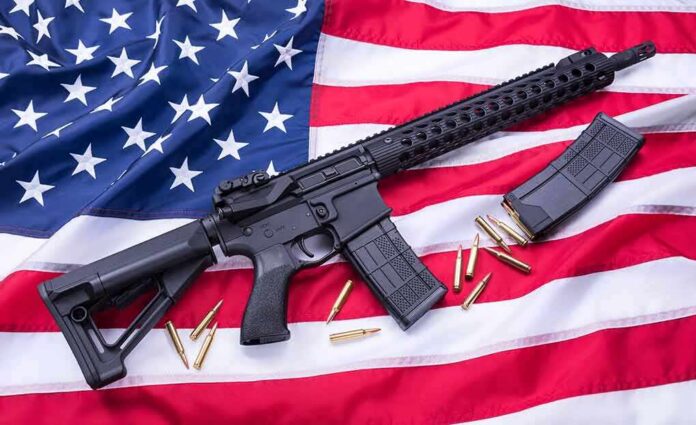
The constitutional fight over AR-15-style rifles turns on a blunt collision of two judicial yardsticks—“dangerous and unusual” versus “in common use”—and these consolidated Supreme Court cases force the Court to choose which rule actually controls when legislatures respond to mass-casualty events with categorical bans.
The Short Version
- Two consolidated Supreme Court cases ask whether states and localities may ban AR-15-platform semiautomatic rifles; the answer will set a nationwide rule.
- Connecticut and Cook County defend their laws on a historical-tradition theory that governments may restrict unusually dangerous weapons, citing Sandy Hook as the proximate catalyst and legislative predicate.
- Challengers—and the federal government—argue AR-15s are “arms in common use” possessed lawfully by millions, which Heller and its progeny place within the Second Amendment’s protection.
- Empirical literature on assault-weapons bans’ public-safety effects remains limited or inconclusive, leaving the historical-constitutional analysis to carry most of the weight.
What the Court Has Been Asked to Decide
The cases—Viramontes v. Cook County (No. 25-238) and Grant v. Higgins (No. 25-566)—arrived at the Supreme Court consolidated, with briefing that squarely frames the question: do the Second and Fourteenth Amendments protect possession of AR-15-platform and similar semiautomatic rifles, such that categorical bans are unconstitutional? The Congressional Research Service identifies the grant of certiorari and the posture as direct tests of state and local authority to prohibit this rifle class. That procedural clarity matters: regardless of local variations, the Court’s answer will operate as a national rule.
On one side, state and county respondents argue that governments have long regulated unusually dangerous weapons and that AR-15-style rifles fall within that tradition. On the other, challengers—and notably the federal government as amicus—say these rifles are commonly possessed for lawful purposes across most of the country and therefore cannot be banned consistent with Heller’s “common use” principle. The issue is not whether regulation is permissible in the abstract; it is whether a categorical possession ban on a widely owned rifle type is compatible with the modern Second Amendment framework.
How the Pro-Ban Case Is Built: A Legislative Response and a Historical Theory
Connecticut’s brief grounds its statute in a concrete legislative response to a specific atrocity. The state first enacted an assault-weapons ban in 1993 and then strengthened it in 2013 after the Sandy Hook Elementary School shooting, in which a gunman using an AR-15-style rifle murdered 20 first-graders and six educators in minutes. The state now defends the law as a targeted prohibition on a subset of semiautomatic rifles it characterizes as extraordinarily lethal, while leaving a broad array of other firearms available for lawful self-defense, hunting, and sport. In doctrinal terms, Connecticut urges the Court to read the Second Amendment as permitting restrictions on weapons deemed unusually dangerous under a historical tradition of regulation.
Institutional support extends beyond a single jurisdiction. Illinois’s attorney general announced a multistate coalition backing the authority of states and localities to regulate AR-15-platform rifles for public-safety reasons, amplifying the claim that these arms are different in kind because of their battlefield lineage, ballistic profiles, and effect on casualty counts in mass shootings. That multistate alignment does not prove the constitutional case, but it shows the defense is not merely symbolic or victim-driven; it is a coordinated governmental stance seeking to preserve local experimentation within federal constitutional bounds.
What the Sandy Hook Families Add—and What They Don’t
The families of Sandy Hook victims filed an amicus brief urging the Court to uphold the restrictions. Their filing provides named firsthand witnesses whose loss is directly tied to the weapon category at issue—a morally forceful link lawmakers often rely upon to justify targeted interventions. They emphasize high casualty counts and devastating wound patterns when these rifles are misused, reinforcing the state’s narrative that the category is distinct. In terms of legal proof, however, grief cannot substitute for doctrine; their amici status humanizes stakes but does not alter the Court’s methodological commitment to text, history, and tradition.
There are also limits in the present public record. The available summaries do not reveal the families’ full evidentiary foundation, expert declarations, or injury-severity analyses. Nor, at least in accessible reporting, do we have a controlled empirical showing that Connecticut’s or Cook County’s bans independently reduced firearm homicides or mass-shooting rates. Those absences do not defeat the states’ constitutional argument—which primarily trades on history rather than social science—but they do constrain any claim that the bans’ public-safety effects are already established in the literature.
The Counter-Case: Common Use and the Scope of the Second Amendment
Challengers frame AR-15s as among the most commonly owned firearms in the nation, possessed by tens of millions of Americans for lawful purposes—self-defense, hunting, and target shooting—and lawful in the overwhelming majority of states. On this view, “arms in common use” are categorically protected from bans, and any line the government draws based on features like detachable magazines or adjustable stocks impermissibly targets configurations rather than misuse. The federal government’s amicus brief adopts much of this logic, underscoring that widespread lawful ownership places these rifles within the Second Amendment’s protection. That alignment is significant: it signals that institutional authority is split, not unified, behind the bans.
Common use, though, is not a self-executing talisman; the Court will test it against the “dangerous and unusual” carveout that Heller itself preserved. The clash is therefore conceptual: can a weapon be both common and, in constitutional terms, unusually dangerous—dangerous enough to permit a categorical prohibition? The respondents say yes; petitioners, and the federal government here, say no. Which frame the justices elevate will decide these cases.
Text, History, and Tradition After Heller and Bruen
Since Heller and Bruen, the Court has rejected free-ranging interest balancing and required governments to justify firearm regulations by reference to a historical tradition of analogous restrictions. Respondents supply analogues in laws addressing weapons seen as terrorizing or disproportionately lethal in their eras; petitioners counter that most historical sources targeted manner of carry, public-affray offenses, or especially dangerous conduct—not categorical possession bans on commonly owned arms in the home. The doctrinal crux is fidelity: how closely must a modern ban mirror historical predecessors, and what counts as a legitimate analogue when technology has shifted from black powder to intermediate cartridges and detachable magazines? The consolidated cases are designed to force a principled answer rather than piecemeal lower-court improvisation.
Sandy Hook families urge Supreme Court to uphold state and local bans on AR-15-style rifles | LINK IN BIO pic.twitter.com/HTAdd71fmW
— MyNBC5 (@MyNBC5) October 30, 2026
What the Empirical Record Can—and Cannot—Resolve
Legislatures often point to casualty patterns in high-profile attacks to justify category-based restrictions, and the Sandy Hook massacre understandably figures prominently in Connecticut’s legislative findings. But when courts look for empirical backup beyond history, the available research on assault-weapons bans is limited. RAND’s syntheses rate the evidence on such bans’ effects on mass shootings, violent crime, and related outcomes as limited or inconclusive, with more consistent—though still limited—signals tied to high-capacity magazine restrictions rather than rifle-feature bans. That does not prove the laws ineffective; it shows the literature has not yet delivered decisive, generalizable effects estimates. As a result, the constitutional argument will likely live or die on the historical axis, not on modern epidemiology.
Practical Stakes: Regulatory Space Versus a Bright-Line Rule
If the Court embraces the challengers’ reading—that common, lawful civilian ownership forecloses categorical bans—states will lose a powerful regulatory lever, and a raft of similar laws will fall in short order. The doctrinal upside is simplicity and predictability; the downside is reduced capacity for jurisdictions to respond to specific casualty mechanisms in mass attacks. If, by contrast, the Court affirms a robust “unusually dangerous” category that can reach some commonly owned arms, governments retain room to draw lines based on configuration and effect—but the Court will then need to articulate a limiting principle to avoid a backdoor return to interest balancing under a historical label. Either way, the justices must supply an administrable rule.
Bottom Line
The families’ brief crystallizes what motivated these laws; the state and county briefs supply the historical theory to defend them; the federal government’s filing underscores how potent the “common use” rule has become. With empirical evidence still unsettled, the Supreme Court’s answer will turn on method: whether the Second Amendment’s core protection yields to a historically grounded “unusually dangerous” carveout when a weapon type is both widely owned and misused in rare but catastrophic events. The consolidated cases force that choice, and their resolution will define the constitutional perimeter of rifle regulation for years to come.
Sources:
washingtontimes.com, usnews.com, sandiegouniontribune.com, supremecourt.gov, scotusblog.com, congress.gov, portal.ct.gov, illinoisattorneygeneral.gov, reuters.com