In a structural collapse, the first truth that matters is lifesaving: New York City’s fire, EMS, and police rescue teams executed a full-scale technical rescue in Flatbush, pulling people from unstable debris while continuing a meticulous search under the constant risk of secondary failure.
At a Glance
- The FDNY, NYPD Emergency Service Unit, and urban search-and-rescue specialists mounted a major technical rescue after a three-story building in Flatbush partially collapsed.
- Rescuers confirmed live removals from the rubble and continued searching amid precarious conditions and void spaces.
- The collapse occurred just after 4 p.m.; scene control, evacuations, and traffic closures supported operations and public safety.
- Early casualty figures varied across outlets, a common feature of collapse incidents while rescues are active.
What happened and why the response is the point
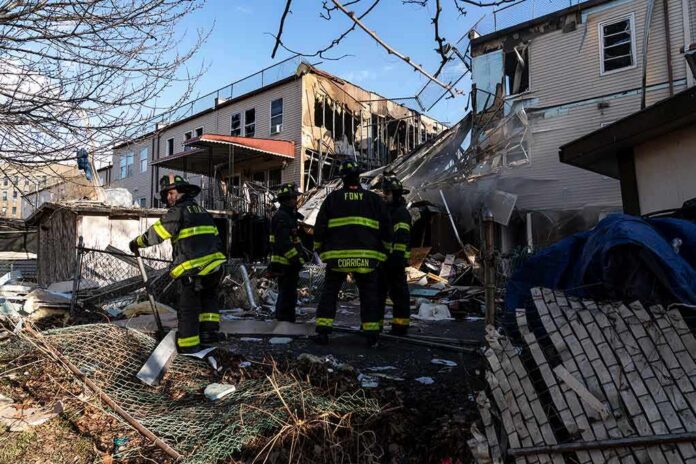
The essential facts are firm. A mixed-use, three-story building in Brooklyn’s Flatbush neighborhood suffered a partial collapse shortly after 4 p.m., with debris falling into an adjacent work area. FDNY units, joined by NYPD’s Emergency Service Unit and other city partners, arrived rapidly and treated the scene as a major technical rescue—an operation that prioritizes survivability, structural stabilization, and disciplined search patterns. Multiple outlets documented firefighters digging through unstable rubble, employing hand-by-hand search methods, and removing victims on stretchers as operations progressed.
Within the first operational period, officials confirmed live rescues from the debris. FDNY communications to reporters stated that at least two people were removed and being evaluated, and separate on-scene reporting corroborated those removals during the active search window. These are the anchor points of any collapse narrative: a verified rescue posture, verified rescues, and a continuing, risk-managed search for others who might be trapped.
How urban technical rescues work when structures fail
Major city fire departments treat collapses as low-frequency, high-consequence events. The first engine and ladder companies establish incident command, control utilities, and define hot, warm, and cold zones to manage collapse hazards. Rescue and squad companies, reinforced by special operations, map the structure’s load paths—how weight is being carried now that gravity has redrawn the building’s geometry—and build shoring: temporary supports to prevent secondary collapse while rescuers cut, lift, and tunnel. NYPD ESU integrates alongside FDNY’s special operations with complementary capabilities, including breaching, lifting, and victim removal under hazardous conditions. The point is speed married to method; improvisation is dangerous without a structural plan.
Search is systematic. Crews divide the debris into grids, probe voids where survivable space might exist, and work toward last-known locations whenever witness information exists. Hand tools dominate early on; they reduce vibration and the risk of dislodging precarious elements. K-9 teams, cameras, and listening devices are common tools in these environments, but their deployment depends on conditions, access, and time. The public sees digging; professionals see a choreography of stabilization, search, and controlled force applied where the structure will tolerate it.
The clock, the map, and command discipline
Dispatch time, address validation, and rapid arrival are not trivia; they structure the entire operation. Reports align on a just-after-4 p.m. collapse with FDNY receiving the initial call around 4:01 p.m. and naming Bedford Avenue near Newkirk and Flatbush as the operational box. That clarity matters because it pins the alarm to a specific resource stack—engines, ladders, rescues, squads, battalion and division chiefs—and lets the public evaluate performance against the department’s own standards for major incidents. It also frames the hazards command must mitigate: a live street grid, a partly occupied mixed-use structure, and an adjacent excavation site with its own stability profile.
Scene control is integral to lifesaving. New York City’s Office of Emergency Management advised the public to avoid the area; law enforcement established closures and detours to clear ingress and egress for heavy rescue, cranes, ambulances, utility cutoffs, and shoring deliveries. Those moves reduce secondary injuries and preserve the precious minutes rescuers need when they find a live victim and must move quickly but safely from void to triage to transport.
Why early numbers swing—and what to trust
In structural collapses, initial casualty figures almost always evolve. That is not incompetence; it is evidence that the rescue is real. Rescuers start with imperfect information: occupants who self-evacuated, bystanders miscounting, victims moving between adjacent spaces, and overlapping 911 calls. Newsrooms relay what official spokespeople can responsibly say while conditions change. In Flatbush, early accounts alternated between “people possibly trapped,” two removals, and later tallies that differed by outlet while searches continued. The mark of reliability is not a frozen number at minute ten; it is the consistent through-line—there is a collapse, there is an active technical rescue, and there are verified removals and patients—that later reconciles into a final registry of victims once the scene is secure.
Cause and accountability are separate questions—and they take time
Two distinct inquiries always follow a collapse. The first is operational: Did the city execute the rescue with professionalism and speed? The second is forensic: Why did the structure fail? Lawfully, these run on different clocks. The Flatbush reporting reflects that separation. While some coverage highlighted adjacent excavation and construction activity, officials stated that the cause remained under investigation during the rescue phase. Building failures in New York have repeatedly traced to discrete, identifiable triggers—ill-considered demolition sequences, removal of load-bearing elements without proper shoring, or foundation undermining—discoverable only after engineers study the debris field, plans, permits, and contractor methods.
City regulators publish annual construction safety analyses that contextualize risk across thousands of projects. Recent reports show incident and injury reductions across the city’s work sites, even as standout failures still occur and demand rigorous follow-up. After prior collapses, the Department of Buildings launched targeted sweeps and released investigation findings attributing failures to specific code violations or unsafe methods—such as removing load-bearing masonry without temporary supports—demonstrating a pattern: when causation is established, it is usually technical, documentable, and enforceable, not speculative.
Brooklyn Building Collapse in Flatbush: What Caused It? https://t.co/kNaOyRlOek
— 𝖈𝖚𝖇𝖒𝖆𝖓𝖉𝖊𝖗 𝖎𝖓 𝖈𝖍𝖎𝖊𝖋🎃🔥🐎🔥🏮 (@yalittleshit) November 12, 2026
What this means for New Yorkers
The Flatbush collapse reinforces three durable lessons. First, New York’s rescue infrastructure is built for bad days; when a load path disappears and a wall becomes rubble, FDNY and NYPD ESU move as a single system to find survivors. Second, the public should expect early ambiguity in counts but clarity in actions: controlled perimeters, systematic searches, and staged medical transport. Third, accountability follows the engineering: the real answers about causation arrive from records, measurements, and sequence reconstruction, not from the heat of the first hours.
Sources:
fox2now.com, whmi.com, cbsnews.com, fox56news.com, diyatvusa.com, pix11.com