
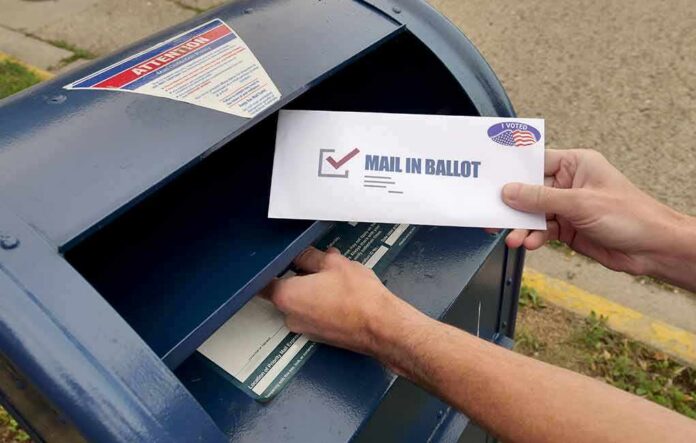
A federal appeals court just cleared the way for a major election integrity rule — and states that refuse to comply won’t get their mail-in ballots delivered before the 2026 midterms.
Story Highlights
- The D.C. Circuit Court of Appeals allowed the U.S. Postal Service’s new mail ballot rule to move forward while legal challenges continue.
- Under the rule, states must hand over voter rolls and unique ballot barcodes to the U.S. Postal Service at least 30 days before mailing federal ballots.
- Postmaster General David Steiner confirmed the U.S. Postal Service will not deliver mail ballots in states that refuse to comply.
- The rule flows directly from President Trump’s Executive Order 14399, signed March 31, 2026, which requires federal agencies to strengthen citizenship verification in elections.
Appeals Court Gives Election Integrity Rule the Green Light
On Friday, July 17, a three-judge panel on the D.C. Circuit Court of Appeals granted a stay that lets the U.S. Postal Service (USPS) enforce its new election mail rule while courts finish hearing the case. The panel found that the USPS met the legal standard needed to keep the rule in place during the appeal. That ruling reversed a lower court order that had temporarily blocked the rule from taking effect.
The rule requires states to register with a new USPS Federal Ballot Mail Portal. States must then submit each voter’s name, address, and a unique serialized barcode tied to their ballot envelope — all at least 30 days before any ballots go out. The USPS can then track every mail ballot from start to finish, verifying it goes to and comes back from an actual registered voter.
Trump’s Executive Order Set This in Motion
President Trump signed Executive Order 14399, titled “Ensuring Citizenship Verification and Integrity in Federal Elections,” on March 31, 2026. The order directed federal agencies, including the USPS, to take new steps to verify who receives mail ballots. The USPS issued its proposed rule on June 2, 2026, directly in response to that order. The rule applies to all general, special, and runoff federal elections going forward.
Postmaster General David Steiner testified before Congress in June that the USPS would simply not deliver mail ballots in any state that refuses to turn over its voter lists. That’s a powerful enforcement tool. States that want their voters to use mail-in ballots for federal races will need to play by the new rules — or their voters won’t get ballots at all.
Democrats Push Back, But the Rule Stands for Now
Democrats in Congress and several state attorneys general moved quickly to fight the rule. Senate Democrats, including Senators Schiff, Padilla, Peters, and Schumer, demanded the USPS drop the rule, calling it an illegal overreach. A coalition of state attorneys general also filed comments opposing the rule, arguing it was unconstitutional. Legal challenges are still working through the courts, and the fight is far from over.
For conservatives who have spent years demanding cleaner elections, this ruling is a meaningful step forward. The rule gives the federal government real tools to verify that mail ballots go to eligible voters and come back from them. Every ballot tied to a unique barcode and a confirmed voter name means far less room for error — or abuse. The 2026 midterms are approaching fast, and this rule could reshape how millions of mail ballots are handled across the country.
Sources:
townhall.com, nypost.com, redstate.com, thegatewaypundit.com, reuters.com, schiff.senate.gov