
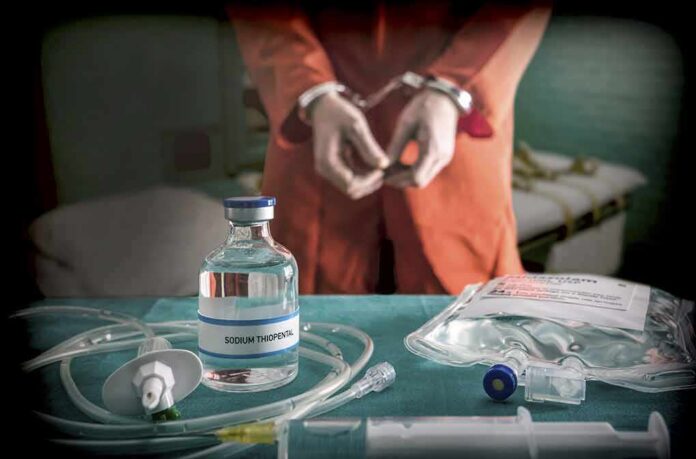
The failure of Tennessee’s execution of Christa Gail Pike is not just an operational misfire; it is a stress test that exposed how a protocol can be followed to the letter and still produce an outcome that neither fulfills the sentence nor satisfies constitutional, medical, or moral expectations.
At a Glance
- The Tennessee Department of Correction says its team complied with the state’s approved lethal-injection protocol, yet Pike survived two doses and was taken to a hospital.
- Multiple media witnesses reported Pike remained alive—breathing and even snoring—well after the second pentobarbital dose, an outcome experts call exceptionally rare.
- Governor Bill Lee paused executions and ordered an independent review to determine what happened and what should change before any future attempt proceeds.
- The episode sits in a longer pattern of lethal-injection failures that blur the line between “botched” procedures and truly “failed” executions, with significant legal and ethical implications.
What Tennessee says happened—and what witnesses saw
Tennessee’s official account is stark: the Department of Correction stated that its staff “followed every step of the State’s lawful, established execution protocol” and that the protocol itself did not authorize further measures beyond what was done before Pike was transported to an outside hospital. The department also asserted that the chemical in its protocol “has consistently been effective,” while underscoring that no additional procedures were permitted once the planned sequence was complete.
Witness accounts describe a very different tableau inside the execution chamber. Reporters present said officials appeared to administer two rounds of pentobarbital; after the second, Pike continued to breathe—at times raggedly, at times with rhythmic snoring—for an extended period before observers were escorted out. One reporter said Pike lifted her head and looked around; others relayed that she asked whether a burning sensation was normal. The blinds were lowered partway through, obscuring some steps, but the audible signs of life persisted behind the curtain until the room was cleared. A number of outlets corroborated the core elements of that witness narrative: two doses administered, breathing and snoring heard long afterward, and subsequent ambulance transport.
Mechanism and failure modes: how lethal injection is supposed to work
Modern lethal-injection protocols aim to render a person deeply unconscious and then cause death through respiratory suppression and cardiac arrest. States that use a single-drug protocol typically rely on a barbiturate—often pentobarbital—at a dose designed to overwhelm normal physiology. When a protocol functions as intended, unconsciousness arrives quickly; reflexive breathing gives way to shallow respirations and then asystole. When it does not, the failure usually traces to one of three places: drug potency and preparation, vascular access and delivery (the drug did not enter the bloodstream at the intended rate or at all), or physiological variability that slows distribution enough that death is delayed beyond the expected window.
In Tennessee’s case, the state’s statement emphasizes protocol compliance and historical efficacy of its drug, while witnesses describe an outcome—sustained breathing and snoring—that is strongly suggestive of incomplete central nervous system depression, delayed bioavailability, or compromised venous access. Journalists on site reported that portions of the procedure happened behind a closed curtain; they could not verify line placement. Those observations do not prove a specific mechanism of failure, but they align with the most common breakdowns seen in other states: difficulties establishing or maintaining IV access or ensuring the full dose reaches circulation promptly.
Rare versus unprecedented: situating Pike’s case in the modern record
Botched and failed executions are distinct. Botched executions involve unanticipated departures from protocol that increase pain or prolong the process; failed executions are those that do not result in death despite the attempt. Both are rare; true failures are rarer still. Legal scholars and practitioners place the number of documented failed executions in the modern era at fewer than ten nationwide—most tied to vascular access problems rather than a person surviving two complete drug rounds. Against that backdrop, Pike’s survival after two pentobarbital doses stands out as an extreme edge case in the lethal-injection era.
It is also not Tennessee’s first recent problem. Earlier breakdowns in the state’s execution operations led to scrutiny of training, drug sourcing, verification steps, and clinical oversight. In response to Pike’s case, Governor Bill Lee ordered a comprehensive third-party review and paused the remaining executions on the calendar to determine exactly what occurred and what should be changed before proceeding further.
Protocol fidelity versus outcome legitimacy
Tennessee’s position—that the team followed protocol and the protocol permitted no further steps—captures a real tension in death-penalty administration: process compliance is necessary for legality, but it is not sufficient for legitimacy when the outcome contradicts the purpose of the protocol. If a protocol anticipates a backup set of syringes but offers no pathway when two rounds leave the prisoner alive, the state meets its rulebook while failing its endpoint. That gap is precisely what an independent review should interrogate: was the drug potent and properly compounded; was IV access secure and intravascular; were dosage volumes and infusion rates verified; and what clinical monitoring—capnography, ECG, or other—was available to confirm physiologic effect rather than relying on visual cues alone?
Witness descriptions of snoring and labored respirations do not specify consciousness; snoring can occur in deep sedation. But prolonged audible breathing after two pentobarbital doses is discordant with the pharmacology the protocol presumes. That discrepancy is the heart of this case, and it is why the governor’s pause signals more than optics—it acknowledges a systems problem whose variables must be isolated and corrected before any just administration can resume.
Legal and ethical implications of a failed execution
American law does not categorically bar a second execution attempt after a failed one. The Supreme Court’s 1947 decision in Francis v. Resweber allowed a second attempt where the first failed because of an equipment malfunction, reasoning that the state’s purpose was not to subject the prisoner to gratuitous pain but to carry out a lawful sentence. Later cases have refined, not reversed, that logic. Whether Pike’s circumstances fit within that doctrinal channel will hinge on factual findings from Tennessee’s review and any ensuing litigation about risk of severe pain and the reliability of the state’s chosen method.
Ethically, the case will reignite two long-running debates. First, can lethal injection be made reliably humane, given constraints on medical professional participation and the complexities of drug sourcing and monitoring? Second, what evidentiary standard should satisfy courts that a protocol—on paper and in practice—minimizes needless pain and materially reduces the risk of a drawn-out, indeterminate procedure? Clinical literature has, for years, questioned assumptions about barbiturate-based executions being invariably quick and painless; those critiques carry greater force when a procedure stalls in public view.
🚨BREAKING: Tennessee death row inmate Christa Pike is alive and being treated in hospital after two lethal injections were administered and her execution failed. pic.twitter.com/rva4jsPxoO
— Nick Shirley RV (@NickShirleyRV) October 1, 2026
What a credible review must answer before Tennessee proceeds
Three inquiries are decisive. First, pharmacology and product integrity: confirm the identity, concentration, stability, and sterility of the pentobarbital used, including chain of custody and independent potency assays. Second, delivery and monitoring: reconstruct IV placement with documentation and imaging where possible; specify infusion rates, volumes, and whether infiltration or extravasation was detected; and identify what physiologic monitors, if any, were used to verify effect in real time. Third, governance and protocol design: examine training, rehearsals, role delineation, and decision trees for contingencies—what triggers a pause, when a second dose is indicated, and what clinical criteria, beyond visual observation, define death or failure.
If those answers reveal a correctable operational lapse, Tennessee will face a narrow task: fix the process, retrain, and revalidate. If they reveal structural deficiencies—drug variability, inadequate monitoring, or protocols that cannot be executed reliably within ethical and legal constraints—the remedy is broader. That could mean revising the protocol fundamentally, shifting methods, or seeking legislative changes. What cannot stand is the current contradiction: a protocol deemed “consistently effective” alongside a high-profile failure that even supporters of capital punishment will recognize as untenable in a system that claims to be orderly and humane.
Sources:
pjmedia.com, apnews.com, yahoo.com, usatoday.com, wsoctv.com, nbcnews.com