When public safety officials move overnight to disrupt a stated plan to attack a seat of government, the stakes are simple and high: prevention is the mission, and timing is the margin. In Texas, authorities say they had credible information of a planned violent attack on the State Capitol and acted before the alleged plot’s target date.
At a Glance
- Texas DPS says it received credible information of a planned violent attack on the State Capitol set for Oct. 1, 2026.
- DPS SWAT arrested 40-year-old Benny Caldera Jr. around 3 a.m. at his residence in Converse, northeast of San Antonio.
- Caldera was booked on a felony charge of making a terroristic threat against a public servant; the FBI and local partners assisted.
- A Senate staff notice described a “main suspect” and “suspected co-conspirators”; the Capitol stayed open under normal hours.
What Authorities Say Happened
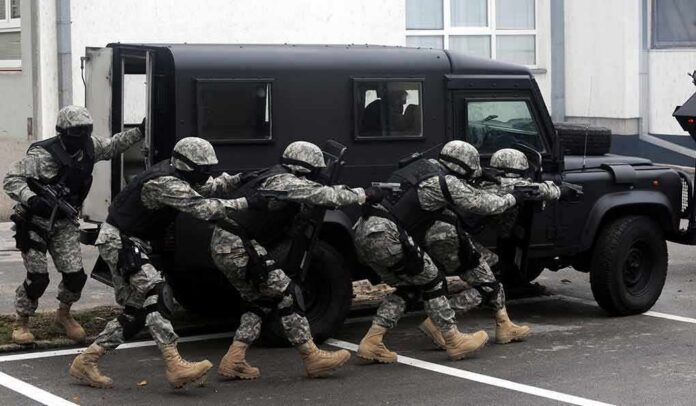
Texas Department of Public Safety officials said they received credible information on a Tuesday evening indicating an individual was planning a violent attack on the Texas State Capitol for Thursday, Oct. 1, 2026. Working through the night with the FBI and local law enforcement, a DPS SWAT team moved to arrest the identified suspect in the pre-dawn hours on Wednesday. The arrest took place at about 3 a.m. at a home in Converse, a Bexar County community outside San Antonio, interrupting what state officials described as a specific plan keyed to a date two days later.
Authorities identified the suspect as 40-year-old Benny Caldera Jr. He was booked on a state felony charge of making a terroristic threat against a public servant, an offense that recognizes threats directed at government officials or institutions tasked with public functions. In parallel with the overnight operation, DPS notified state leaders; a notice to senators and staff from the Secretary of the Senate referred to a “main suspect” and “suspected co-conspirators.” After the arrest, the Capitol remained open for normal hours with increased law enforcement presence as the investigation continued.
How Threat Disruption Works in Practice
When an intelligence lead points to a date-certain plot against a government facility, agencies triage on two axes: credibility and imminence. Credibility asks whether the source and content clear internal thresholds—corroboration, specificity, and the subject’s demonstrated capability. Imminence weighs timing against the operational risk of waiting for more facts. If both alarms flash, the standard playbook is swift: contain the subject, isolate potential collaborators, and stabilize the target site. That is why these cases often present as a tight timeline—tip on Tuesday, SWAT action before dawn Wednesday, and a security-forward posture in the days that follow.
Multi-agency coordination is not ornamental; it is the mechanism for speed. State police own the ground around the Capitol, but the FBI’s Joint Terrorism Task Forces hold investigative reach across jurisdictions and digital channels. Local departments contribute local knowledge—addresses, routines, prior calls for service—that can make a 3 a.m. entry safer and more certain. The Texas case tracks this division of labor: DPS in the lead, FBI participation, and local partners assisting with the overnight operation.
The Charge and Its Legal Meaning
Texas law distinguishes threats made against the public at large from threats aimed at public servants carrying out official duties. A felony terroristic threat charge against a public servant signals prosecutors believe the target was not an individual grievance but a function of state—legislating, administering, or securing a public building. In practical terms, that elevates potential penalties, justifies rapid protective measures, and aligns the case with specialized investigative resources. The arrest in Converse reflects that posture: remove the subject from circulation first, then work the file for evidentiary completeness as prosecutors prepare to present the case.
Because the alleged target was a statehouse, the protective objective extended beyond one suspect. The Senate notice’s reference to “suspected co-conspirators” explains the heightened presence at the Capitol and the emphasis on continuity—keeping the building open while reducing exposure to residual risk. That balance—maintain public access while mitigating threat—has become a defining feature of statehouse security since major incidents in the last decade prompted enduring changes in how agencies posture against domestic violent extremists.
Timeline and Operational Decisions
The sequence reported across outlets is consistent: a Tuesday-evening tip indicating a Thursday attack date; an early-Wednesday SWAT arrest; normal operations at the Capitol with additional troopers on site. In threat mitigation, that timeline signals two judgments. First, the information was concrete enough to justify immediate action rather than a wait-and-see approach. Second, the risk to the Capitol could be reduced to acceptable levels by removing the main suspect and elevating visible security, without resorting to closure or sweeping lockdowns that disrupt public business.
Such timelines also reflect legal process. Once a subject is in custody, investigators can execute search warrants, interview associates, and stabilize electronic evidence. If additional actors surface, charges can be added; if not, the initial arrest stands on the charge that justified the intervention. In parallel, legislative security offices and DPS maintain routine operations so elected officials and the public can engage in the civic work a Capitol exists to host.
BREAKING: Texas DPS arrests suspect in alleged plot to attack Texas Capitol.
Texas Department of Public Safety arrested 40-year-old Benny Caldera Jr. of Converse around 3 a.m. Wednesday after receiving credible information of a planned attack on the Texas Capitol set for…
— Burn it Down News (@upinflamesnews) September 30, 2026
Why This Fits a Broader Security Pattern
Statehouses are symbolic and practical centers of government—high-value targets for individuals who view disruption as leverage. After the U.S. Capitol breach in 2021, federal and state authorities publicly assessed that domestic violent extremists pose an elevated threat to government facilities and officials, a stance that has shaped posture at capitols nationwide ever since. Intelligence about planned actions keyed to legislative calendars or prominent dates now triggers faster interagency responses as a matter of doctrine, not improvisation.
What It Means Going Forward
The Texas operation underscores three durable dynamics. First, speed matters; when officials see both credible intent and a near-term date, preemptive arrests are the norm. Second, openness remains the policy aim; despite credible threats, capitols strive to remain accessible public spaces, with security measures layered rather than monolithic. Third, coordination is the backbone; DPS, the FBI, and local partners used a common playbook to move from intelligence intake to an arrest, then to a stabilized security posture at the Capitol while the investigation continues.
Sources:
kvue.com, nbcdfw.com, texastribune.org, timesnownews.com, abc13.com, ksat.com