When elite sport and high office intersect, ceremony becomes storyline: at the 2026 Presidents Cup, President Trump’s presence as honorary chairman and his trophy presentation were woven directly into Team USA’s comeback narrative—most notably by U.S. captain Brandt Snedeker—illustrating how symbolism, timing, and attribution often stand in for causation in victory lore.
At a Glance
- President Trump served as honorary chairman of the 2026 Presidents Cup and presented the trophy to Team USA after a comeback win.
- U.S. captain Brandt Snedeker publicly credited Trump for the turnaround, a postgame attribution that became part of the event’s story arc.
- The honorary-chairman role is longstanding; multiple U.S. presidents have filled it, including Trump in 2017, so 2026 followed established tradition.
- Team USA’s win marked the Americans’ 11th straight Presidents Cup victory, extending a decades-long competitive pattern.
What Happened: Ceremony, Attribution, and a Streak Extended
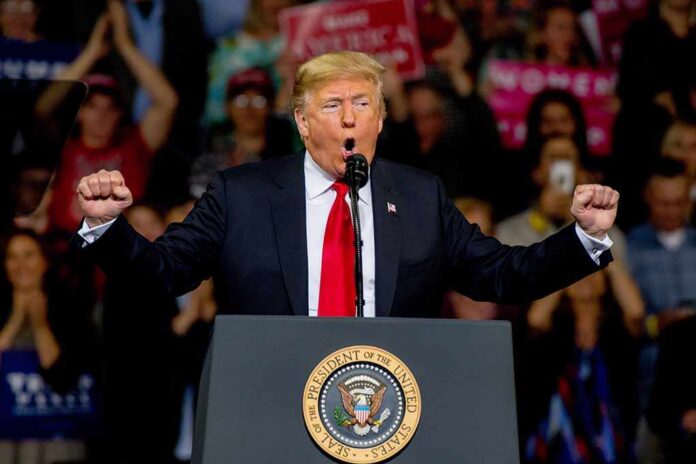
The 2026 Presidents Cup at Medinah Country Club culminated with a familiar tableau: the U.S. squad lifting the trophy, the home crowd roaring, and the honorary chairman—President Trump—on stage to hand over the silverware. Trump had accepted the ceremonial role a month prior, a standard appointment the PGA Tour extends to a head of state or former one when the matches are on U.S. soil. He arrived for the closing ceremony and presented the Presidents Cup to Team USA after a stirring Sunday rally sealed the Americans’ 11th consecutive win.
Snedeker, the first-time U.S. captain, pushed the moment beyond pageantry. In interviews after his team flipped a three-point deficit to dominate singles, he assigned credit for the comeback to Trump’s involvement—an emphatic, on-the-record flourish that ensured the presidential cameo would be stitched into the folklore of Medinah 2026. The remark traveled quickly across golf media and general outlets, not because it proved a measurable effect, but because it tied emotion and authority to a result that already fit an American dynasty storyline at this event.
How the Honorary-Chairman Role Works—and Why It Matters in the Story
The honorary chairman is not a tournament official with competitive authority; the position is ceremonial. It encompasses visibility—opening messages, sponsor and dignitary engagements, and, if schedules align, a presence at the closing ceremony to award the trophy. The Presidents Cup’s modern tradition has included several U.S. presidents in this capacity, and Trump’s 2026 turn at Medinah was his second, following Liberty National in 2017. That continuity is the point: the role aims to elevate the event’s stature, not to influence pairings, course setup, or rules.
Because the function is ceremonial, its influence is narrative, not tactical. Players and captains know the difference. Yet big-time sport is an engine for mythmaking; when an emotionally charged outcome follows a high-profile appearance, attribution can migrate from logistics and matchups to symbolism and leadership aura. Golf, which hinges on individual execution under pressure, is particularly hospitable to such post hoc storytelling. Snedeker’s crediting of Trump thus landed as part gratitude, part theatrics, and entirely consistent with how teams shape the memory of a week.
The Competitive Backbone: From Deficit to Sunday Dominance
Separate from ceremony, the golf was sharp. The United States entered Sunday behind and then surged—the “biggest singles margin of victory” framing captured why the win felt like a reversal in real time. Snedeker had been candid the prior evening about the hole his team had dug and his own accountability for it; on Sunday, veterans and rookies alike converted under the gun, with late-session rallies and finishing-hole nerve. That performance stretched the Americans’ Presidents Cup stranglehold into an 11th straight victory, a streak that says more about roster depth, home-course familiarity, and match-play know-how than any single external factor on a given Sunday.
Momentum in team match play is as much architecture as magic. Captains set orders to front-load confidence or back-end anchors; assistants track live boards to nudge pairings and pacing; analytics inform who sees which holes most often and where form carries. The United States, as usual, fielded more top-20 players and deeper form charts, which, over four days, tends to manifest in the formats that reward sustained ball-striking and putting streaks. Within that structure, emotional catalysts matter at the margins—crowd surges, a galvanizing message, a timely putt that flips three nearby boards through scoreboard pressure—but the spine is still shot quality across 200-plus competitive holes.
Why Snedeker’s Credit to Trump Resonated
Context explains the line’s democratic traction. First, it came from the captain on the heels of a comeback: the messenger and the moment both carried weight. Second, it mapped onto an institutional tradition; presidents have long been visible at the Presidents Cup, and Trump’s second stint in the role made his participation legible rather than anomalous. Third, it offered a clean storyline—external spark, internal response—that media can translate instantly for audiences who may not follow the granular tactics of foursomes versus four-ball or how singles orders are engineered. In short, it packaged a complicated team performance into a single, memorable credit line.
That does not mean the claim is a technical account of causation. It functions as a leader’s public framing—morale, gratitude, and political theater in one stroke—attached to an event expressly designed to intertwine sport with civic ceremony. The Presidents Cup’s format invites this: the biennial rhythm, the team uniforms, the flag-and-anthem staging, and a closing scene where the honorary chairman stands shoulder-to-shoulder with players. In such settings, attribution naturally migrates to the most visible figure at the denouement.
Tradition, Precedent, and the 2017 Through-Line
Trump’s 2026 role fits a well-worn groove. He served as honorary chairman in 2017, joining a short roster of presidents who have filled the post multiple times. The idea is continuity—attach the event to the prestige of the office and reinforce its quasi-state-visit aura when hosted by the United States. In 2017, as in 2026, the American team won convincingly; in both cases, the concluding images featured the president, the cup, and a triumphant U.S. squad. That repetition is not incidental. It is how institutions manufacture tradition, and how fans recall editions of a tournament that otherwise blur amid similar outcomes and recurring stars.
The International Team’s persistent challenge—assembling cohesion from a multinational roster, away from home crowds and course dictates—remains the longer arc tension. The U.S. advantage is not new; it has been entrenched through depth and match-play seasoning. For the Internationals, the lesson of Medinah 2026 is the same one they have wrestled with since the mid-1990s: narrow variance in foursomes, win the pivotal middle session, and avoid arriving at Sunday needing an outlier slate of upsets. Ceremonial atmospherics don’t decide that; pairings, form, and nerveless putting do.
NEW: President Trump presents the Presidents Cup trophy to U.S. Team Captain Brandt Snedeker as Team USA celebrates its victory at Medinah Country Club in Illinois. The U.S. Team defeats the International Team 17-13 following Sunday's singles matches, closing out four days of… https://t.co/Oyqah90ZYv
— C👘 (@Viv_Teacher) September 28, 2026
The Lasting Takeaway
Two truths can sit comfortably together. First, the facts: President Trump served as honorary chairman, attended the closing ceremony, and presented the Presidents Cup trophy to a U.S. team that stormed through singles to extend an 11-event winning streak. Second, the framing: Snedeker credited Trump for the comeback, elevating ceremony into catalyst and ensuring the president’s presence became part of the tournament’s official memory. The technical determinants of victory—roster depth, execution in pressure windows, and the captain’s Sunday calculus—won the cup. But in the annals of sport, outcomes are remembered through symbols. In 2026, at Medinah, the symbol was the president handing over a trophy to a team that turned a deficit into a dynasty’s next chapter.
Sources:
thegatewaypundit.com, golfweek.usatoday.com, sports.yahoo.com, fox32chicago.com