
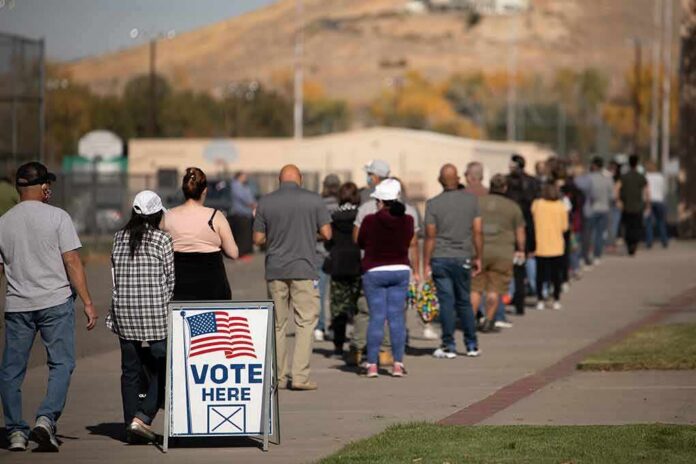
In Arizona’s most competitive House district, the Democratic primary isn’t just a contest of résumés; it is a stress test of how modern parties pick nominees in swing terrain—where a measurable local front-runner, Amish Shah, collides with national gatekeeping that has rallied behind Marlene Galán-Woods, and the outcome will shape not only November’s odds but how much voice local voters retain in the age of centralized “electability.”
At a Glance
- AZ-1 is a must-win battleground where Democrats see a rare pickup path after the Republican incumbent left to run for governor.
- Amish Shah holds a substantial lead among likely Democratic primary voters in the only public live-caller survey released to date.
- National Democrats have made their largest primary investment of the cycle to boost Marlene Galán-Woods, intensifying intraparty friction over “meddling.”
- Turnout dynamics and independent voters will decide November—but the nominee’s pathway is forged now by how Democrats resolve local-vs-national control.
Why AZ-1 is structurally hard—and unusually flippable right now
Arizona’s 1st Congressional District crosses the politically heterogenous northeast Phoenix suburbs, including parts of Scottsdale—territory where ticket-splitting is common and independent voters are decisive. Republicans narrowly held the seat in 2024, but the incumbent stepped aside to pursue the governorship, opening a cleaner pathway for Democrats in a presidential midterm environment. The field is well defined: on the Democratic side, former state lawmaker and ER physician Amish Shah, former journalist Marlene Galán-Woods, Rick McCartney, and Jonathan Treble; Republicans are contesting their own primary to keep the district in the column they’ve held under shifting coalitions since redistricting. The race’s competitiveness is not a media concoction—it’s embedded in the map and in recent vote margins.
Because the seat is open, the primary winner will not face the usual incumbency advantages in November. That changes the calculus for both factions inside the Democratic coalition. Pragmatists want the candidate with the smoothest translation to independents; organizers argue the candidate must mobilize irregular Democrats in a low-trust environment. AZ-1 demands both: a nominee who can hold suburban moderates while energizing a base that often under-participates in primaries.
The core factual landscape: Shah’s measurable lead, Galán-Woods’ national boost
On the measurable side of the ledger, Amish Shah enters the late-primary stretch with a commanding advantage in a February live-caller survey of 400 likely Democratic primary voters, leading Galán-Woods by roughly three-to-one, with the rest of the field in low single digits. In a crowded field where fragmentation usually narrows margins, a spread that lopsided is unusual; it suggests both name recognition and a durable preference among habitual primary voters. Against that, the Democratic Congressional Campaign Committee (DCCC) placed a $200,000 joint ad buy with Galán-Woods—its largest primary expenditure in the cycle—signaling explicit national preference despite Shah’s prior nomination experience and current standing with local Democrats.
Those two data points—one about voters, one about institutions—explain the contest’s tension. The survey is not destiny, but it is evidence that habitual Democratic voters know the options and are leaning decisively. The DCCC buy is not a verdict on who can govern, but it is a credible marker of how national strategists grade general-election viability in a district like AZ-1, where swing voters often decide outcomes late.
Mechanism of electability: what wins AZ-1 in November
To understand the clash, start with AZ-1’s arithmetic. The district’s electorate tilts slightly right by registration, with a large share of independents who behave more like fiscally cautious suburbanites than ideologues. Success requires a candidate who is visibly competent on affordability and housing, credibly pragmatic on immigration and border management, and disciplined on national controversies that can spook swing voters. In public forums and debates, all four Democratic contenders have converged on affordability, healthcare costs, and a tempered law-and-order frame on immigration; differences are more about emphasis than direction, which is typical when facing a general electorate that punishes extremes.
In that context, “electability” is not a vibe; it is a composite of three quantifiable assets. First, prior ballot exposure and district-specific name ID—Shah benefits here after years of legislative service and a prior run; Galán-Woods carries media familiarity and a prior campaign, giving her a separate recognition channel. Second, legislative or executive evidence of getting things done; Shah’s camp leans hard on productivity under a GOP-controlled statehouse, a signal designed to reassure suburbanites who reward cross-aisle competence. Third, coalition breadth—endorsements that cut across ideological lines, and the ability to bank early votes from low-propensity Democrats while not triggering defections among independents. Both leading campaigns have curated endorsements and public validators to project that breadth.
How we arrived here: the nationalization of primary politics
The DCCC’s decision to explicitly back Galán-Woods fits a broader pattern: since 2020, national party committees have taken a more active hand in picking nominees in competitive districts, preferring perceived general-election fit even when that conflicts with local primary polling or prior outcomes. In AZ-1, this manifests as national muscle behind a candidate who finished outside the top two in a previous cycle, while the previous Democratic nominee runs again with a measurable base. Axios reports the Arizona buy is the largest DCCC primary spend this cycle, underscoring how seriously national strategists treat this seat—and how comfortable they are overruling local sentiment when they believe the November path demands it.
Strategists defend the approach as a necessary evolution in an era when a single House seat can swing control. Critics inside state parties warn that this centralization depresses primary engagement and hardens post-primary resentments, especially when voters perceive “insiders” short-circuiting open competition. In AZ-1, that tension surfaced explicitly on the trail and in televised forums where candidates sparred over attack ads and insider influence, a dispute less about ideology than about process legitimacy.
Weighing the cases: what the evidence actually supports
Strip away slogans and look at proof. The strongest empirical indicator available is the February live-caller poll, which shows Shah far ahead with likely primary voters—precisely the universe that will decide the nomination. That is a load-bearing fact, not cherry-picked noise. The countervailing fact is the DCCC’s unprecedented primary expenditure for Galán-Woods, which is not proof she leads but is evidence that national operatives believe she is a better November bet in a district where Republicans are competitive and independents abundant. Both facts can be true simultaneously; they simply speak to different electorates—habitual Democratic primary voters versus a hypothetical November coalition.
Debates and earned media add texture but not contradiction. The leading Democrats have performed credibly on policy in public forums; none has disqualified themselves on the issues that move suburban swing voters, and each has tried to claim the mantle of pragmatic problem-solver. The decisive difference heading into voting is therefore structural: Shah’s banked recognition with in-party voters and ground operation versus Galán-Woods’ injection of national resources and message discipline targeted at a median general-election voter.
Turnout, timing, and the early-vote wrinkle
Arizona primaries, especially those scheduled in late July, suffer from chronically low participation; typical turnout hovers near a third of registered voters statewide, with partisanship amplified among those who do participate. That dynamic increases the value of name recognition and field work among high-propensity Democrats—advantages that tend to favor a candidate like Shah who has run and governed locally. It also means that national ad spending, while visible, may arrive to an audience that is smaller and more set in its preferences than November’s electorate. In short: July rewards base familiarity; November rewards cross-pressured persuasion.
For Democrats eyeing November, two turnout facts matter. First, independents can’t vote in partisan primaries without requesting a ballot; many do not, which biases the primary electorate toward partisan regulars. Second, the general electorate in suburban Maricopa County has repeatedly punished candidates perceived as chaotic or doctrinaire. A Democrat who emerges from July with a unified base and a reassuring profile on costs, competence, and border order has a plausible path in AZ-1. A nominee who wins a knife fight and carries visible scars into September will not.
What it means going forward
Three judgments flow from the evidence. One, Shah enters the final stretch as the clear favorite among likely Democratic primary voters; until contrary, high-quality polling appears, that is the operative baseline. Two, the DCCC’s wager on Galán-Woods clarifies—not confuses—the national party’s theory of victory in suburban swing districts: preference for message and biography they believe test well with independents, even at the cost of aggravating local activists. Three, whichever candidate wins, closing ranks immediately is not optional. AZ-1 is the archetype of a seat decided at the margins; fractured coalitions lose here.
The broader lesson is less parochial. Parties now treat primaries in true swing seats as extensions of the general election, using money and messaging to shape the choice long before November. That may offend local sensibilities, but it reflects the math of a closely divided House. Voters in AZ-1 have the rare leverage to either ratify the national model or reassert local primacy by elevating the candidate who already commands the confidence of habitual Democratic voters. Either path can yield a winner in November. Only one will be chosen next week.
PROJECT 18 — ARIZONA PRIMARY PREVIEW
🗓️ Tuesday, July 21🔔 Turn on notifications. Arizona voters will decide critical House primaries and who challenges Democratic Governor Katie Hobbs.
775,000 early ballots already cast in AZ. Record numbers.
🇺🇸 TRUMP-ENDORSED
Governor:…
— Robin Tzi (@rdejay) July 20, 2026
How to read the last days before voting
If you are evaluating the candidates through the lens that decides suburban swing seats, ask four questions. Who demonstrates concrete, district-grounded problem-solving on affordability and housing? Who can litigate border security without lapsing into slogans that alienate moderates or the base? Who has the apparatus to bank early votes efficiently in low-turnout conditions? And who can enter September with a coalition broad enough to hold Democrats and invite independents? The available evidence—public polling of likely primary voters and the scale of national investment—points to two different theories of the same race. The primary will tell us which electorate is in charge.
Sources:
townhall.com, kjzz.org, news.ballotpedia.org, azhighground.com, youtube.com, troboughforaz.com, c-span.org, azcentral.com, axios.com