
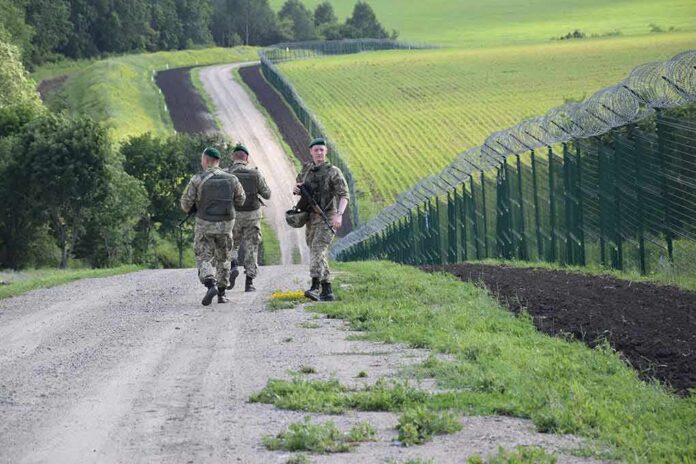
Finland’s 200-kilometer barrier on its Russian frontier is not a symbolic relic of another era; it is a modern, sensor-backed border system built to counter a specific pressure tactic—instrumentalized migration—that Helsinki classifies as part of Russia’s hybrid warfare toolkit.
The Short Version
- Finland completed a 200-kilometer fence along sections of its 1,340-kilometer border with Russia; officials marked completion near the Nuijamaa crossing.
- The barrier integrates cameras, sensors, and patrol roads; authorities stress it is a surveillance and access-control system, not just a fence.
- Helsinki built it after 2023 saw a spike in visa-less arrivals at eastern crossings and a land-border shutdown; leaders linked the pattern to Russian hybrid pressure.
- Project cost reports cluster around €356–€380 million, reflecting different accounting cuts across stages and contracts.
- Finland’s move fits a wider European shift toward physical barriers in response to “instrumentalized” migration on the EU’s eastern edge.
What Finland Built, and Why
Finnish authorities publicly marked completion of the border-barrier project on 7 September 2026, with Interior Minister Mari Rantanen at the Nuijamaa site. The scope is clear in the record: approximately 200 kilometers of fencing along selected, higher-risk segments of the 1,340-kilometer frontier with Russia. The Finnish Border Guard, the implementing authority, consistently described the barrier as one component of a layered surveillance architecture designed to support patrols, shape access, and—if required—deny entry at ground level. Rantanen summed up the intent plainly: the fence helps surveillance and can keep people out of Finnish territory when needed.
Mechanically, this is a physical-plus-electronic system. Reporting describes a roughly 4.5-meter-high structure, equipped with cameras and sensors, integrated with patrol roads and other technical surveillance measures to extend the reach and responsiveness of border units. This is not a continuous wall end-to-end; it is a strategically sited networked barrier, positioned to slow mass movement, channel crossings toward controlled points, and furnish the Border Guard with early warning and better interdiction geometry.
The Trigger: Hybrid Pressure via Instrumentalized Migration
The immediate backdrop was a marked change in flows at the eastern land crossings in late 2023. More than 1,300 people without visas arrived across several checkpoints—a small absolute number by global standards, but operationally abrupt for Finland’s historically quiet eastern frontier. Helsinki closed the land border, briefly reopened selected posts in December, then reclosed when the pattern resumed. Finnish officials characterized the surge as instrumentalized migration—a hostile use of human movement to create pressure, disrupt administration, and test external-border resilience. That is why the fence was framed as a hybrid-warfare countermeasure as much as a border-management tool.
The hybrid label is not new to the region. Academic and policy work has analyzed how neighboring states have leveraged migration to coerce EU border authorities, with earlier episodes on the Norway–Russia route (2015–16) and the Belarus–EU frontier. Research has documented security services facilitating flows to create targeted strain, and European institutions now explicitly describe “instrumentalization” as a category of border risk. Finland’s response therefore aligns with an emerging doctrine: treat manipulated flows as security incidents that justify extraordinary channeling and reinforcement, while keeping legal pathways and asylum processing at designated points.
Cost, Governance, and the Role of the Border Guard
This was a national infrastructure program, not an ad hoc fix. Reported costs range from roughly €356 million to about €380 million across outlets, a spread that likely reflects differing inclusion of surveillance equipment, site preparation, VAT treatment, and contingency budgeting. What matters operationally is that the Finnish Border Guard was in charge, with senior leadership—cited as Chief Vice Admiral Markku Hassinen in coverage—owning the surveillance case for the barrier and its integration into patrol patterns and remote sensing.
Finland’s public messaging was disciplined. The fence, officials said, is a necessary part of an effective border surveillance system in unpredictable times. The phrasing is doing a lot of work: the system has to perform under stress, including sudden, state-shaped surges that overwhelm routine processing. A physical barrier buys time and shapes movement; cameras and sensors convert presence into data; patrol roads convert data into timely response. By design, the result is not hermetic sealing but a controlled, surveilled border that is harder to exploit at scale.
How It Fits the European Pattern
Finland’s build-out is part of a broader eastern-EU rearmoring of land borders after 2021, when Belarus orchestrated crossings into Lithuania, Latvia, and Poland, and after Russia’s full-scale war against Ukraine reframed border stability as strategic deterrence as well as migration control. European Parliament analysis notes two official reasons repeatedly cited for fences: prevent irregular migration and combat terrorism; the “instrumentalization” frame has since been codified in EU debates and, in some cases, law and practice. In that sense, Finland’s fence both answers an operational problem and signals that Helsinki now treats migration manipulation as a national-security vector, not merely a humanitarian-administrative challenge.
Scholars also remind us these structures carry symbolic weight. They materialize a government’s threat perception—an outward-facing statement that the state will absorb near-term cost and domestic debate to harden a vulnerable seam. That symbolism is not incidental; it can deter would-be facilitators upstream by narrowing the payoff from directing flows toward a given frontier. But symbolism without capability is theater. Finland’s design brief—sensors, patrol roads, integrated surveillance—aims to ensure the symbol works.
Technical Effectiveness and Limits
What do fences do well? They delay and channel movement, raise the resources required to attempt a crossing, and reduce the number of uncontrolled contact points. When fused with cameras and ground sensors, they increase detection probability at the perimeter and cut response times. They also protect the integrity of official crossing points, which is where asylum can be lodged in a controlled process. What do they not do? They do not erase demand or intent; historical cases show barriers can redirect routes rather than end irregular movement altogether. Policymakers who understand this design to effect will pair a fence with mobile patrols, intelligence on facilitators, resilient reception capacity at controlled points, and diplomacy aimed at the upstream actors shaping flows.
On Finland’s frontier specifically, the 200-kilometer system addresses targeted vulnerabilities rather than attempting to harden every meter of taiga. That choice reflects both cost-benefit logic and terrain. In forests and marsh, the combination of natural obstacles, sensors on crossing corridors, and rapid-response patrols can outperform a continuous physical barrier. The Border Guard’s emphasis on surveillance integration suggests the metric of success will be fewer mass presentations at remote posts and faster, more predictable control of those that occur.
What This Means Going Forward
Finland has translated an abstract hybrid-warfare risk into a concrete border architecture. The political signal to Moscow is unambiguous, but the practical audience is the Finnish Border Guard: they now have a tool that converts surprise into time and time into control. For the EU, the build affirms a doctrine that treats state-shaped migration as coercion requiring physical, legal, and diplomatic countermeasures. Expect continued debate over cost and civil liberties—those are constants in border politics—but the core facts are settled: the fence is built, it is part of a larger surveillance system, and it exists to blunt a specific tactic that Europe’s eastern members have confronted repeatedly since 2021.
'HYBRID WARFARE': Finland completed a 124-mile border fence along its frontier with Russia after Moscow allegedly weaponized migration to destabilize the Nordic nation — pushing over 1,300 visa-less migrants toward Finnish checkpoints after Helsinki joined NATO in 2023.… pic.twitter.com/446ZgZaYNp
— Fox News World (@FNCGlobalNews) September 18, 2026
How to Judge Success
Three tests will matter over time. First, incident geometry: do mass, visa-less arrivals at remote posts decline, and are emergent routes detected earlier? Second, operational tempo: are patrol response times shorter and processing more controlled when pressure builds? Third, strategic signaling: does the combination of barrier and policy reduce the incentive for any state actor to steer flows toward Finland? None yields a single number, but together they describe whether a physical barrier, made smart with sensors and linked to doctrine, does what it is supposed to do on Europe’s longest NATO land frontier.
Sources:
foxnews.com, themoscowtimes.com, english.news.cn, janes.com, militarnyi.com, wfmd.com, rte.ie, iz.ru, ecre.org, unn.ua, cambridge.org, js.ugd.edu.mk