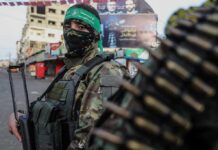
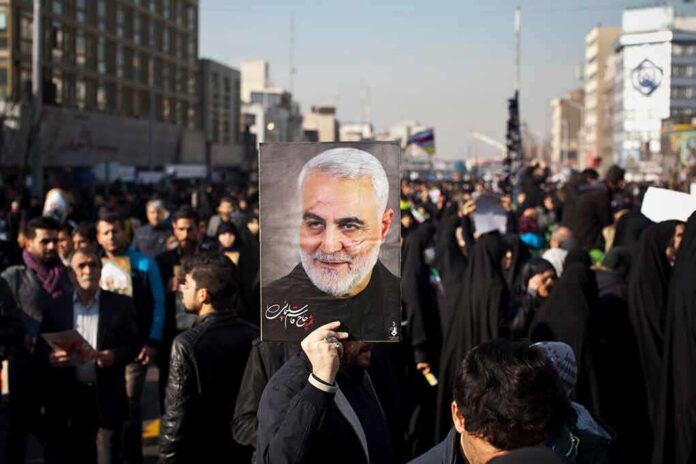
The Islamic Revolutionary Guard Corps is not a conventional state military but an ideologized vanguard built around martyrdom, jihad, and clerical supremacy—so when policymakers sit down to “negotiate” with it as if it were a normal strategic actor, they are often talking past an organization whose core texts treat death and permanent revolution as success conditions, not risks to be minimized.
Key Points
- The IRGC is constitutionally mandated as an “ideological army” whose mission is jihad and export of the Islamic Revolution, not defense of Iran’s borders.
- Its internal indoctrination program frames the world in absolutist religious terms—dar al‑Islam versus dar al‑kufr, Imam and Ummah—casting broad categories of people as enemies to be fought, not bargained with.
- This worldview elevates clerical rule and the supreme leader’s authority to near‑prophetic status, tying obedience and violence to religious duty rather than negotiable interest.
- External negotiations with the Iranian state routinely crash into this ideological architecture: diplomats offer trade‑offs while Guard commanders are trained to treat compromise as betrayal and martyrdom as victory.
- Effective policy therefore starts by recognizing where persuasion ends and coercion, containment, or regime‑level change become the only instruments compatible with the IRGC’s own doctrine.
An Ideological Army, Not a Normal Military Actor
To understand why “you cannot negotiate with people who want to die” resonates so strongly in analyses of the IRGC, you have to start with what the institution is for. Iran’s regular army—the Artesh—exists to protect territorial borders. The IRGC, by contrast, was written into the 1979 constitution as an “ideological army” mandated to conduct “jihad in God’s way” and extend the sovereignty of God’s law across the world. That difference is not rhetorical; it determines recruitment, training, promotion, and operations.
Article 150 of the constitution tasks the IRGC with guarding “the Revolution and its achievements,” embedding it as the regime’s shield and sword rather than a neutral national defense force. Written evidence presented to the UK Parliament underscores that the corps’ formal ideological mission is armed jihad against the “enemies of Islam,” broadly defined as non‑Muslims and regime opponents, including Muslims. In other words, the IRGC’s foundational documents do not describe an institution that weighs cost–benefit in terms of GDP or casualty ratios; they describe a permanent militant project.
Inside the IRGC’s Worldview: Velayat‑e Faqih, Mahdism, and Martyrdom
The IRGC’s ideology rests on a specific Shia Islamist architecture centered on velayat‑e faqih, clerical guardianship. Under this doctrine, political sovereignty is vested not in citizens but in a senior Shia jurist who rules as the representative of the Hidden Imam until his return. IRGC training materials take this further, teaching recruits that the supreme leader “has the same authority of the Prophet and the infallible [Shia] imams,” and therefore can “control the affairs of all Muslims in all matters” with a responsibility to spread Islam globally. Obedience to this figure is not a tactical choice; it is a religious obligation.
Analysts have shown that IRGC strategic culture is built around ten ideological principles—belief in God, the Supreme Leader, the righteousness of warriors of Islam, resurrection, leadership of the infallible Imam, divine victory, jihad, heavenly obligations, divine intervention, and fate. Taken seriously, this cluster privileges martyrdom and “divine victory” over conventional military prudence. A worldview in which death in battle is a shortcut to salvation and outcomes are ultimately determined by divine intervention is structurally resistant to the language of mutual compromise.
Layered onto this is Mahdism: a focus on the apocalyptic return of the twelfth Imam and the IRGC’s role in preparing the ground. That eschatological lens encourages commanders and ideologues to read regional upheaval as accelerants of a sacred timeline, not crises to be damped down. From the standpoint of Western negotiators, those are the people across the table when talks touch missile programs, proxy militias, or nuclear thresholds.
A Violent, Absolutist Division of the World
IRGC indoctrination manuals divide the world into two civilizational blocs: the land of Muslims (dar al‑Islam) and the land of infidels (dar al‑kufr), explicitly rejecting the modern nation‑state as a mere Western construct. The Tony Blair Institute’s analysis of internal textbooks describes a “totalitarian Islamist vision” that encourages violence against those declared “enemies of Islam,” including Jews, Christians, Zoroastrians, and dissenting Iranians. Within this frame, domestic protest is not political disagreement; it is apostasy rationalizing torture and suppression.
Kasra Aarabi’s parliamentary evidence stresses that the ideology is “violent and extremist,” closely resembling that of proscribed terrorist organizations such as al‑Qaeda and ISIS. Another report characterizes the IRGC as operating “no differently” from these groups in its combination of indoctrination, militancy, hostage‑taking, and hijacking. When an organization defines itself as part of an axis of resistance against a global “Axis of Domination” led by the United States and its allies, the space for interest‑based bargaining shrinks dramatically. Concessions become capitulation to an existential enemy, not trade‑offs in a shared security dilemma.
Negotiation Meets Ideology: Why Talks Keep Failing
Western diplomats and political leaders repeatedly approach Tehran with the mental model of a pressured state: a government that wants regime survival, economic relief, and security guarantees, and that might trade nuclear limits or militia restraint for sanctions relief or recognition. That model fits parts of the Iranian system—particularly technocratic ministries—but it maps poorly onto the IRGC, which now dominates foreign policy, domestic repression, and key economic sectors.
Commentators from within the Iranian diaspora and analytic circles have pointed out that many American negotiators mistake Islamic Republic duplicity for “Persian negotiating tactics,” personalizing what is in fact doctrinal.[Liberty Politics video summary] Under concepts like taqiyya (religiously sanctioned dissimulation) and the broader revolutionary ethos, the regime’s security organs see deception of unbelievers and enemies as both permissible and strategically wise. A pattern emerges: negotiators arrive optimistic, encounter hardline positions masked by reassuring rhetoric, and leave perplexed when agreed frameworks are violated almost as soon as ink dries.
This is not because IRGC officers are irrational in a clinical sense. Within their own ideological frame, they are highly rational: they prioritize regime survival, expansion of influence, and the weakening of adversaries. But the toolset available to them—proxy warfare, armed jihad, ideological export—is not designed to stabilize compromises; it is designed to leverage agreements tactically while continuing a long‑term revolutionary project.
People Who Want to Die: Martyrdom as Strategic Logic
The phrase “you cannot negotiate with people who want to die” captures a specific problem: when an adversary treats self‑sacrifice as success, the usual deterrent of harm loses traction. IRGC educational programs glorify martyrdom, presenting death in battle against enemies of Islam as the highest form of religious fulfillment. In that context, the threat of casualties—civilian or military—does not operate the way it does in Western strategic calculation, where political leaders fear body bags and public backlash.
Proxy militias aligned with the IRGC, from Lebanese Hizbullah to Yemeni Houthis, are drawn into this culture of martyrdom and religious war. They are trained to see their struggle as part of a transnational jihad, where battlefield losses are seeds of eventual divine victory. Negotiations that hinge on promising “peace” in exchange for disarmament therefore collide with a movement that does not primarily seek peace; it seeks vindication in an eschatological narrative. To the extent that IRGC planners calculate, they calculate around endurance: how much pressure their networks can sustain while still advancing the revolution.
Ideology Versus Pragmatism: Is There Any Room for Bargain?
Scholarly work on the IRGC often debates whether ideology is the driver of behavior or the language used to justify fundamentally pragmatic state interests. There is no single answer, because the corps is both an ideological vanguard and a bureaucratic power center embedded in the state. Commanders worry about budgets, logistics, and reputational costs; they also study doctrinal texts that elevate clerical authority and armed jihad above all.
Constructivist analyses argue that IRGC ideology shapes foreign policy in concrete ways: who is supported, which risks are accepted, and which red lines are non‑negotiable. At the same time, regime survival remains central. The leadership will bargain tactically when existential threat looms, as seen in past nuclear negotiations. But those bargains are bounded by dogma: recognition of Israel, renunciation of “resistance,” or deep demobilization of the Guard’s regional network cut against the very identity the corps exists to protect.
This mix of ideological rigidity and tactical pragmatism is why some observers describe diplomacy with Tehran as inherently fragile. Agreements can be reached when they shore up regime survival or relieve intolerable pressure. Yet once pressure lifts, the centrifugal force of revolutionary ideology pulls behavior back toward expansion and confrontation.
Policy Implications: Talking Clearly About Limits of Negotiation
If an adversary’s core mission is revolutionary, its supreme authority is sacralized, and its educational system teaches that enemies must be fought until a divinely ordained victory, treating it as just another bargaining partner is a category error. For the IRGC, the evidence base is broad and consistent: constitutional mandates, training manuals, analyst testimony, and observed behavior all point to an organization whose identity is tied to militant Shia Islamism and export of revolution.
That does not mean diplomacy is pointless; it means diplomacy must be nested in a wider strategy of containment, deterrence, and support for alternative centers of legitimacy, including the Iranian people themselves. Commentators close to Iranian protest movements stress that conflating Iranians with the IRGC alienates natural allies, many of whom are risking their lives to oppose the regime’s ideology.[Liberty Politics video summary] Negotiation that acknowledges this internal divide—speaking over the heads of ideologues to a population that does not want to die for Mahdist fantasies—has a different character than sterile elite talks about centrifuge counts.
Ultimately, you can negotiate over tactics with an organization like the IRGC: pauses, prisoner exchanges, limited de‑escalation. You cannot negotiate it out of the existential narrative that defines its existence. Recognizing that boundary is the first step toward designing policies that do not depend on wishful thinking about ideological transformation, but instead on realistic assessments of power, time horizons, and the willingness of ordinary Iranians to chart a different course.
The end of the Islamic Republic will not only benefit the West and the non-Muslim civilized world, but also the Sunni and Shia Arab neighbors who have themselves been victims of the sectarian wars and the Ayatollahs' sponsorship of both Shia and Sunni Islamist terrorists. These… https://t.co/rLZmkgzFQi
— Cyrus S 🇺🇸 (@CyrusShares) July 27, 2026
The Human Cost Behind the Ideology
Behind the abstract language of jihad and revolution sit very concrete lives. Religious minorities such as the Baha’is have endured decades of persecution, from property seizures and exclusion from education to arrest and torture, justified explicitly in the regime’s Islamist terms.[Liberty Politics resistance video summary] IRGC indoctrination does not simply shape foreign deployments; it rationalizes domestic repression by casting any rejection of clerical rule as rejection of Islam itself.
When Baha’is—whose own faith urges restraint from political disunity—join protests despite severe risk, analysts read it as a signal that the regime’s coercive control is fraying. Yet the Guard’s response has remained consistent with its training: treat dissent as religious deviance, double down on force, and present crackdowns as defense of the faith. That cycle illustrates, in microcosm, why external actors find their appeals to common interest so often rebuffed. For an institution built to advance a violent, supremacist interpretation of Shia Islamism, people who refuse to submit are not partners to be persuaded; they are obstacles to be removed.
Sources:
youtube.com, institute.global, en.wikipedia.org, dss.missouristate.edu, washingtoninstitute.org, alexanderhamiltonsociety.org, assets.ctfassets.net, tandfonline.com, apps.dtic.mil, mei.edu, aph.gov.au