
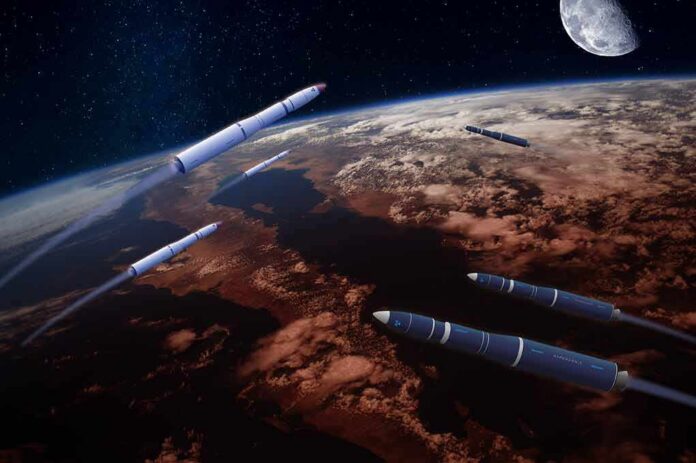
A dead SpaceX Falcon 9 upper stage, tumbling through cislunar space since early 2025, is now so well-tracked that astronomers can predict its August 5, 2026 collision with the Moon to within seconds and a few kilometres—and are treating the unplanned crash as a rare, controlled experiment in how the lunar surface responds to a high‑speed impact.
At a Glance
- A discarded Falcon 9 second stage, about five stories tall and roughly 4,000 kg in mass, is expected to hit the Moon near Einstein crater on 5 August 2026 at about 5,400 mph, creating a fresh 20–30 m crater.
- The impact is predicted for around 06:35–06:44 UTC (2:35–2:44 a.m. Eastern), on the sunlit western limb of the Moon’s near side, with no risk to Earth or operational lunar missions.
- Independent tracker Bill Gray’s Project Pluto orbit solutions underpin both the timing and location, and have been folded into detailed physics simulations of the expected ejecta plume and crater.
- Telescopes on Earth and in space will try to catch a faint flash and dust cloud rising tens of kilometres high, offering a unique calibration point for models of impacts, regolith structure, and lunar hazards.
- The event highlights a growing issue: as more missions transit cislunar space, “abandoned” stages in high orbits can wander for years before striking the Moon, raising questions about standards for disposal and long‑term lunar environmental stewardship.
What Is Going to Hit the Moon—and When?
The object in question is the upper stage—the second stage—of a SpaceX Falcon 9 that launched two lunar landers on 15 January 2025 into a high‑energy trajectory toward the Moon. Once it finished its job boosting the payloads toward their targets, the stage was left in a highly elongated, “Moon‑crossing” orbit around Earth, with no fuel or hardware to steer it further. Over the following year, subtle gravitational tugs from Earth, the Moon, and the Sun reshaped that orbit until numerical tracking showed an inevitable intersection with the lunar surface.
That tracking has been led by independent astronomer Bill Gray, creator of the widely used Project Pluto orbital software. Using optical observations from multiple observatories and standard orbit‑determination techniques, Gray projects an impact on 5 August 2026 at roughly 06:35–06:44 UTC (about 2:35–2:44 a.m. U.S. Eastern time), with location near 19° north, 266–267° east lunar longitude—close to the Einstein crater on the Moon’s western limb as seen from Earth. The uncertainties are small: Gray now quotes a timing error of only a few seconds and positional uncertainty of a few kilometres.
Because there is no atmosphere at the Moon to slow the stage, it will still be travelling at about 2.4 km/s, or 5,400 mph, at impact—roughly Mach 7 in Earth air, if there were any.
How a “Lost” Rocket Stage Ends up on a Collision Course
Uncontrolled lunar impacts are not mysterious accidents so much as the natural end state of certain orbits. After a mission uses its upper stage for a lunar injection burn, operators have a limited set of options: deliberately target the stage to fall back into Earth’s atmosphere, park it in a stable graveyard orbit, or let it drift in an elongated Earth orbit that crosses the Moon’s path. The last option is attractive when propellant margins are tight, but it effectively hands the stage over to celestial mechanics.
In this case, the Falcon 9 stage was “abandoned in a Moon‑crossing high‑Earth orbit.” Each swing past Earth and the Moon slightly altered its path; over dozens of revolutions, these small perturbations compounded until the predicted orbit actually intersected the solid body of the Moon rather than just its orbital track. Once that happens in the models—and once further tracking confirms the trajectory—the impact becomes essentially certain. There is no propulsion left on the stage and no practical way to intercept or tow it; headlines emphasizing that “no one can stop” the impact are accurate in the narrow sense, but the underlying reason is simple: there is nothing left to steer.
What the Impact Will Look Like: Crater and Plume
From a physics standpoint, the event is straightforward. A roughly 4,000 kg hollow aluminium structure, about 13–14 metres long, will hit lunar regolith—powdery, fractured surface material—at 2.4 km/s. The kinetic energy is around 11.8 gigajoules, comparable to detonating about 2.8 metric tons of TNT. That is well below the energies of typical natural asteroid strikes, but still enough to excavate a fresh crater 20–30 metres wide and several metres deep.
A recent numerical study led by Benjamin Fernando and colleagues uses high‑fidelity hydrocode simulations to explore the impact, driven by Gray’s orbital solution. The team modelled a vertical, end‑on hit into regolith and found that the upper stage should mostly crush and fragment on contact rather than punch deep below the surface, because its hollow structure is mechanically weaker than a solid rock of comparable mass. In their models, the ejecta blanket—the carpet of thrown‑out material surrounding the crater—is continuous over roughly 70 metres, with about 1.1–1.2 million kilograms of lunar soil excavated and lofted.
The plume itself is expected to rise tens of kilometres above the surface. Simulations suggest a central ejecta spike reaching roughly 75–100 km in altitude, surrounded by a broader fan of dust and debris at lower heights. In the vacuum of space, the finest dust grains will follow ballistic arcs, eventually settling back over minutes to hours; there is no wind to disperse them.
Can Anyone See It from Earth?
The impact geography is unusually favourable. The predicted site lies on sunlit terrain near the Moon’s western limb, on the near side but close to the edge from our perspective. At the predicted time, the Moon will be above the horizon for much of the Americas and parts of Europe and Africa, giving professional and advanced amateur observatories a chance to watch.
Whether they will actually see anything is a harder question. The impact flash will be fleeting and faint, likely at or below the sensitivity of small telescopes. However, the event is bright enough in some models that large optical telescopes and fast near‑infrared instruments may detect a brief change in brightness, especially if they can image at high frame rates and subtract out the static lunar background. The plume might be more accessible: ground‑based telescopes equipped with narrow‑band filters could pick up sunlight scattered off the dust cloud as it rises tens of kilometres above the limb, silhouetted against dark space.
Spacecraft add further possibilities. NASA’s Lunar Reconnaissance Orbiter (LRO) and other lunar orbiters have previously imaged impact sites from mission‑deliberate crashes with metre‑scale resolution, and are expected to do the same here. Before‑and‑after imaging will let scientists measure the crater size, ejecta patterns, and any subtle colour changes that reveal fresh subsurface material. Even if no one catches the flash itself, a well‑resolved post‑impact image will be scientifically valuable.
Why Scientists Care About an Unplanned Crash
At first glance, a dead rocket hitting the Moon looks like space junk pollution. For lunar scientists, though, it is also an exquisitely timed natural experiment. Unlike most meteoroids, the Falcon 9 upper stage arrives with known mass, known structure, and a precisely constrained velocity and trajectory. That means models of the impact—how deep the stage penetrates, how large a crater it should make, how high the plume should rise—can be compared directly with what actually happens.
Such comparisons matter. Impact cratering is the dominant geologic process on the Moon; crater counts underpin estimates of surface age, and ejecta patterns tell researchers about the mechanical properties of regolith at different depths. But most of that science rests on scaling laws extrapolated over orders of magnitude in energy and object size. Artificial impacts at well‑characterized energies, like this one, give rare calibration points for those scaling relationships.
There are also practical stakes. As commercial and national missions multiply, questions about dust hazards—both from landings and from secondary impacts—become more urgent. Dust lofted by an impact can coat optics, abrade moving parts, and obscure critical terrain. Observing how a 20–30 metre crater’s worth of regolith behaves in real time helps engineers refine risk models for future surface operations.
Safety, Risk, and the Space‑Debris Problem in Cislunar Space
For Earth and current spacecraft, the impact is harmless. The stage will hit the Moon, not Earth, and it is not on a trajectory that grazes any active lunar landers or orbiters. There is no lunar atmosphere to turn the event into a broad shock wave, and the crater will be minuscule on lunar scales—one more pockmark on a world already saturated with them.
Nonetheless, the event crystallizes an emerging concern: debris in cislunar space. For decades, most debris discussions have focused on low Earth orbit and geostationary orbit. Now, as more missions traverse the Earth‑Moon system, a new class of derelicts—upper stages in high, unstable orbits—has appeared. These objects may wander for years before eventually colliding with the Moon or, in rarer cases, returning toward Earth. Tracking them is observationally challenging; they are faint, move in complex paths, and can be lost and rediscovered, as happened with this Falcon 9 stage.
Policy and practice are only beginning to catch up. Some space agencies deliberately target spent stages to crash into the Moon as part of mission design, both to dispose of hardware and to generate known seismic signals for deployed instruments, as was done during the Apollo era. Others favour deorbiting into Earth’s atmosphere, trading cislunar cleanliness for a controlled burn‑up in the sky. Commercial operators juggle reliability margins, fuel budgets, and regulatory expectations. Events like this impact, widely publicized and scientifically dissected, are likely to sharpen calls for clearer standards about where and how we leave large pieces of metal in cislunar space.
Looking Ahead: What We Stand to Learn
When the Falcon 9 upper stage finally hits, the moment itself will be over in milliseconds. Its scientific and policy implications will last far longer. If telescopes capture the flash or plume, they will provide rare, direct observations of an impact at a known energy scale. Post‑impact imaging from lunar orbiters will ground‑truth numerical models of cratering and ejecta in a way that purely theoretical work cannot. Each agreement—or discrepancy—between model and observation will refine how researchers interpret every other crater on the Moon.
At the same time, the story of this “lost” stage, identified and its fate predicted by an independent tracking effort, shows how much of the cislunar environment we still treat casually. As lunar exploration shifts from rare national flag‑planting missions to sustained activity by multiple actors, the path taken by this drifting piece of hardware is likely to look less like an oddity and more like an early warning. The Moon will survive yet another scar. The question is whether we use this one to become better custodians of the space between here and there.
A spent SpaceX Falcon 9 upper stage (from the January 15, 2025 launch of two lunar landers) is on an uncontrolled trajectory and will impact the Moon on August 5, 2026.
It will strike near Einstein Crater on the near side at ~5,400 mph (8,700 km/h), roughly seven times the speed…
— Numbers Don’t Lie (@Objective_Data) July 31, 2026
Sources:
yahoo.com, space.com, arstechnica.com, youtube.com, techtimes.com, usatoday.com, facebook.com, iflscience.com, abcnews.com, phys.org