
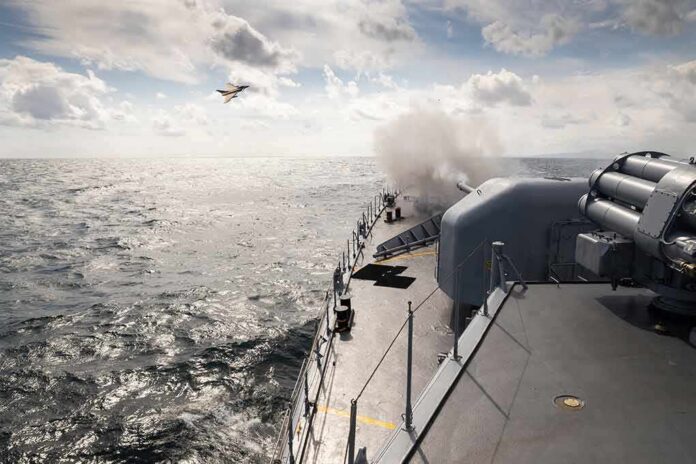
Russia’s live-fire drill off Plymouth was a lawful exercise in international waters, but its proximity, timing and allied response turned it into a pointed piece of strategic theatre aimed at reminding Britain’s new government how closely Moscow is watching – and how far its navy is willing to push near UK shores.
Key Points
- A Russian Baltic Fleet frigate, Neustrashimy, conducted a 30‑minute live‑fire artillery exercise roughly 40 nautical miles south of Plymouth, in a busy shipping corridor but outside UK territorial waters.
- HMS Tyne shadowed the frigate and repositioned after the Russian vessel formally notified its intent to fire; a French military aircraft also monitored the drill and made radio contact.
- The exercise coincided with Andy Burnham’s first day as prime minister and was described by UK officials as “irresponsible” and by senior military figures as provocative signalling from Moscow.
- The incident fits a broader pattern: Russian naval activity near the UK is often lawful but politically charged, routinely shadowed by the Royal Navy and framed as part of Russia’s hybrid pressure on NATO states.
What Actually Happened off Plymouth
The core facts of the Plymouth incident are not in dispute. On a Monday morning in July, the Russian frigate Neustrashimy, part of the Baltic Fleet, carried out a live‑fire artillery exercise about 40 nautical miles (roughly 45–46 miles) south of Plymouth. This placed the ship in international waters but inside one of the world’s densest shipping routes, the approaches to the English Channel, where commercial traffic transits constantly between the Atlantic and northern Europe. The drill lasted around 30 minutes and involved the frigate firing its main gun; UK reporting notes that the Ministry of Defence did not publicly specify the exact weapon systems used.
Neustrashimy was already being shadowed by the Royal Navy’s offshore patrol vessel HMS Tyne, which had been tracking the Russian ship’s movements. Before commencing gunnery, the Russian crew informed Tyne of their intention to conduct live‑fire and requested that the British vessel move to a “safer distance.” HMS Tyne complied, increasing the separation from roughly two nautical miles to about five, and continued to monitor the exercise from further out. A French maritime patrol aircraft also orbited the area and established radio contact with the Russian frigate to clarify its intentions, underlining that this was being watched as an allied security event, not simply a training shoot.
Legal Exercise, Political Signal
From a maritime law standpoint, Moscow stayed on the right side of the line. Warships are permitted to conduct weapons drills in international waters so long as they observe basic safety norms, including notice to nearby vessels and responsible handling of live ammunition. British ministers themselves confirmed that “standard maritime safety procedures were followed” during the Plymouth exercise and that no international law was broken. There were no rounds fired toward British territory, no damage to shipping, and no incursion into UK territorial seas.
Yet legality does not exhaust the meaning of the event. What made this drill notable was where</em it took place, when</em it happened, and how</em it was framed. Live‑fire exercises by Russian frigates usually occur within designated national training areas, often closer to home waters or in broad ocean zones explicitly notified in advance. Firing a main gun in the congested approaches to the English Channel, within visual range of allied assets and merchant traffic, is unusual enough that British defence officials and multiple outlets described it as “rare” and “highly unusual.”
Timing sharpened the message. The drill coincided with Andy Burnham’s first day as prime minister and with his early public reaffirmation of UK support for Ukraine. It unfolded against a backdrop of steadily rising Russian naval presence around the British Isles: shadow fleet tankers running sanctions‑busting routes through the Channel, intelligence ships such as Yantar operating off UK coasts, and previous episodes where Russian vessels fired near civilian yachts or surfaced submarines in daylight to advertise their presence. Within that pattern, a conspicuous, live‑fire display just off Plymouth was read in London and allied capitals as deliberate signalling, even though UK defence sources stopped short of formally attributing the drill to the prime minister’s appointment.
How London and Its Allies Responded
Operationally, Britain treated the exercise seriously but measuredly. HMS Tyne’s shadowing posture and repositioning at Russia’s request reflect the Royal Navy’s well‑established playbook for monitoring foreign warships in the UK’s “area of interest” – the band of waters around the British Isles where the navy routinely tracks Russian transits and flights. A Ministry of Defence spokesperson emphasised that the navy “monitored the exercise throughout” and “continues to track the vessel’s activity closely,” echoing language used in earlier statements about Russian flotillas moving through the Channel.
Politically, the rhetoric was sharper. Britain’s new defence secretary, Wes Streeting, publicly branded the exercise “irresponsible” and folded it into a narrative of “ongoing daily threats” from Russia, citing it as one more example of provocative behaviour in a climate of war in Ukraine and friction with NATO. Former senior officers, including a past First Sea Lord, described the drills as intended to “provoke” Britain, even while cautioning against overstating the link to Burnham’s swearing‑in and noting that such a decision is more likely tied to broader messaging than to one domestic political calendar.
Analysts interviewed by international outlets framed the event as a demonstration by President Vladimir Putin of Russia’s military reach and a test of NATO surveillance and reaction times, rather than a rehearsal for combat. In parallel, pro‑Kremlin commentators on Russian television escalated verbal threats toward the UK, talking about sinking Royal Navy ships involved in “piracy” or seizing commercial vessels and invoking nuclear options in more general debates about the war. Taken together, these strands underscore why a single, half‑hour gun drill can carry outsized political weight: it becomes another episode in a cumulative campaign of intimidation and signalling.
Russia’s Pattern of Naval Signalling Near the UK
The Plymouth exercise does not stand alone; it sits within a broader pattern of Russian military activity that is lawful in form but coercive in tone. Over the past decade, the number of Russian naval vessels passing close to the UK has increased steadily, as has the frequency with which Royal Navy units are deployed to shadow them. Official UK statements repeatedly note that “most of this activity is lawful and benign,” yet the monitoring is constant because these movements occur near critical sea lines of communication and submarine infrastructure.
Specific recent episodes illustrate the pattern. In June, the frigate Admiral Grigorovich fired warning shots in the direction of a British couple’s yacht south of the Isle of Wight, claiming it was on a dangerous course; the civilians denied any near‑collision, and the incident was widely interpreted as gratuitous intimidation. In the English Channel, so‑called Russian “shadow fleet” tankers have moved under opaque flags and ownership structures to bypass sanctions, prompting heightened scrutiny and, in one case, a Royal Marine boarding operation on a tanker linked to Russian interests. A Russian Kilo‑class submarine, Krasnodar, transited the Channel on the surface with a tanker escort, a posture analysts described as designed more to be seen than to remain stealthy.
Further north, Russia has mounted long‑range bomber flights and nuclear‑themed drills in the Barents and Norwegian Seas, forcing NATO jets to intercept Tu‑160 strategic aircraft and MiG‑31 escorts near UK approaches. Moscow has also announced tactical nuclear exercises and integrated drills with Belarus that explicitly advertise nuclear‑capable systems and forward deployment, in what independent experts characterise as messaging aimed at NATO’s eastern flank. Against this canvas, the live‑fire drill off Plymouth reads as one more brushstroke in a deliberate picture: Russia flexing naval muscle where Western publics will notice, while staying within the letter of international law.
Hybrid Warfare and Strategic Messaging Toward Britain
Conceptually, the Plymouth incident fits within what many security analysts describe as Russian “hybrid warfare” against the UK – a blend of cyber operations, information campaigns, covert intelligence activity and calibrated military moves designed to unsettle, intimidate and distract without triggering full‑scale war. Britain has been a prominent supporter of Ukraine, supplying weapons, training and diplomatic backing; Moscow’s rhetoric frequently singles out London as a prime antagonist, and its actions have mirrored that focus.
Hybrid tactics rely on ambiguity. A live‑fire drill that is genuinely useful for Russian gunnery crews can simultaneously serve as theatre for Western audiences. A surfaced submarine crossing the Channel can be both a transit and a signal. From the Kremlin’s perspective, maintaining that all these actions are lawful allows it to accuse NATO of hysteria or overreaction, while still tightening the psychological screws on governments that must answer to domestic publics worried about security.
For Britain, this ambiguity presents a dilemma. Downplaying such incidents risks normalising aggressive behaviour and eroding deterrence; over‑reacting risks feeding Moscow’s narrative of Western panic and giving disproportionate weight to relatively small operational events. The Royal Navy’s posture – shadow closely, communicate professionally, keep the public informed but avoid escalatory language – reflects an attempt to walk that line.
Was Burnham Personally Being “Sized Up”?
One of the more striking frames applied to the Plymouth drill in commentary and social media was that Russia was “testing” or “sizing up” Andy Burnham’s new government. The coincidence of dates is real: the frigate fired its guns hours before Burnham formally took office, and the Ministry of Defence confirmed the drill as he was publicly recommitting to support Kyiv. The symbolism is obvious, and it is unsurprising that pundits and headline writers leaned into it.
However, the publicly available record does not show direct evidence that Moscow scheduled the exercise specifically to probe the new prime minister. UK defence sources declined to attribute motive when asked, and one former First Sea Lord explicitly doubted the drill was timed to Burnham’s first day, even while calling it provocative. There are no Russian Navy notices, intercepted communications or on‑record statements from Russian commanders tying the gunnery to the change of government. Absent that, the safest assessment is that the exercise formed part of Russia’s ongoing campaign of pressure and visibility near UK waters, with timing that made it politically salient in London but not necessarily micro‑targeted at Burnham personally.
The distinction matters. Seeing every Russian movement near the UK as a personal test of the prime minister risks overstating Moscow’s precision and giving its signalling more weight than it may merit. Recognising the Plymouth drill as one in a pattern of coercive but lawful actions – calibrated to the broader NATO‑Russia confrontation and to Britain’s role in supporting Ukraine – allows a clearer view of the strategic picture without inflating a single episode into a personal duel.
A Russian warship conducted a live-fire exercise off the coast of Plymouth, England, on Monday, July 20, 2026.
· The Vessel: The Russian frigate Neustrashimy (Baltic Fleet) carried out the exercise.
· Location: The exercise took place in international waters, approximately 40…
— Solomon (@iamalijandro) July 21, 2026
What This Means for UK Maritime Security
For Britain’s maritime security posture, the Plymouth incident is less a turning point than a confirmation of trends. The Royal Navy and Royal Air Force have built up a routine of shadowing Russian ships and aircraft, deploying assets like HMS Tyne, HMS Iron Duke and P‑8A patrol planes whenever foreign military platforms approach UK waters. These missions are now part of the normal rhythm of defence operations, demanding persistent readiness and careful rules of engagement.
Strategically, the UK must assume that Russia will continue to exploit international waters near the British Isles as a stage for signalling. That implies sustained investment in surveillance, rapid decision‑making processes to avoid miscalculation, and close coordination with allies such as France and Norway, whose aircraft and ships often share the same operating picture. It also requires a calibrated public narrative: one that takes Russian hybrid pressure seriously, communicates the reality of risk, but avoids letting Moscow dictate the tempo of British politics with every gunnery drill or bomber flight.
In that sense, Russia’s live‑fire exercise off Plymouth was both ordinary and extraordinary. Ordinary in that it followed a now‑familiar script of lawful activity wrapped in menace; extraordinary in how clearly it illustrated the fine line modern navies tread between routine training, strategic messaging and the shadow of confrontation just beyond the horizon.
Sources:
19fortyfive.com, bbc.com, facebook.com, timesnownews.com, independent.co.uk, youtube.com, gov.uk, aa.com.tr, theguardian.com, cnn.com, euro-sd.com, resilienceimperative.com, bbc.co.uk, navylookout.com